
What Routine Plumbing Maintenance Actually Prevents
Why would a system that isn't broken need anything done to it at all? That question is worth answering directly, because most of what routine plumbing maintenance actually does is catch a problem while it's still invisible, not fix something that's already failed. A handful of the most common household failures share the same pattern: a slow, silent mechanism that runs for months or years before producing any symptom you'd notice on your own.
Why Does a Water Heater Need Attention If It's Making Hot Water Fine?
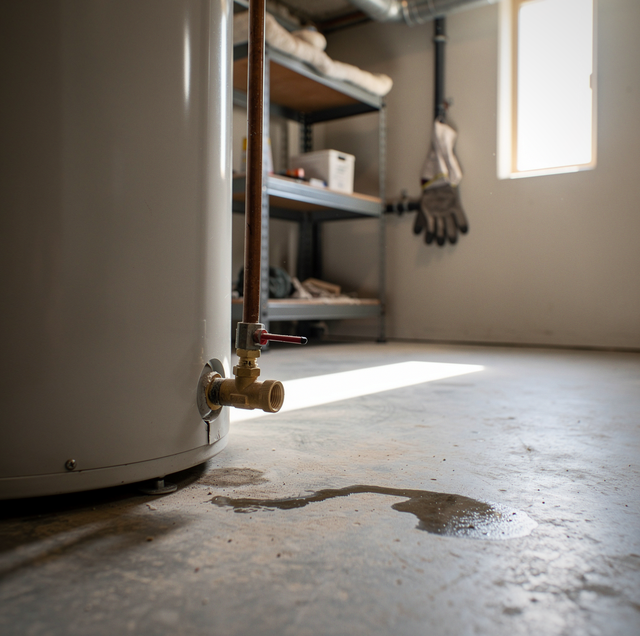
Hard water contains dissolved calcium and magnesium, which settle out as the tank heats, and the resulting mineral sediment sinks to the bottom rather than staying in suspension. Once a layer builds up there, it insulates the burner or lower heating element from the water it's supposed to be heating, forcing the unit to run longer cycles to reach the same temperature and pushing the metal at the tank's bottom to run hotter than it was designed for. That extra heat accelerates pitting on the tank's interior, and a tank that pits through eventually leaks, at which point the whole unit needs replacing rather than servicing. A yearly flush, which drains and flushes loose sediment out through the tank's drain valve before it hardens into scale, keeps that layer from ever forming into something a flush can no longer remove.
Why Do Clean Drains Still Need Attention Before They Ever Clog?
A drain that runs freely today isn't necessarily clean on the inside. Grease, soap residue, and organic matter coat the interior wall of the pipe in a thin film with every use, and that film doesn't rinse away completely; it thickens gradually, narrowing the pipe's effective diameter over months without ever fully stopping flow until the last bit of clearance finally closes. By the time water backs up, that buildup has usually been progressing for a long stretch already. Preventive drain treatment or periodic hydro-jetting clears that film from the pipe wall while there's still plenty of clearance, rather than waiting until only cutting or jetting a full blockage will do.
Why Would a Slow Leak Need a Look Before It's Actually Leaking?
Pinhole corrosion doesn't start as a hole. It starts as a small area of weakened metal, often where old flux residue was left on a soldered joint or where two dissimilar metals meet and set up a slow galvanic reaction. That weak spot thins gradually from the inside out, and a supply line can carry water perfectly well for a long stretch of that process before it finally opens into an actual pinhole. An inspection during a maintenance visit looks for the early tells: green or bluish staining around a copper joint, a valve stem that's grown stiff or hard to turn from mineral buildup, or a fitting with visible surface corrosion, catching the weak point while it's still solid enough to repair on a schedule instead of during a spray.
Why Does a Sewer Line That Isn't Backed Up Get a Camera Inspection?
Tree roots don't need a crack to get into a sewer line. They can enter through the small gap at a joint between two sections of pipe, sensing moisture and nutrients seeping through a seam that's only a few millimeters wide and growing toward it long before the line shows any sign of trouble at the surface. A root mass inside a pipe starts as a thin intrusion that catches paper and debris, gradually narrowing the channel, much like drain buildup, until what started as a partial obstruction becomes a full blockage. A camera run through the line on a routine schedule catches root intrusion, a bellied low spot where the pipe has settled, or a cracked section while there's still time to schedule root-cutting or a targeted spot repair, rather than discovering the problem the day the line finally backs up into a shower.
Why Would a Working Toilet Need Its Flapper or Fill Valve Checked?
A rubber flapper degrades from constant chlorine exposure over years, becoming stiff and slightly warped even though it still looks intact and still drops back into place after every flush. A flapper that doesn't seat with a perfect seal lets water seep from the tank into the bowl continuously, often too quietly to hear, wasting water for months before anyone notices a running sound or a water bill that doesn't add up. A fill valve washer wears in a similar, slow way. A maintenance check tests the seal directly, sometimes with a dye tablet dropped into the tank to see whether color appears in the bowl within a few minutes, catching a leak that produces no sound or visible symptoms on its own.
Why Check a Gas Appliance Connector That's Never Given Any Trouble?
A flexible gas connector's outer coating can develop a hairline crack in its braid from age, minor vibration, or nearby moisture, well before that crack opens enough to actually let gas escape and produce a detectable smell. A visual check during a maintenance visit looks for kinking, surface rust, or cracking in the connector's coating, along with confirming the shutoff valve behind it still turns freely, catching a connector on its way to failing rather than waiting for it to become an active leak.
Why Does a Main Shutoff Valve That's Never Touched Need Checking?
A main shutoff valve that sits in the same open position for years can seize without anyone knowing until the moment it's actually needed. A gate valve depends on a threaded stem rising and lowering smoothly through a packing seal; if that stem sits still long enough, mineral deposits and light corrosion can bind the threads so the handle turns hard, strips, or doesn't move the internal gate at all. A ball valve has a different failure mode: mineral scale can build up a thin ring around the ball as it seats against the valve body, and a ball that's never rotated can develop enough resistance from that ring that it won't turn cleanly when someone finally needs it to.
The failure only shows up at the worst possible time. If a supply line bursts and the main shutoff won't close, or closes only partway, water keeps flowing while someone searches for a wrench, a different valve, or the street-side curb stop, turning a contained leak into a flooded room. Turning the main shutoff closed and back open once a year, as part of a routine visit, keeps the stem threads or the ball's seating surface from ever locking into place, so the valve still works the one time it actually matters.
Maintenance Task Reference
| Task | What It Prevents | Recommended Interval |
|---|---|---|
| Water heater flush and descale | Sediment insulating the tank, longer heating cycles, tank pitting and early failure | Annually |
| Drain treatment or hydro-jetting | Grease and residue narrowing pipe diameter, eventual backups | Annually to every two years |
| Supply line and shutoff valve inspection | Slow leaks from hidden corrosion, seized valves during an emergency | Annually |
| Sewer camera inspection | Root intrusion, bellied sections, and cracks progressing to a full blockage | Every two to three years, sooner where mature trees are nearby |
| Toilet flapper and fill valve check | Silent water waste and an eventual running toilet | Every one to two years |
| Gas appliance connector visual check | Undetected corrosion progressing to an active leak | Annually |
The Pattern Behind All of It
Every failure covered here follows the same shape: a mechanism that's already in motion long before it produces a symptom you can notice without looking for it. Sediment doesn't announce itself until a tank pops or bangs. A pipe wall doesn't announce itself until it sprays. A root mass doesn't announce itself until a drain finally backs up. Routine maintenance exists specifically to interrupt that progression while the fix is still small: a flush, a camera pass, a swapped flapper, rather than waiting for the mechanism to finish its work on its own timeline.
Frequently Asked Questions
A popping or rumbling sound during heating cycles is a reliable early sign. It's caused by water trapped underneath a layer of hardened sediment boiling and bubbling up through it, which sounds distinctly different from the soft ticking of thermal expansion elsewhere in the supply lines.
Modern jetting equipment lets a plumber adjust water pressure to match the line's age and material, and a camera inspection beforehand confirms whether a section can handle full-pressure jetting or needs a gentler enzyme-based treatment, since older clay or cast iron sections can be more brittle than modern PVC.
An inexpensive gauge that threads onto an outdoor hose bib gives a static reading in under a minute. Testing it when no other fixture in the house is running gives the most accurate number, since water use elsewhere temporarily lowers the reading and can mask a pressure problem that shows up at other times.
Yes, and the pipe material affects how much of a target those joints are. Older clay or cast-iron sections, common in homes built before the 1970s, rely on mortar or rubber-gasket joints that leave a slightly wider seam than the solvent-welded joints used in modern PVC lines, giving roots an easier entry point even in an otherwise sound pipe. That's part of why a camera inspection is worth scheduling sooner in a home with mature trees near an older clay line than in a newer home with PVC, regardless of whether either line has ever backed up.
Even a leak too slow to hear can move several hundred gallons a month through a worn flapper, since the seal only needs to be imperfect by a small margin for water to seep past continuously rather than in a single noticeable trickle that a person would catch by ear.
Yes, and a single visit typically covers most of the checks described above in one appointment: the water heater flush, a visual check of supply lines and connectors, testing the main shutoff, and confirming the toilet flapper seals, with the sewer camera and drain treatment usually running on their own longer two-to-three-year cycle rather than at every visit. Keeping a simple record of each visit, noting a valve that's turning stiffer or a connector showing early surface rust, also makes it easier to catch a component trending toward failure over several years, rather than relying on a single visit to catch everything at once.
Get a full maintenance check before a small problem becomes an emergency call — no upsell pricing, ever. Ser Plumbing hydro jets lines across the area, from hydrojetting in Bellflower to Compton. Call (310) 953-3566.
