
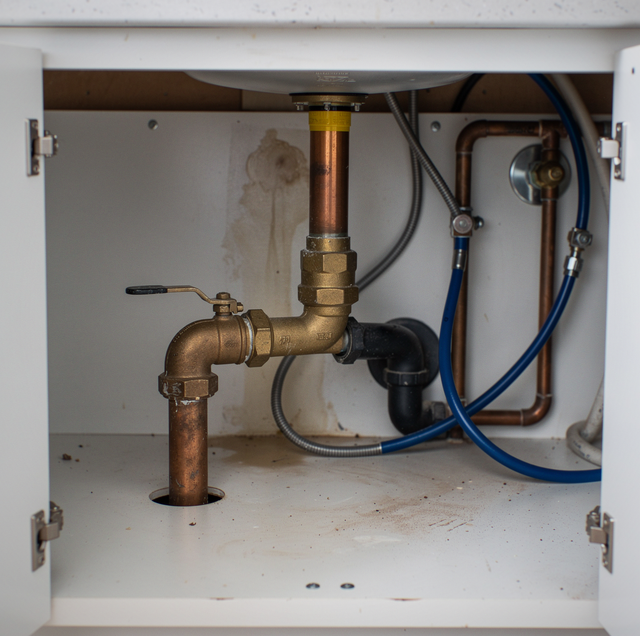
A part with no daily work gives no daily feedback. That is the whole trouble with a water shutoff, and it is why it is the one component about which nobody in the house can hold an opinion.
The pipe around it has been reporting its condition for years, in stains, in pinholes, in a shower that lost its push. The main shutoff has said nothing in all that time, because saying nothing is the entire job it was given. It sits in the position someone left it on the day the house was plumbed, holding a handle no one has any reason to touch.
Then one night, a line lets go inside a wall, and that valve has exactly one job: it is the only thing in the building that can do it.
A repipe is the one moment when the question is easy to settle. The water is already down, the crew is at every fixture, and every line these valves control is being replaced anyway. Whether the old valves stay is a decision made without anyone saying it out loud.
Quick Answer: A repipe is the right moment to replace the main water shutoff and every angle stop. Old multi-turn valves commonly fail open, and new supply lines behind them make your emergency shutoff as unreliable as it already was.
What Actually Fails Inside an Old Main Valve
The main shutoff on an older house is usually a multi-turn gate valve. Inside the body is a wedge, the gate, that drops into a seat to block the flow, raised and lowered by a threaded stem passing out through a packing seal. How it is built explains how it fails.
The gate comes off the stem: Years sitting in water corrode the connection between the gate and the end of the stem. The handle still turns, the stem still travels, and the gate stays where it has always been, parked open. Nothing you feel from outside separates that from a valve doing its job.
The threads seize: In hard water, the deposits that scale a water heater build on the stem threads and around the packing. The handle stops moving, or the handwheel breaks off in your hand instead.
The seat stops sealing: The gate lands, but a pitted seat never closes fully, and water keeps trickling past.
All three fail toward whatever position the valve was left in; on a handle nobody touches, it's usually open, and an open valve gives nothing away. Two variants are worse than that. A gate that has corroded off its stem can drop into its seat and stay there, and a valve left part closed and then seized holds that position permanently, which is one way a house loses flow with nothing in the walls to blame.
A main shutoff that resists is telling you something. Force it with a wrench or a pipe on the handle, and you can shear the stem or crack an old body, leaving a valve that cannot hold water at all.
What a Quarter-Turn Ball Valve Changes
A ball valve works on a different principle. Inside the body is a ball with a hole bored through it, held between two seats. A quarter turn of the lever rotates the ball so that the bore either lines up with the pipe or crosses it. Nothing rises, nothing travels, nothing threads.
Fewer parts can seize: the motion is rotation against seats, not a threaded stem climbing through packing.
The handle indicates the state: a lever aligned with the pipe means open; across it means closed. A multi-turn handle tells you nothing, which is how one can sit half-closed for years without anyone knowing.
The failure is usually legible: it moves, or it does not, and worn seats show up as a lever fully over while a tap keeps trickling. A ball valve is not permanent, but its condition reads in one motion instead of hiding for twenty years.
Why the Failure Stays Invisible Until It Matters
A pipe under pressure is tested constantly, which is why a failing pipe eventually shows itself. A valve holding water in the open position is not being tested at all. Sitting there full of water proves nothing about the ability to close, because closing is a different action from holding.
There is one test: closing the valve and confirming the water stops downstream. Turning the handle is not the test, because handle movement and water stopping are separate outcomes, and the gate-off-the-stem failure lives in the gap between them.
Until then, nobody knows whether the old main will close, including the plumber. Replacing it turns an unknown into a known, which is the real product.
Valve Types, How They Fail, and What You Notice
| Valve type | How it fails | What you notice |
|---|---|---|
| Multi-turn gate valve at the main | The gate corrodes off the stem, parking open or dropping into the seat | The handle turns freely, and the water never slows or never fully returns |
| Multi-turn gate valve, seized | Scale binds the stem threads and packing | The handle will not move, or the handwheel snaps off |
| Multi-turn compression angle stop | The washer hardens onto the seat and never reseats | It closes partway, or weeps at the packing nut |
| Old angle stop kept on a new system | The ferrule shifts when the body is turned | A joint dry for years beads, then drips hours later |
| Quarter-turn ball valve, never exercised | Scale rings the seat where the ball rests | Stiffness through the first part of the swing |
Why Old Angle Stops Are the Weakest Point on a New System
The main is one valve. The angle stops are the small valves under every sink and behind every toilet; the same problem repeated at every fixture, and they get used far more often. Closing the main shuts off the whole house; a stop kills the water at one fixture and leaves the rest running.
New stops are part of a complete repipe. The stop is the last component in the run, so leaving the old ones means the newest system in the house ends, at every fixture, in its oldest part.
Then there is what the work itself does to them. A compression stop seals in two places, and both have been holding still for two decades.
The valve seal: a rubber washer pressed against a brass seat. Rubber left compressed against warm metal hardens and takes a permanent set, so when the stem finally moves the washer can tear or leave a flattened ring that no longer seats. That is how a stop closes, feels closed, and leaks anyway.
The stem packing: a dried ring around a stem that has never rotated. The nut has only ever held a stationary stem, so moving it breaks that seal and the stop weeps at the nut rather than the outlet.
The compression joint: a brass ferrule cold-formed onto the tubing when the house was built. Closing a stop puts torque on the body, and torque moves the ferrule against a groove it has occupied for years.
That is the mechanism behind the complaint blamed on the plumber: it was dry until somebody touched it. It truly was, and touching it is unavoidable, because the old stops have to be closed for the work to happen.
Why Replacing Every Stop Is Not an Upsell
This is the question homeowners type into a search box: the company wants to replace all the angle stops; is that necessary, or is somebody padding a bill? On a house being repiped, the answer is yes, all of them, for three reasons.
Age parity: every stop went in with the pipe that is now coming out, and has drunk the same water since. If the pipe is old enough to replace on age alone, so is the valve at its end.
Access already exists: the crew is under that sink, with the water down, because the line feeding it is being replaced. Doing the stop later means recreating those conditions one fixture at a time.
Disturbance is unavoidable: the old stop has to be operated for the repipe to proceed, and that is what pushes a resting valve into the failure it has been holding off.
An upsell adds work that changes nothing about the system's failure. New stops change how the whole building fails: whether a leak stays contained at one cabinet or becomes a decision about the entire water supply. For a house that is not being repiped, a stop-by-stop judgment of condition is reasonable, but during a repipe, that judgment collapses because access and disturbance are already in place.
A stop dry that has been dry for decades can bead and then drip hours after the crew leaves because closing it moves parts that had not moved since it was installed. Report it the same day rather than waiting for it to settle.
Where the Main Lives, and Why Access Is Worth Designing For
In slab-foundation housing, there is no basement and usually no crawlspace, so the main shutoff has nowhere interior to hide. It ends up at the perimeter: where the supply line comes out of the ground against an exterior wall, inside a garage near the front, in a recessed wall box, or out at the meter.
That last one is worth separating. The valve at the meter is normally the provider's, and they typically want their key; how far their responsibility extends beyond it is set by the provider rather than by the plumbing. Providers do not all draw that line in the same place, so confirm it with yours. Either way, a house whose only shutoff sits out at the meter has none of its own to reach.
Two things decide whether a shutoff is usable when it is needed, and both get settled while the walls are open.
Can you reach it standing, without moving anything: shutoffs disappear behind shelving, a shrub that grew in, or a water heater installed later in the same closet. A valve you must excavate is a valve you do not have.
Does the handle have room to finish its travel: a lever needs clearance to swing, and a sound valve set too close to a wall can only move partway, which is the same as not closing.
The repipe is the moment to settle both, because the connections there are being remade anyway, and because the new lines run overhead rather than under the concrete, the entry point sometimes shifts. Seismic work on gas appliances is a separate item; on the water side, the plan is one working shutoff everyone at home can find and reach.
What a Plumber Weighs, and What to Ask For
A plumber looking at your main runs a short list: the type and apparent age of the valve; what the pipe is made of on either side of it, since old threaded galvanized is a different task from copper; whether a second shutoff exists upstream; whether the location is reachable; and whether the utility's valve at the meter still holds, because that is what the house leans on while the house valve is off.
What to ask for, as a decision rather than a procedure:
Ask for quarter-turn, named as such: not new valves. Quarter-turn ball valves at the main and quarter-turn stops at the fixtures, in those words, not just new.
Ask that the main be on the list: stops are commonly included, and the main is commonly assumed, and assumed is not included. Ask where it ends up as well: same place, better place, or a second one where you can reach it.
Ask who handles the meter valve: if it does not hold, someone has to arrange the shutdown, and that needs to be on the calendar before the day arrives.
What the Valve Is Doing on the Night You Need It
Everything above is mechanism, and mechanism is what settles one minute in the life of a house. Water is coming through a ceiling at an hour nobody chose, and the only question that matters is what sits inside the two valves being reached for.
If the stop under that fixture is a hardened washer on a brass seat, on a ferrule that has not moved since the house was built, turning it is the first real work it has been asked to do in decades. It can close, feel closed, and pass water anyway. If the main is a gate on a corroded stem, the handle turns the way it always has and reports nothing, because the handle and the gate stopped being connected at some point nobody can name.
Neither failure arrives that night. Both arrived quietly, years earlier, and then waited for the only test that finds them, which is being asked to close. A repipe is the one occasion when that test gets run on purpose: on a scheduled morning, with the water already off and someone there to replace whatever does not pass.
Frequently Asked Questions
Yes, and it is ordinary standalone work. What sets the size of the job is what sits on either side of the valve and whether anything upstream can hold the water back while the old one comes out. Where the only upstream valve is the utility's, that shutdown gets arranged through them.
By the handle. A quarter-turn stop has a small lever that swings through a right angle and stops hard at each end. A multi-turn stop has a round or oval knurled handle that keeps rotating several turns before the water responds. Expect a mix: the pair under a kitchen sink may have been changed during an old faucet swap while the toilet stops, which nobody ever has a reason to replace, are original.
The connection decides it, not the handle. That stop is sitting on a compression ferrule cold-formed onto the tubing being removed, so the joint comes apart whatever the handle looks like. A body unmade and remade around a used washer is not the valve you had the week before.
The outlet side does not, because the connection to the fixture supply connector is the same whatever feeds it. The inlet side does. A stop landing on plastic tubing takes a different connection than one on a copper stub-out, and many crews end every drop in a stub-out so every stop matches.
It happens in older houses and is worth raising early. Some fixtures were fed directly with no stop ever installed; others have one hidden behind a panel. Tubs and showers usually have none by design and are isolated further back on the branch, which is why an access panel behind a shower valve is worth asking about.
A common recommendation is once a year, and the point is movement rather than inspection. Close each one, reopen it, and let the fixture run. A valve that used to move freely and now resists is itself the finding.
Get the valve list settled before the repipe starts — have a licensed plumber walk the house, count the stops, look at the main shutoff, and tell you what stays, what goes, and where the shutoff ends up. Ser Plumbing repipes homes across the area, from repiping in Norwalk to Long Beach. Call (310) 953-3566.
