
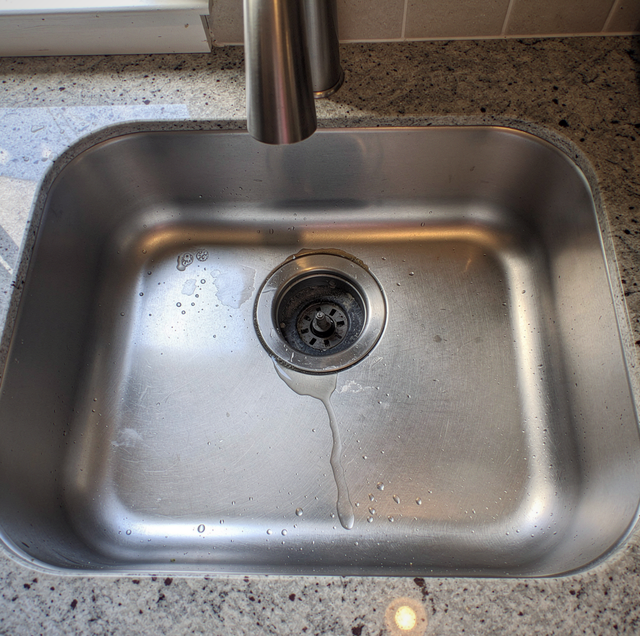
Throw out the fruit bowl, and the flies should go with it. Except a week later they are still circling the sink, sometimes worse than before, with nothing ripe left in the kitchen for them to land on. That gap between cause and effect is the clue: the population living in your kitchen was never feeding on the fruit on your counter. It is feeding on a thin, sugary film coating surfaces a few inches below the sink strainer, inside the disposal and the pipe just past it, and that film does not go anywhere when the fruit does.
Fruit flies: The small insects with reddish eyes that dart in short, erratic bursts are drawn to fermenting sugar and yeast, which is exactly what rots on a disposal's interior surfaces between uses.
Drain flies: A fuzzy, moth-shaped insect that rests flat against a wall near a drain rather than darting around is a different species entirely, breeding in the thicker, gelatinous mat that builds up in a slow or stagnant drain somewhere else in the house. Confirming which one you have tells you where to look first.
Either way, the fix is not chasing adults out of the air. An adult fly is the visible symptom of a breeding surface that is still intact. Removing that surface is the only thing that stops the next generation from showing up, and the surface sits in a handful of specific locations along one short stretch of plumbing, each easy to miss because water passes near it constantly without ever actually scrubbing it clean.
Where a Brush at the Mouth Stops
The lip of the splash guard is the one surface in this whole run of plumbing a homeowner can actually get to. Peeling those rubber flaps back and scrubbing the visible underside with a brush and dish soap does lift film, and on a unit where the smell is strongest right at the sink opening, that is worth doing.
What a brush at the mouth cannot follow is the shape of everything below it. Inside the chamber, the flywheel plate is rinsed every time the unit runs, since it sits directly in the flow. The shelf-like ledge above the flywheel housing and the underside of the stationary grind ring do not sit in that flow at all. Pulp thrown outward during grinding lands on both and dries between uses into a coating plain water does not lift back off. Past the chamber, the discharge tube leaves sideways, and the trap turns twice, so a brush handle stops well short of either one.
Cut power at the breaker, not just the wall switch, before working at the disposal mouth. A flywheel that stalls under load can restart the moment the jam frees, and a switch bumped by a hip is enough.
That is why the same unit can look clean from above, smell better for a few days after an opening scrub, and still be producing flies a week later. The surfaces holding the breeding film begin exactly where the reachable ones end.
The Discharge Tube and Tailpiece
Ground material leaves the chamber through a side discharge tube that connects to a tailpiece and then the drain line proper. On most installs, that tube runs horizontal for a short stretch, or even angles slightly upward, before dropping into the trap arm. A brief, low-flow rinse rarely reaches the velocity needed to fully scour a horizontal run of pipe; it clears the center of the flow and leaves a thin residue lined along the pipe wall, which is out of sight the moment the tube is reconnected.
Over weeks, that lining thickens toward the center of the bore, heaviest along the bottom of the horizontal run where the flow slows first. Nothing about normal disposal use interrupts it, because normal use is exactly what created it.
The Dishwasher Branch, Where One Exists
A dishwasher that drains through the disposal, by way of an air gap or a high loop, sends food particles and rinse-aid residue through that branch line every cycle, but only when the dishwasher runs, not every time the sink does. That intermittent flow means the branch experiences long stretches with no water moving through it at all, which is more than enough time for a film to form along its walls. If a kitchen has both a garbage disposal and flies that seem to hover near the dishwasher rather than the sink basin itself, this branch is worth ruling in rather than assuming it is the disposal chamber alone.
The Trap Below the Disposal
Past the tailpiece sits the P-trap, holding a column of standing water whose job is to block sewer gas from coming back up the line. On a sink that gets light use, that standing water sits undisturbed for hours at a stretch, and a thin film forms right at the surface line of that water, on the boundary where the trapped air meets it. A trap that dries out entirely is a separate problem, usually the reason a drain smells bad on its own; a trap that stays full but rarely moves is the one that matters here.
Why Ice, Peel and Foaming Cleaners Only Reach So Far
Running ice cubes, with or without rock salt or citrus peel, through a spinning disposal does real work: it knocks loose whatever is sitting directly in the flywheel's path and can freshen the smell coming off the chamber itself. What it cannot do is reach a surface the flywheel does not throw material against, which rules out the underside of the splash guard, the back of the grind ring, and everything past the discharge tube. Foaming store-bought drain treatments behave the same way; foam expands into open space and coats whatever it touches on the way down, but a film that already lines a horizontal tube or sits below a standing trap line is downstream of where most of that foam ever travels. A chemical drain product carries the same limit and caution label as a fixture with an attached disposal, so treat its reach as no larger than a topical one.
Floor Drains and Idle Fixtures Elsewhere in the House
Not every fly problem near a kitchen traces back to the disposal at all. A floor drain in a laundry room or garage, a bathroom sink used only occasionally, or a cleanout somewhere in the house can each hold standing water and the same kind of film, entirely independent of anything happening at the kitchen sink. If the insects you are seeing are the fuzzy, moth-shaped kind resting on a wall near one of those fixtures rather than darting around the kitchen, that drain is the one holding the breeding material, not the disposal. Once that identification is made, the work belongs at that floor drain or that unused basin, and the kitchen sink comes off the list entirely.
Frequently Asked Questions
Because clearing visible adults does nothing to the film they came from. Reference material on fruit fly biology generally describes a full generation, egg to breeding adult, completing in roughly a week under warm household conditions, which is fast enough that a population can look fully replaced before anyone notices the film underneath was never touched.
Less than people expect. The difference is the actuator, not the drain path: a batch-feed unit runs only when its magnetic stopper is seated in the sink opening, closing the switch circuit, so it cannot be run hands-free with the drain uncovered. Both types discharge through the same tube to the same trap with water flowing, so the low-flow zones that hold film are identical. What does differ is access. That stopper is a removable part; it collects the same film on its own underside, and it can be lifted out and scrubbed at the sink with no tools and nothing loosened.
No, and the difference that matters is whether the guard comes out. Every guard is molded elastomer or rubber rather than a rigid plastic, but on many units it is a separate ring that lifts free of the sink flange once the mounting is loosened, so the underside can be cleaned away from the fixture. A guard molded into the flange assembly cannot be removed without pulling the disposal off its mount, which is why the same film is treated as a pour-in problem on one unit and a disassembly job on another.
Yes, if the branch is not actually flowing. A branch that drains slowly holds rinse water and detergent residue in the hose instead of clearing it each cycle, and a hose holding standing water is a breeding surface on the same terms as the discharge tube. The hose makes that worse on its own account: most dishwasher drain hose is corrugated, and every rib in that inner wall is a small ledge residue settles on that a smooth-bore tube does not give it. If flies concentrate near the dishwasher rather than the basin, have the branch's flow checked before treating the chamber again.
Yes. Reaching the underside of a splash guard or the inside of a discharge tube for direct cleaning means removing that part rather than treating it from above, typically unbolting the discharge tube or the trap at its slip joints. That is also why the tailpiece gasket and the trap washers get replaced on reassembly rather than reused, since a compressed slip-joint washer rarely reseats cleanly on the second pass.
Then you are almost certainly looking at drain flies rather than fruit flies, and the disposal is not the source. A floor drain that goes dry between wash cycles stops sealing the line below it, and the gelatinous mat that those flies breed in settles in that line rather than anywhere in the kitchen. Topping the trap back up does not end it by itself, because the larvae live inside the mat rather than in the water above it, so the mat has to come off the pipe wall. Confirming the insect before treating any fixture is what keeps the work aimed at the right drain.
Remove the film a kitchen routine can't reach — a disposal inspection and cleaning that gets to the surfaces water passes but never rinses. Ser Plumbing repairs drain lines across the area, from drain line repair in Bellflower to Lakewood. Call (310) 953-3566.
