
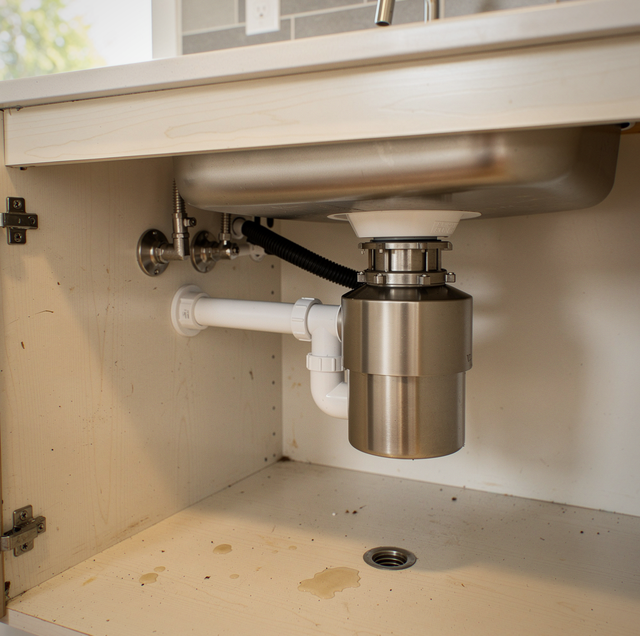
Take a new garbage disposal out of its carton and look at the short nipple molded into the side of the housing, near the mounting flange. That nipple is the dishwasher inlet, and it is not open. A disc sits a short way inside, formed as part of the housing at the factory and left there on purpose. The port ships sealed because plenty of sinks get a disposal and no dishwasher, and a sealed port is how one part number covers both.
Now connect a dishwasher to that inlet without driving the disc out. The appliance runs its cycle, the drain pump starts, and it pushes wash water into a closed dead end. Water climbs partway up the hose, then falls back and stands at the bottom of the tub when the cycle ends. That puddle reads like a failed appliance. The appliance is fine. A molded disc still sitting in the port is entirely to blame.
The knockout is one step in a sequence: a supply connection, a drain connection, and the path the hose takes between them. Follow the water in the order it moves, and each piece explains itself.
The Dishwasher Supply Connection
A dishwasher is fed by a single line branched off the hot plumbing already under the sink, usually at the hot angle stop that feeds the faucet. Two clean ways to take it: swap the existing stop for a dual-outlet angle stop, which carries a second threaded outlet on the same body, or set a tee below the stop and run the dishwasher leg from it.
The connector should be a braided stainless dishwasher supply line, long enough to reach without tension and short enough that it is not coiled in the cabinet. It crosses into the dishwasher bay through a hole bored in the cabinet side wall, and that hole deserves attention. A raw-cut edge in particle board or the sheared edge of a sheet metal cabinet will saw at the braid every time the appliance vibrates. Ream it smooth or fit a grommet first.
Never a saddle valve: A pierced-pipe tap is not an acceptable way to feed a dishwasher, and a careful plumber refuses to install one.
Why the coil matters: Slack looped in the cabinet is not harmless spare length. The braid is a sleeve over a soft inner tube, and a tight coil holds that tube at a fixed radius for years, which is where it eventually splits. A coil also sits on the cabinet floor, in the one place where a stored bottle gets dragged across it and where a leak from anywhere else pools first, so a weeping fitting is read as a bad supply line, and the wrong part gets replaced. Measure the actual run and buy the length that makes it in one gentle sweep, with the excess taken up by routing rather than by a loop.
The Knockout in the Drain Inlet
Back to the disc. Removing it is not delicate work, but it is easy to do halfway.
The plug gets driven inward from outside the disposal. It breaks free at the molded ring around its edge and drops into the grind chamber.
The second half of the job is the one that gets skipped. That freed plug is solid and does not dissolve, grind, or wash through, so it has to be reached through the sink opening and pulled out by hand. Left in the chamber, it will rattle on the grind plate, wedge against the grind ring, or park across the discharge, throttling everything behind it.
The disposal's breaker goes off before the knockout is touched and stays off until the drain hose is connected. The freed plug is then retrieved by hand, and a plug spun against the grind ring damages the splash guard.
Knock the plug out only if a dishwasher is being connected to that inlet. A disposal on a sink with no dishwasher keeps its port sealed, and punching it open leaves a nipple that will spray under load.
The Drain Hose Route from the Appliance to the Cabinet
The drain hose leaves the dishwasher at the pump housing under the tub and exits low, usually at a back corner of the appliance bay. From there it has to reach the sink cabinet, and the route it takes is a real part of the install.
No crush points: The hose is flexible corrugated tubing, and it tolerates bends but not compression. A hose pinched behind a leveling foot, or pressed flat where the dishwasher was pushed back into its bay, holds that shape permanently once the ribs collapse.
No slack on the cabinet floor: Extra-length coiled at the bottom of the cabinet creates low spots. Each one holds standing water after every cycle, and warm standing water in a hose turns into a smell nobody can trace.
Nothing rubbing: The drain hose and the braided supply line should not cross and lie against one another; vibration wears through the softer one.
Then the hose has to climb, and what happens at the top of that climb is the real question.
The High Loop and the Siphon It Prevents
A high loop is what the name says. The drain hose is carried up and fastened at its highest point to the underside of the countertop, or to the cabinet wall as close under the counter as it will go, before dropping back down to the disposal inlet.
The reason is water levels, not parts. Picture the hose without the loop, running flat from the appliance to the disposal. Fill the sink, and the water standing in the basin and the disposal chamber is higher than the whole length of that hose. Water finds the lower place, and it runs backward into the dishwasher tub.
The second failure is quieter and worse. Once a hose fills solid with water and its two ends sit at different heights, the falling column pulls the column behind it. That is a siphon, and it does not need the sink to be full. It can draw dirty sink water into the tub, or empty a dishwasher partway through a cycle.
Raising the hose so its apex sits above the flood rim of the sink defeats both. Backward flow would have to climb, and the water column breaks at the top of the arc instead of running continuously. A high loop has no valve, no diaphragm, no moving part at all. It is height doing the work.
The Air Gap on the Sink Deck
The air gap addresses the same problem with a physical break rather than height.
It is a small fitting mounted through a hole in the sink deck or countertop. Above the deck sits a chrome or brushed cover, slotted so the inside stays open to room air. Below the deck, the body has two legs of different sizes: the smaller one takes the drain hose coming from the dishwasher, and the larger one carries a second hose down to the disposal inlet nipple.
Inside the body, those two legs do not connect. Drain water arrives up the small inlet leg, discharges into an open chamber vented to the room, and falls by gravity into the larger outlet leg. For a moment it travels through open air, and that break is the whole mechanism. Nothing siphons across it because a siphon requires an unbroken column, and there is none. Nothing backs up into the dishwasher either, because water that cannot get away reaches the open chamber and spills onto the counter instead. The outlet leg is larger, so the chamber always drains faster than it fills.
The two legs are not interchangeable, and reversing them is the failure that gets blamed on the fitting. With the hose from the dishwasher clamped onto the large outlet leg, the body is being asked to push water up the small side, and the chamber overflows onto the deck on nearly every cycle.
Requirements differ: Whether an air gap is required, or a high loop is accepted in its place, varies by jurisdiction and sometimes by the particular installation. That is not something to settle from an article. A licensed plumber confirms what applies to your house before the fitting is chosen.
The Tailpiece Branch When There Is No Disposal
Plenty of kitchen sinks have no disposal at all. The drain connection then lands on a dishwasher tailpiece, the vertical tube running from the sink basket strainer down to the trap. It carries a molded branch nipple, sized for the drain hose and clamped the same way.
What matters is where that branch sits. It belongs above the trap, so everything the dishwasher discharges still passes through the trap seal. A branch tied in below the trap weir would leave the hose open to the drain line, and the trap would no longer be doing its one job.
A dishwasher hookup is not complicated work, but it is unforgiving. Every part of it lives behind a cabinet door or under an appliance nobody moves, and most of its mistakes leak slowly instead of loudly.
Frequently Asked Questions
An air gap has no valve, no float, and no moving part inside, so the fitting itself is rarely what failed. Spillage means water cannot flow downstream fast enough, and the usual culprit is the corrugated outlet hose running to the disposal. Its ribbed inner wall catches starch and grease far more readily than a smooth-wall hose. The cover lifts straight off, and the escutcheon beneath it unthreads, opening the chamber for cleaning and for flushing the outlet leg.
It has to be fastened. Every cycle sends hot water through that hose, and the corrugated wall goes slightly soft while it is warm, so a loop wedged up by nothing but its own stiffness relaxes a little further each year until the arc has flattened out. The apex gets held mechanically instead, with a cable clamp, a screw-mounted bracket, or a strap driven into the underside of the countertop. Where the fixing lands matters as much as fitting one at all: a clamp set partway down the rise still lets the crown sag between fixings, so the fastener belongs at the top of the arc itself.
Most residential dishwashers are plumbed hot, because the internal heating element is sized to raise already-hot water the last few degrees rather than heat cold water from scratch. Fed cold, many machines run much longer to reach temperature, and some detergents dissolve poorly at low temperatures. A few models are specified for a cold supply, and the appliance's installation instructions are the authority there, not a general rule.
Sink deck accessory holes are a standard size, most commonly one and three-eighths inches, which is why air gaps, side sprayers, and other deck accessories interchange. With the air gap gone, the hole gets a stainless or matching-finish deck plug, seated on a gasket and drawn down from below with a nut. Left open, it is a direct path for counter spills into the cabinet.
Usually not. Most dishwasher drain hoses ship with a molded stepped end, a series of concentric rings of increasing diameter, meant to be cut with a utility knife at the ring matching the fitting. Cutting a step too far back leaves a joint no clamp can fully close, and cutting too short forces the hose over a fitting it cannot seat on. A worm-drive clamp holds these joints better over time than the spring clamp some hoses arrive with.
It is worth having. A dual-outlet stop shuts the faucet and the dishwasher together with one handle, which puts the sink out of service whenever the dishwasher needs to be isolated; a separate quarter-turn ball stop on the dishwasher leg avoids that. However it is valved, the last fitting in the run is a 90-degree brass elbow threaded into the appliance's fill valve, and that joint needs proper sealant. It is a common slow-weep point, and it sits under the machine, where a leak goes unseen.
Hand the dishwasher hookup to a licensed plumber — supply, knockout, drain route and drainage protection done right the first time. Ser Plumbing installs sewer cleanouts across the area, from sewer cleanout installation in Downey to Long Beach. Call (310) 953-3566.
