Home/Downey/Sewer Cleanout Installation
Downey, California

Sewer Cleanout Installation in Downey, CA

We Look for Yours First | Placed Where It Can Be Used | CSLB #1051553 | Se Habla Español

Before anyone sells you a cleanout, first find out whether your Downey property already has one. Answering that takes a locate, and the locate is where this visit starts.

Ser Plumbing looks first and installs second. If yours exists, we uncover it, and the question of installing one goes away. If it does not, we put one where it can actually be reached in twenty years, which is a decision with more to it than picking a spot near the house.
CSLB License #1051553Licensed, Bonded & Insured5.0 Google RatedWe Search Before We SellSe Habla Español
Ser Plumbing service van on a Southeast LA County residential street Excellent on Google5.0Verified customer reviews
No travel feeWithin 15 miles
of our Paramount shop
What we cover

Why This Comes Up

01

A plumber told you there is no access

Without one, a main line has to be worked through a roof vent or a pulled toilet. Both are slower, and neither reaches as well, which is generally discovered during the first backup.

02

You have one and no one can find it

Then the visit is a search with a method behind it. The line is traced from the inside and marked on the surface, and its position is recorded relative to something fixed so the search does not have to be repeated.

03

The line is being replaced anyway

The moment to add access is while the trench is already open, and that moment gets missed more than any other because no one thought to ask.

04

You are buying the property

A buyer inspecting a sewer wants to know whether the line can be reached at all, because that answer shapes what every future service call looks like. → Pre purchase plumbing inspection

How it runs

How it Goes

We ask what you have been told, and by whom. Reports that a property has no cleanout are frequently conclusions drawn from a quick look rather than findings from a locate.

A transmitter goes down the line, and we track it from the surface, marking the route and the depth.

If a cleanout is found, we uncover it, check that it is usable, and that is usually the end of the visit.

If there is none, we walk the marked route with you and choose the placement, weighing depth, what sits on the surface, and the clearance Downey requires between a sewer run and established planting, which is covered below.

Installation, brought to grade and capped, the opening restored, and the location recorded so the next person does not have to hunt for it.
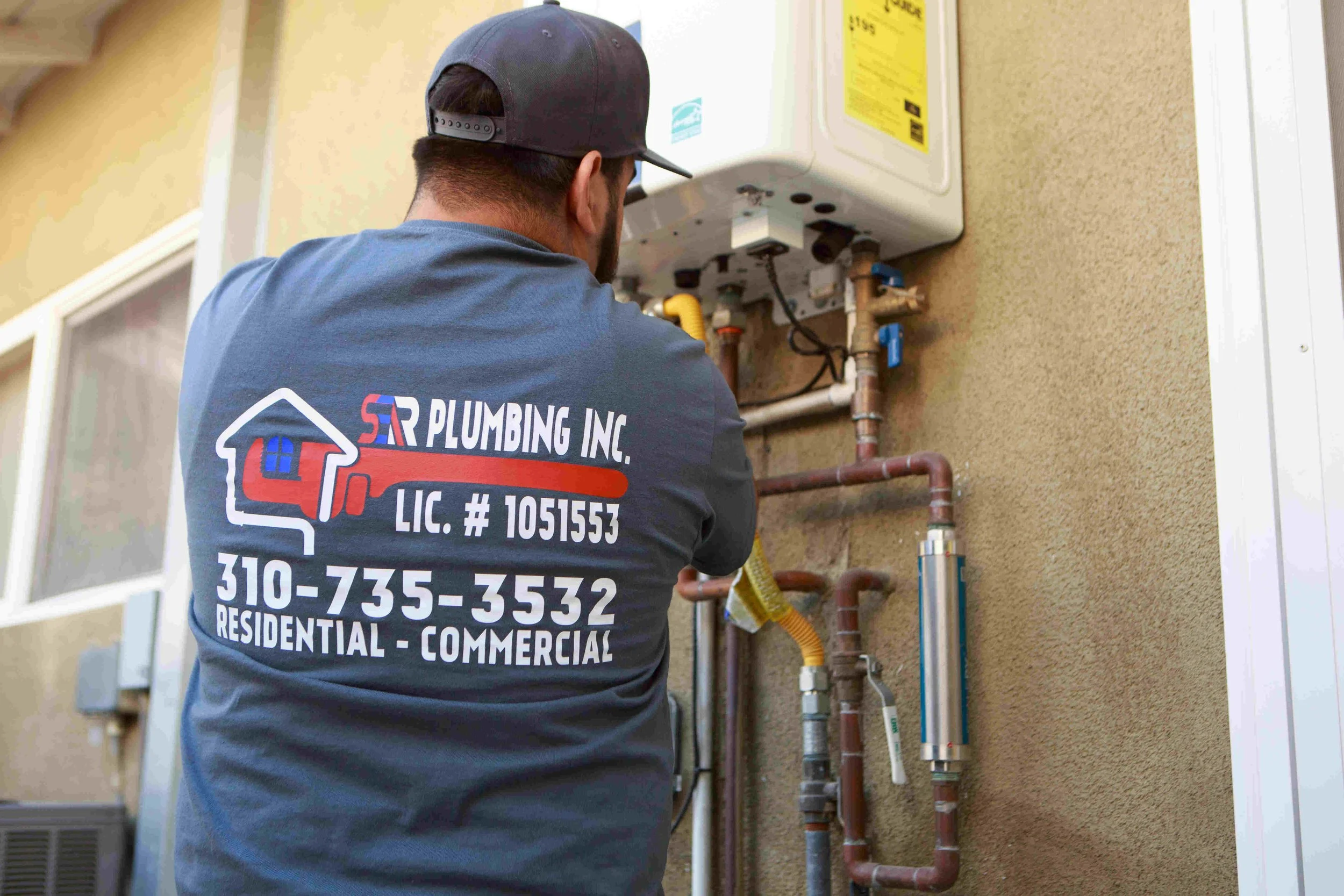
Ser Plumbing plumber working on a residential supply line
The detail

Ten Feet from Anything Planted Decides Where it Goes

The thing that actually moves a cleanout in this city is a distance. Downey requires sewer pipe to be laid at least ten feet from any tree, bush, or hedge, and on a Downey lot that is a real measurement: a mature parkway tree at the front, a hedge along one fence line, and a shrub bed against the house can leave one usable corridor between them. So the placement conversation starts with what is planted and where it stands, and it can put the access further from the building than anyone pictured when they called.

That distance also decides which of two jobs you are buying. Where ten feet can be found near the house, the access sits shallow and well inside the property. Where planting pushes it out toward the front of the lot, the same fitting lands on a deeper part of a line that falls as it runs, and what sits over it is more likely to be a driveway or a walk than a lawn. Walking the marked route with the planting in view is what settles that before a figure is written.

Ten feet is the figure this city works to on both sides of the question. The sewer rule places it between the pipe and the established planting. Downey's street tree ordinance sets the same clearance the other way around, keeping city trees ten feet away from water and gas meters. On a standard frontage with a parkway tree, a meter, and a service run, those two clearances describe one narrow corridor, and the cleanout has to be sited inside it. That is a conversation to have standing on the lawn with the route marked, which is why the locate happens first.

None of that comes from a Downey cleanout rule, because the city has not written one: no ordinance, no public works standard, and no standard drawing here requires a property-line cleanout, sets spacing, or requires one to be added when a lateral is replaced. The governing code is the California Plumbing Code, which Downey adopts by reference with no local technical amendments. So, a quote citing a city requirement for a particular cleanout arrangement is citing something the city has not written.

One local detail that does bite is terminology. Downey's municipal code assigns the city responsibility for maintaining "terminal cleanouts", which sounds like it might mean yours. It does not. Those are structures on the city's own main line sewers, listed in the code alongside mains, manholes, and pumping stations. Access on a private lateral is a separate issue, and the code places lateral maintenance on the property owner. → Sewer line repair downey

What we cover

What We do

01

Locating an existing cleanout

A transmitter is run in the line and tracked from the surface, so an existing cleanout can be found without digging speculatively.

02

One-way cleanout installation

Access in a single direction, toward the main. Straightforward, and the right answer where the line only needs to be worked one way.

03

Two-way cleanout installation

Access in both directions, back toward the house and out toward the main, from a single opening. A larger install, and the one that matters when a blockage sits on the house side.

04

Riser, cap, and surface finish

Brought to grade, capped, and set so a mower or a car can pass over it depending on where it lands.

Pricing & response

Pricing & Response

Depth is the main driver, and Downey's own standard puts a residential lateral at six feet at the property line and a commercial or apartment-house lateral at eight. Placement closer to the building is generally shallower.

Standard labor discounts apply: military and first responders 10% up to $100, seniors 65+ and teachers 5% up to $50, first-time customers 10% on qualifying repairs. One discount per job. No travel fee to Downey.

ItemDowney pricing
Service call, residential$89
Locating an existing cleanoutQuoted before we start. If we find one, that is often the whole visit
One-way cleanout installationWritten figure once the line is located and its depth is known
Two-way cleanout installationQuoted in writing once the line is located. A larger install than a one-way
Camera inspectionFrom $250
What we cover

Where a New one Can Go, and Staying Able to Find it
01

Placement is a twenty-year decision

Depth, what sits on the surface, and the required clearance from planting all bear on where a new access can go. A spot chosen only for convenience on the day tends to end up under a later driveway extension or behind a mature shrub.

02

We record where it is

The location goes on your paperwork. An access point no one can locate does not help on the day it is needed.

The detail

One Way, two Ways, and Which one You Need

A one-way cleanout opens the line in a single direction, normally toward the main, and it handles the common case: a blockage downstream of the house, cleared out toward the street. A two-way opens both directions from a single access, so the same opening reaches back under the building and out toward the connection. The difference matters on the day a blockage sits upstream of the access, between it and the building. With a one-way that means going in through a roof vent or pulling a toilet. With a two-way it means taking the cap off.

Which one is right depends on the run. A long lateral, a house with additions that changed how the drainage comes together, or a property where the line has already given trouble in more than one place all argue for the two-way. A short, simple, well-understood run often does not need it. The layout decides it, so the route gets marked before the type is chosen.

Ser Plumbing service work on a mid-century home
Service area

Sewer Cleanout Work in Downey and across SE LA County and North Orange County

Cleanout locating and installation from our Paramount shop across the core service area: Paramount, Bellflower, Downey, Lynwood, South Gate, Compton, Bell Gardens, Bell, Walnut Park, Santa Fe Springs, Lakewood, Norwalk, Long Beach, Maywood, Artesia, Cerritos, and East Rancho Dominguez, plus Huntington Park, Cudahy, Pico Rivera, Whittier, Montebello, Signal Hill, Anaheim, and Garden Grove. No travel fee within 15 miles of Paramount.

Full coverage details at Service areas

FAQ

Downey Sewer Cleanout FAQS

Straight answers for Downey homeowners. Anything not covered here, just ask.

Ask us directly
Ser Plumbing technician documenting findings on a service call
Does Downey require me to have a cleanout?

No. If a quote cites a city requirement, ask which section it is, because there is none to cite; what applies is the state plumbing code the city adopts by reference. Then ask for the answer on the estimate in writing. "Code requires it" and "we recommend it" are two different sentences, and only one of them can be checked by anybody.

The city maintains terminal cleanouts. Is that mine?

No, and the overlapping name causes real confusion. If you call the city about a terminal cleanout they will be discussing a structure on their main. Say 'the cleanout on my lateral' and the conversation stays on your property.

How much does it cost?

It is quoted in writing once the line is located, because depth and surface drive the number more than anything else. No starting figure is published for this work. If it helps to know what moves it: a cleanout landing in a lawn, in a driveway and in a sidewalk are three different jobs on the same lateral.

One-way or two-way?

One question usually settles it: has this line ever blocked between the house and where the access would sit? If nobody knows, that is what the locate and the footage are for, and the type can be chosen after the route is marked. One practical note for the day itself. The cap has to finish flush with whatever surface it lands in, so say early if the likely spot is a driveway you have recently had resurfaced.

What if I already have one?

Then the visit becomes a locate. Ask us to do two things while we are there: confirm the cap comes off, since a seized or painted-over cap is common and is a small job now, and photograph the position against a fixed feature so it can be found again.

Reviews

What Downey Customers Say

Our verified Google reviews load below in real time, unedited.

5.0★★★★★Google Rating · verified reviewsLeave us a review
Book now

Book Downey Service

Told your Downey line has no access? Let us go looking before anyone digs. (310) 953-3566.

Call (310) 953-3566
Book Downey ServiceSame-day with a morning call. Se habla español.