
The last morning of a repipe has a shape to it. The crew runs the final tests, the walls go back together, somebody hands you a folder or promises to send one, and the truck pulls away.
What belongs in that folder is settled ground, and any company worth hiring will produce it on the day: the permit and its signed-off inspection, where a permit was applied for; the photographs taken before the drywall went up; a record of what went into the walls; and the warranties named separately. Ask for those four before the truck leaves, and you will get them.
The trouble starts about a week later, when the folder turns out to answer questions nobody has asked yet and to say nothing about the ones that arrive first. Which valve shuts off the guest bathroom. Why a length of old pipe is still in the ground behind the garage. Where the folder itself went after somebody tidied the kitchen counter. Those are not sign-off questions. They are custody questions, and they became yours the moment the truck left, because everybody who could have answered them in a sentence is now working on another house.
Quick Answer: The closeout packet is the start of a repipe file, not the whole file. What it leaves to you is a labeled shutoff map, the scope sheet with any change orders, and a copy kept somewhere off the property.
What the Packet Covers, and What to Do With It
Take the four packet items as read. What follows is one line each on what to do with them once they are in your hands, which is the part nobody covers on the last day.
The permit and the signed-off inspection: Two pieces of paper, and not the same piece of paper. One says the work was applied for and authorized to begin. The other says an inspector came, looked, and closed the department's file on your job. Only your building department could say whether the job needed a permit in the first place, so the question now is which of the two pieces of paper you are actually holding. Then copy three things onto the front of the file: the permit number, the department that issued it, and the date of the final inspection. Departments generally keep their own records by address, and that number is what they use to find it after your paper goes missing.
The photographs of the open walls: What a good set covers is a conversation for the week before the drywall rather than the week after. By the time the folder reaches you, the only decision left is whether the images survive the next three phones, so keep them at full resolution and keep them somewhere other than the device they were taken on.
The materials record: One page naming what is in the walls, with the certification strings copied off the print line word for word, since the exact string is what a listing search matches on. Two lines are usually missing from the version handed to you, and both are yours to add: the company that did the work, written exactly as it appears on the invoice, and the dates the job ran.
The warranties: One comes from the company that installed the system and one from the makers of the tubing and fittings. Three things go on the front. The date each term runs from, because completion and final sign-off are not always the same day. Whether any manufacturer registration was filed for you or left for you, since some of those windows close. And who to call, written as the exact entity name from the contract, with the phone number and the license number underneath it. Numbers get disconnected, and companies get sold, restructured, and renamed, so the entity name and the license number belong side by side rather than either one being trusted on its own to still point at the same business years later.
Keep the invoice in full, since a coverage question opens with a request for proof of the work.
Rename the photo files the week you get them: room first, then what the frame shows. A folder of 200 images called IMG_4417 is a set that nobody is going to search through years later.
The Labeled Shutoff Map
Most of the stop valves in the house were handled during the repipe, and some reasonably were not, since a quarter-turn stop in good condition can stay. Either way, the knowledge of which valve isolates what is at its peak on the last day and mostly gone within a week. Nobody writes it down, because on that day it looks too obvious to be worth writing.
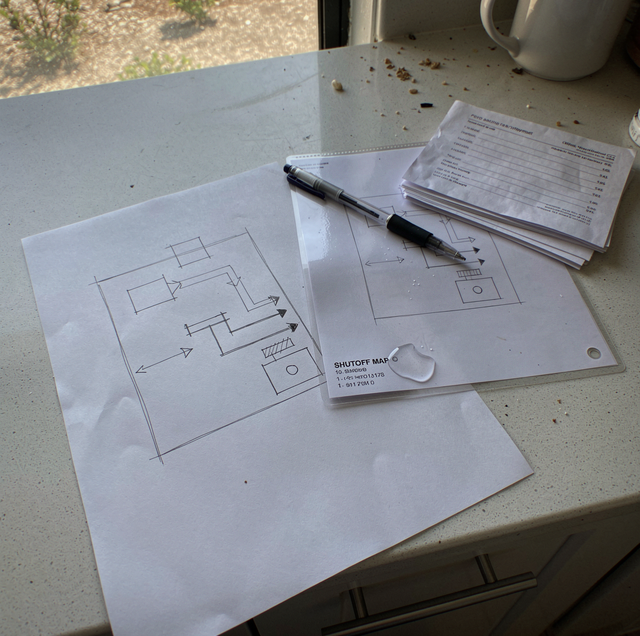
So draw it once, then. A sketch of the floor plan, not to scale, on one page. A numbered dot for the main, and one for every fixture stop: under each sink, behind each toilet, at the laundry, at the water heater, at each hose bib. A dot for any branch that can be shut on its own, a garage line, an irrigation takeoff, a capped stub left for a future building. Then one line per number saying what that valve stops.
Two details separate a map from a drawing. The main gets described from something permanent, paced off a door frame rather than off a shrub somebody will pull out. And where a fixture has no stop of its own, which is ordinary for tubs and showers, the note says so and names the valve that does cover it. A gap on the page reads to whoever is holding it as an instruction to keep looking, and looking is the one thing there is no time for.
The reason to draw it while the job is fresh is that the person who needs it is rarely the person who made it. It gets read by whoever happens to be standing in the hallway at the moment water is arriving somewhere it should not be, and that may be a house sitter, a teenager, a tenant, or a neighbor with a key. Writing it for that reader changes what goes on it: plain words instead of trade names, the room a valve serves rather than the branch it belongs to, and an arrow showing which way closes it. Somebody who has never thought about your plumbing should be able to act off the page without interpreting it.
Reconstructing the map later means opening every cabinet in the house and guessing at the rest, which is why almost no household has one. Draw it in the week the crew leaves, and the guessing is somebody's fresh memory rather than an archaeology project.
The Scope Sheet and Any Change Orders
The written scope is the record of what was agreed. Each change order is a record of what changed, when, and who requested it. Keep the version you accepted rather than the drafts in front of it, and keep each change order with its own date attached rather than folded into a revised sheet at the end.
Those pages are what make the rest of the folder readable. The scope specifies which openings were to be patched and to what step, which is the only way a future reader can tell an unfinished wall from one finished exactly as agreed. It says what was left out, which answers the question that surfaces years later about why a length of old pipe is still in the ground. And it names what was added while the walls were open, so a capped stub in a garage has a paragraph standing behind it instead of being a mystery somebody discovers with a flashlight.
Change orders do a second thing the scope cannot. A repipe is work where conditions turn up after the walls open, and the honest ones get written down at the moment they are found: a rotted section of framing, a wall that had clearly been opened before, a run that could not go where the plan put it. Read in sequence, the change orders are the only record anyone will ever have of what the house turned out to be, as opposed to what it was believed to be on the day somebody wrote the quote. That account is worth more than it looks. It is what the next contractor reads before quoting anything else in the building, and it is what tells you, later and calmly, whether the surprises belonged to the house or to the sheet.
Write one page at the top of the stack naming what the job ended as. The rooms that were opened, what was added, what was deferred, and to when. A future reader then gets to the answer without reading four documents in the right order, and you get a version written while you still remember which of the changes mattered.
File each change order against the scope line it changes rather than at the back of the folder. Years later the question is not what changed but what the scope said before it changed, and the two are only useful together.
What Each Piece Answers, and Who Asks
| What you keep | What it answers later | Who tends to ask |
|---|---|---|
| Permit and signed-off inspection | Whether the work was inspected and accepted, and when | Buyers and their inspectors, at a sale |
| Photographs of the open walls | Where every line runs overhead and inside the walls | The next plumber, or anyone cutting a ceiling |
| Materials record | What the tubing, fittings and valves are, and what certifies them | A manufacturer handling a claim |
| Warranty paperwork | What is covered, from what date, and who to call | You, the first time a new joint seeps |
| Labeled shutoff map | Which valve stops which water, and where the main is | Whoever is home when a line lets go |
| Scope sheet and change orders | What was agreed, and what changed | You and the company that did the work |
Read down the middle column and the folder explains itself. Each piece answers one question that gets asked at a moment when the person who could have answered it in a sentence is no longer reachable.
Keeping the File Where It Will Be Found
A file that exists and cannot be found has done none of this.
Keep it in two places and make one of them off the property. The photographs are the reason. They live on a phone that gets replaced or a laptop that dies, and nobody can recreate them once the walls are shut. A cloud folder, a drive at a relative's house, an email to yourself with the set attached: any of those works. One copy, sitting in the house the pipe is in, does not.
Then tell one other person in the household where the file is and how to open it. Somebody home alone when a line lets go needs the shutoff map, and needs it without phoning you first. That page earns a copy of its own, taped inside the cabinet door nearest the main, where it gets read by whoever is standing there.
And when the house changes hands, hand the file across rather than leaving it to be discovered. Put it on the list with the keys and the garage remotes. What the next owner receives is the only account of a system they will never see, written by the only people who ever saw it. Keep your own copy too, because questions about a house arrive after you have gone.
The file was never really for you. It is for whoever comes after the pipe is in and the people who put it there have moved on to other houses, and it reaches them only if someone in between was deliberately keeping it. Custody is the whole of the job.
Frequently Asked Questions
Some of it is recoverable. Building departments generally maintain their own records of permits by address, so a permit and a final inspection can often be requested even when a seller kept nothing. An exposed run in a garage or a water heater closet usually carries a legible print line that gives you the material and the standards it was made to. What cannot be recovered is the photographic record, so the map is the piece worth building yourself: one afternoon of opening cabinets and labeling what you find.
Both, doing different jobs. Paper survives dead accounts, forgotten passwords and a phone nobody else can get into, and the shutoff map belongs near the valve it describes rather than in a folder. Digital survives fire, water and a move, and it is the only sensible home for photographs, which lose most of their usefulness printed small. Keep those at full resolution rather than flattening them into a single small file, and check every few years that the format still opens.
Often, for their own purposes, and how long they hold it varies from company to company. Treat that as a courtesy rather than as your backup. Companies change hands, change record systems and close, and a job file from a decade back is not always retrievable even under the same trading name. Ask about their practice while your job is current, and ask for anything they hold in a form you can store yourself.
One dated page in your own words, written the week the job ends. Note the day the water came back on for good. Note which rooms were opened and what became of each opening, since that is what you will read against the scope years from now. Note anything deferred and the date it was promised. And note where leftover tubing, fittings, and touch-up paint were stored, because that is the box somebody hunts for later and cannot find.
The pieces age at different rates, and none of them expire as records. A warranty term has ended, but the document still states what was installed and by whom. The photographs get consulted more as time passes rather than less, because the number of people who remember the work only falls. Keep the file as long as you own the house, then let it go with the house.
Yes, and mostly to people holding drills. Anyone fishing wire through a ceiling, hanging a cabinet on a wet wall, or driving an anchor into an attic joist is working within inches of supply lines they cannot see. Send the relevant frames over before that work starts rather than after somebody hits something. It is the one item in the folder that prevents a repair instead of explaining one.
Ask for the closeout packet before the truck leaves — the open walls photographed, the permit record, the materials and the warranties handed over on the last day rather than chased a month later. Ser Plumbing repairs water heaters across the area, from water heater repair in Downey to Long Beach. Call (310) 953-3566.
