
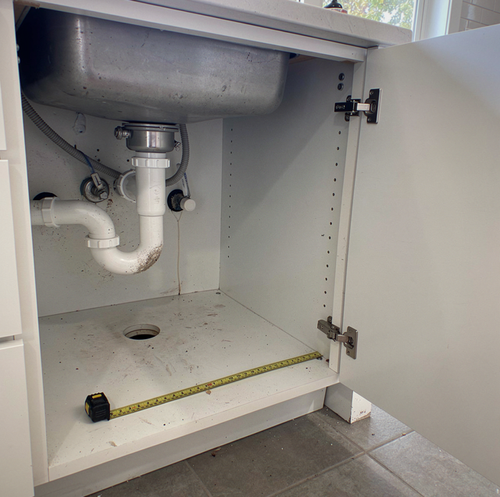
Quick Answer: The plumbing under your sink, not personal preference, narrows the choice first: your cabinet's width, the existing drain height, and what already occupies that vertical space decide which bowl configurations are even candidates before finish or capacity matter.
A sink display lines up bowls side by side, single and double, deep and shallow, and the buying guides online argue the same two points every time: one big basin for roasting pans, two smaller ones for washing and rinsing at once. None of those guides ever open the cabinet doors underneath. What actually narrows your field is the plumbing already sitting in that cabinet, not a preference for one basin over two, because the cabinet box, the drain already stubbed into the wall, and whatever else already lives in that space were all sized around the sink you have now, not the one you are considering.
The Question Under the Sink, Not on the Showroom Floor
A kitchen sink swap that keeps the same bowl count and roughly the same depth is the simple version of this job: your cabinet already accommodates the footprint, and the drain still leaves toward the wall from where it always did. The connections underneath still come apart and get remade, but they get remade in the same positions. Crossing from one bowl to two, or from two bowls to one large one, changes the shape of what has to fit into a space that was never designed with a choice in mind. Your cabinet's interior width does not change because a sink catalog offers a different layout. The height between the sink and wherever the drain already exits toward the wall does not change either. The only change is the sink itself, and it either works with what your kitchen already has or it does not.
That is the real decision, and it starts with a walk to the cabinet before it starts with a walk to a showroom. Open the doors, look at what already occupies that space, and measure before you compare basin counts on paper. Nothing has to come apart for that; the numbers are taken around what is already there, not by moving it.
Depth Is the Dimension the Box Doesn't Explain
Length and width are printed on the front of every sink box, large enough to compare across a shelf of options. Depth is usually printed too, in smaller type, and it is the dimension easiest to skim past when comparing color and finish. That is a mistake specific to this choice, because depth is the one number that reaches down into a cabinet interior you have already filled with something else.
A basin that sits deeper than the one it replaces claims more of the vertical space between your counter and your cabinet floor. Whatever already lives in that space- a trap, a disposal, a bin, a filter housing- was arranged around your old sink's depth. A new bowl that sits lower into that column is not a problem the label can flag, because the label only describes the sink, not the cabinet you are putting it into.
Depth also moves the sink's own drain opening. A bowl that sits lower puts its outlet lower in the cabinet, while the point where the drain leaves toward the wall stays exactly where it has always been. Everything that has to fit between those two points now fits into a shorter column than it had before, and that shorter column is what the extra depth spends. It is why a sink can clear the cutout and clear both cabinet walls and still be the wrong sink for the space underneath it.
Cabinet Width Sets the Outer Limit Before Bowl Count Does
A sink base cabinet is built to a fixed interior width between its two side walls, and that width does not expand to suit whichever configuration looks best on a countertop rendering. A single large basin and a divided sink of the same overall footprint use that width differently: one concentrates its bulk near the center, the other spreads it toward both side walls, closer to where your cabinet's own hardware and framing sit. If a garbage disposal already hangs under one of your existing bowls, its housing is one more thing taking up part of that same interior width, and whichever bowl ends up above it is part of the decision before you settle on a new footprint.
Measure your cabinet's width at the back wall, not only at the front opening. Face frames and side panels can taper the interior narrower toward the rear, and that narrower point is what the sink's footprint has to clear.
Comparing a sink's outer dimensions against your cabinet's opening is only the first check. What matters more is whether that footprint still clears your cabinet when measured at its tightest point, not its widest.
The Faucet Deck Moves When the Bowl Layout Does
A sink's faucet holes are punched or drilled relative to the bowl arrangement, not to a fixed point on the counter or the wall behind it. A single bowl typically centers that hole pattern over the one basin, while a divided sink usually sets it at the point where the two basins meet. Moving from one arrangement to the other moves your faucet with it, even when the counter itself is not touched. Where that faucet ends up is not a detail to leave for installation day; it belongs in the same walk to the cabinet as everything else.
Read the Cabinet Before You Read the Spec Sheet
None of this makes a single bowl the right choice or a double bowl the wrong one. It means the choice gets made in the right order: what your cabinet, your drain, and anything already installed underneath will accept, checked before a bowl count or a basin depth gets settled on preference alone. With the cabinet doors open, four checks cover it:
- Your cabinet's interior width, measured at its narrowest point, not the printed footprint on the box.
- How much vertical room already exists below your sink before a new bowl adds its own depth on top of it.
- Where the faucet deck's holes will land once the bowl arrangement changes.
- Whether the new sink meets an opening that is already cut, as a drop-in, or has to be set against stone finished to it, as an undermount.
Mount style changes what has to be checked, not just what is seen. A drop-in rests its rim on the counter; an undermount is tied to the finished cut edge below it. Whether an existing opening can take the configuration you are considering is a countertop question with its own answer, and it gets settled separately from the cabinet questions above.
Whichever bowl configuration answers to all four checks is the one that fits.
Frequently Asked Questions
Not for a reason that has anything to do with the plumbing. Single bowls are commonly built deeper because the entire basin is a single working space, and the added depth is where a manufacturer adds room without changing the footprint a cabinet must accept. That added depth shows up below the rim, not above the counter, which is why the counter height and the faucet position above it stay the same while what happens beneath the sink does not.
Because the divider takes its own width out of the middle, and each basin loses more at the corners, where the walls curve down into the floor instead of meeting at a square angle. Both losses come off the usable interior, not off the outside footprint printed on the box, so each basin ends up smaller than half the sink's overall width by more than the divider alone accounts for.
A stretcher rail is the front support strip that runs between a base cabinet's two side walls, just under the countertop, and it is what keeps the cabinet box square before a sink is ever set into it. Where a cabinet was built as a sink base, that rail is often shortened or absent for exactly this reason. A cabinet not originally built as a sink base can still carry a full rail across the front, and where a wide or deep bowl will not clear it, modifying that rail is cabinetry work rather than part of the plumbing scope, which is worth knowing before the sink is bought.
The bowl clearing the opening and the installer having room to set it are two different things. A drop-in's mounting clips grip the underside of the countertop, drawn up by screws seated in channels on the sink's own underside, and an undermount's rail or clips anchor into the stone just past the cut edge. Either way, the hardware needs both a surface to grab and a hand able to reach it from below. A footprint sized to run edge-to-edge inside a narrow cabinet interior can leave no room for that hardware to grab, even though the basin itself technically clears the space.
It can, and the part worth checking is what sits above the sink rather than the sink itself. A hole pattern that lands farther back or farther to one side can put the faucet body under a windowsill, a deep backsplash ledge, or the edge of an upper cabinet, and that ceiling limits how far the spout swings before it meets something. Measure the clear height and the setback above the deck before the arrangement changes, not after.
Yes, and it has less room to give. A base cabinet's depth is fixed, and the counter above it gives up part of that depth to the front for the front overhang and to the wall at the back. The window a bowl actually has to land in, front-to-back, is smaller than the countertop's depth, and a sink sized to the counter rather than to that window leaves no bearing surface for a rim or a mounting rail along one edge.
Settle the cabinet's limits before the sink is ordered — a licensed plumber reads the width, the drain height, and whatever already hangs under there as one set of numbers instead of three. Ser Plumbing replaces cast iron sewer lines across the area, from cast iron sewer replacement in Bellflower to Lakewood. Call (310) 953-3566.
