
Quick Answer: The clearest sign a sewer line is failing rather than a single drain being clogged is that trouble shows up at several fixtures at once, usually starting with the lowest ones. Gurgling toilets, backed-up drains, a sewage smell, and a soggy or oddly green patch over the pipe all point to the main line, not one sink.
A clogged sink is annoying. A failing main sewer line is a different problem entirely, and it announces itself in ways a single clog never does. The main line is the one big pipe that carries everything (every toilet, sink, tub, shower, and washing machine drain) out to the municipal sewer or a septic tank. When that pipe breaks down, the waste from the whole house has nowhere clean to go, so the symptoms spread across fixtures instead of staying at one drain.
Reading those symptoms early is the difference between a planned repair and a floor covered in sewage. Below is how a plumber tells a main-line failure apart from a local clog, what causes the line to fail in the first place, and how the problem gets pinpointed underground.
The One Pattern That Points to the Main Line
Here is the single most useful thing to understand: a local clog affects one fixture, and a main-line problem affects several at once. When the main line is blocked or collapsing, the backup starts at the lowest openings in the house, because water follows gravity and pools at the bottom first. A floor drain in a garage or laundry room, a first-floor tub, or a ground-level shower will show trouble before an upstairs sink does.
Picture the main line as the single doorway that everyone in a crowded building has to exit through. Jam that doorway, and it does not matter which room people came from; they all pile up at the same choke point. That is why a failing main line hits the whole house instead of one room.
So the first question to ask is not "what is wrong with this drain," but "is more than one fixture acting up?" If flushing a toilet makes the shower drain bubble, or running the washing machine backs water up into a tub, the trouble is downstream of both of them, out in the main line.
Slow Drains and Backups That Arrive Together
A single slow drain is usually a local issue: hair in the pop-up, grease in the trap, a blockage in that one branch. But when two or three fixtures slow down over the same stretch of time, and especially when they back up when you use something else, the shared main line is the common thread.
Watch the lowest fixtures. A ground-floor tub or a floor drain that gurgles, drains slowly, or lets water rise up into it when the toilet is flushed is a strong tell, because those low openings are where a backed-up main line pushes water out first. If wastewater comes up into a tub or shower when you flush a toilet, that is close to a definitive sign: the toilet's waste cannot get past a downstream blockage, so it takes the next lowest exit it can find.
Gurgling Toilets and Sewage Odor
Sound is one of the earliest warnings, and it shows up before a full backup does. A toilet that gurgles or bubbles when you run a sink, start the washer, or empty a tub is reacting to trapped air. When draining water cannot move freely past an obstruction, air gets displaced and pushes back up through the nearest water seal, which is often the toilet, and you hear that glugging.
Smell is the other early warning. A properly working sewer system is sealed and vented, so you should never smell it. A sewage or rotten odor drifting up from drains, or hanging around a spot in the yard, means waste is escaping somewhere it should not, either sitting in a compromised line or leaking out of a crack underground. Indoors, it tends to be strongest near floor-level drains; outside, it clusters over the buried pipe.
What the Yard Is Telling You
The sewer line runs underground from the house to the street or the tank, and a break in it changes the ground above. A crack or a loose joint leaks nutrient-rich wastewater into the soil, and that acts like fertilizer. The result is a stripe or patch of grass over the line that is noticeably greener, thicker, or faster-growing than the lawn around it, sometimes with no obvious cause.
If the leak is bad enough, that same patch turns soggy or spongy underfoot, even when it has not rained, or sinks into a shallow depression as soil washes into the pipe. A wet, sunken, or unusually lush line across the yard that traces the path from the house toward the street is one of the more reliable outdoor signs of a failing sewer line. In severe, long-running cases, leaking water and sewage can attract rodents and pests to the area, and settling ground can appear as new cracks in a slab or foundation.
Recurring Clogs That Come Right Back
One clog, cleared, gone: that is normal. A clog in the same place that returns within days or weeks, no matter how many times it is snaked, is a different animal. Fast-returning clogs mean something structural is catching waste every time it passes, and clearing the surface blockage does nothing about the underlying flaw. Roots that keep regrowing, a corroded section that snags debris, or a sag in the pipe that holds standing water will all reclog on a schedule until the actual defect is fixed. If you are calling for the same backup over and over, stop treating it as a clog and start treating it as a line problem.
Why Sewer Lines Fail in the First Place
Understanding the causes makes the signs above make sense. Sewer lines fail for a handful of well-known reasons:
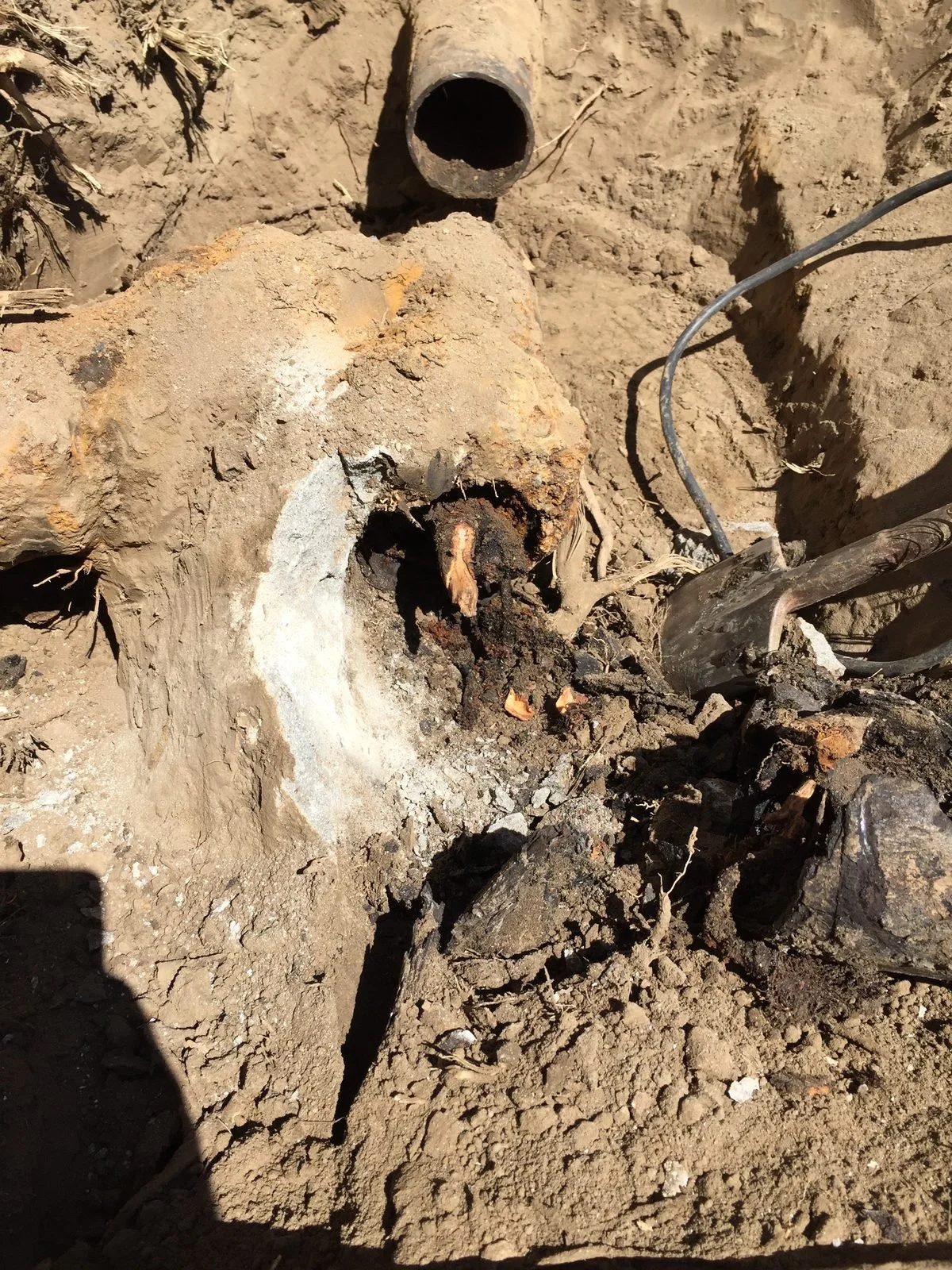
- Tree-root intrusion: Roots seek water and nutrients, and a sewer line is full of both. They work into the tiny gaps at pipe joints, then thicken and spread inside, catching waste and eventually cracking the pipe. This is the leading cause in older neighborhoods with mature trees.
- Pipe belly or sag: If the ground beneath a section settles, the pipe dips below its intended grade and forms a low spot that holds standing water and waste instead of draining through.
- Corrosion in old cast iron: Older homes were plumbed with cast iron that rusts and scales from the inside over decades, narrowing the pipe and eventually flaking or breaking apart.
- Collapsed clay or Orangeburg pipe: Vitrified clay is brittle and cracks at the joints; Orangeburg (a tar-impregnated fiber pipe used in some mid-century construction) softens and deforms with age until it collapses.
- Grease buildup: Cooking fats poured down the drain congeal on the pipe walls and slowly close off the passage.
- Ground shifting: Soil movement stresses and misaligns the pipe over time.
Several of these often work together. Roots exploit a joint that ground movement has already loosened; grease collects fastest at a belly that is already holding water.
How a Plumber Actually Finds the Problem
You cannot diagnose a buried pipe by guessing, and you should not dig blindly to look. The tool that settles it is a sewer camera inspection: a waterproof camera on a flexible cable is fed into the line through a cleanout, and it sends back live video of the inside of the pipe. That footage shows exactly what is wrong (roots, a crack, a belly holding water, a corroded or collapsed section) and where along the run it sits.
Once the trouble is found, the repair is matched to it. A blockage or root mass may be cleared with a mechanical rooter or hydro-jetting, which uses high-pressure water to scour the pipe walls. A single broken section may call for a spot repair. A line that is failing along its length may be a candidate for trenchless lining, where a new pipe is formed inside the old one without a full-length trench, or for outright replacement. Which approach fits depends entirely on what the camera shows, which is why the inspection comes first.
A Word on Safety
This is not a job to push through on your own past the point of diagnosis. Raw sewage is a biohazard: it carries bacteria and pathogens, and standing sewage indoors is a health risk that needs proper cleanup, not a mop and a bucket. Main-line work also involves buried pipe, cleanouts under pressure, and equipment that can damage the line further if used incorrectly. Spotting the signs early and calling a licensed plumber before a small failure becomes a backup is the safe play. The signs are readable; acting on them promptly is what keeps a manageable repair from turning into a flooded floor.
Frequently Asked Questions
The pattern gives it away. A main-line problem shows up at several fixtures at the same time, and it hits the lowest drains first, so a floor drain, a ground-level tub, or a first-floor shower will back up or gurgle before an upstairs sink does. A single slow sink with every other fixture draining normally is a local clog in that one branch. If you flush a toilet and a nearby low drain bubbles or backs up, the blockage is downstream in the main line rather than in any one fixture.
Which fixture gurgles helps locate the blockage? If only the toilet nearest the washer bubbles, the clog is likely just downstream of that branch, so the fix is close to that fixture. If several fixtures gurgle at once, the blockage sits farther down the main and affects everything above it. There is one twist worth ruling out: a blocked vent stack on the roof can mimic the same gurgle without any main-line clog at all, because the drain cannot pull air the normal way and steals it through the traps instead. Check whether the pattern is isolated or shared before assuming the worst.
Two things dominate. The first is tree roots: they grow toward the moisture inside the line and force their way into the joints, then thicken until they crack the pipe and snag passing waste. The second is the age of the pipe material itself. Older homes were often plumbed with vitrified clay, cast iron, or Orangeburg, and all three break down over the decades. Clay cracks at its joints, cast iron corrodes and scales from the inside, and Orangeburg softens and collapses. Roots frequently exploit the gaps that an aging pipe has already opened up.
A belly is a section of the line that has sagged below its intended slope, usually because the ground under it settled. Instead of running downhill so waste flows straight through, that dip sits level or low, so water pools there and solids drop out and collect in the standing water. Snaking clears the pile for a while, but the low spot is still low, so waste settles into it again, and the clog returns. The backups keep coming until the sag itself is corrected, because the shape of the pipe, not a one-time blockage, is the real problem.
Yes, and it is the step that removes the guesswork. A camera mounted on a flexible cable is fed into the line and streams live video from inside the pipe, so a plumber sees the exact type of damage, whether that is roots, a crack, a corroded stretch, or a belly holding water. A locating device paired with the camera pinpoints the spot from the surface, including how deep it sits. That means any digging or spot repair is aimed precisely at the fault instead of opening up a long trench to hunt for it.
Yes. Cutting or hydro-jetting roots restores flow, but it only removes the growth that is there now; it does not seal the gap the roots came through. The same joint is still open and still leaking the moisture that drew the roots in the first place, so they regrow into that exact spot, often within a season or two, and the clogs return. A lasting fix has to close the entry point, which means sealing, relining, or replacing the affected section of pipe so roots no longer have a way in.
Book a camera inspection at the first sign of trouble — catch a failing sewer line before it backs up indoors. Ser Plumbing hydro jets lines across the area, from hydrojetting in Long Beach to Norwalk. Call (310) 953-3566.