
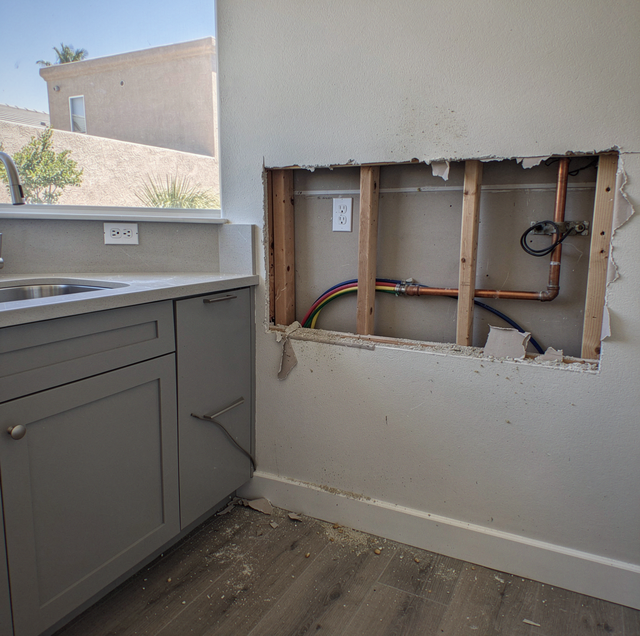
One line on a repipe estimate reads: access holes as required. Four words. They cover cutting into the walls and ceilings of your house, and they say nothing about how many openings, how large, where they land, or what the wall looks like on the day the crew drives away. The same four words can sit on a sheet that closes and finishes every opening and on a sheet that leaves you a stack of holes and a phone number for somebody else.
That one line is most of the answer to why two honest quotes for the same repipe read nothing alike. The pipe itself is fixed. A repipe replaces the pressurized lines feeding your fixtures, and both bidders know it. Everything around that core is a boundary each of them drew, and a line item is where a boundary either gets written down or gets left for you to find out about later.
Quick Answer: Two repipe quotes usually differ because they describe different work, not because one bidder is greedy. Read them as two lists rather than two numbers, and the lines one sheet leaves silent are what separates them.
Eight line items account for most of it. Read as two numbers, the sheets are baffling. Read as two lists of work, they explain themselves quickly.
Where the Pipe Itself Gets Named
Material and grade: repipe in copper, or repipe in PEX, names a family rather than a product. Copper is sold in more than one wall thickness, and the designation belongs on the page. PEX is made through multiple cross-linking processes, and the types differ in flexibility and the fittings they accept. A quote that names the manufacturer, the type, and the tubing sizes tells you what is going into your walls. One naming only the family has left itself room to decide later.
Fitting system: how the pipe is joined. Cold expansion, copper crimp rings, stainless clamps, press connections, soldered joints on copper. What the method settles, from your side, is how many connections finish up sealed inside finished construction, and that count belongs on the page beside the type. Two sheets can both say "PEX" and refer to different hardware in the wall.
Which Valves and Connections Ride Along
Valves: a new angle stop at every fixture, the main shutoff, laundry valves, hose bib valves, isolation valves at the water heater. A sheet reading new stops as required commits to nothing you can check when the crew drives away. A sheet naming how many, and whether they are quarter-turn, commits to something. A sheet that quietly leaves the old stops in has made a decision you should have been told about.
Fixture supply connections: between each new stop and the faucet, toilet, or valve above it sits a short flexible connector. Replacing them is a line item, and reusing them is a line item as well, whether or not anyone writes it down. A reused connector is the oldest component in a system that is otherwise brand new, and a sheet that says "reconnect" has not told you what it means.
Wall Access and Patching, the Line Two Sheets Most Often Draw Differently
This is the item that two bidders are most likely to describe differently, and it is most often missing from the shorter sheet. In slab-foundation housing, the new system is routed overhead, and how much of your house that route has to open varies a great deal house to house. A single story with a walkable attic above every wet wall needs few openings. Add a second story, stacked bathrooms, a ceiling with nothing above it, or cabinets and tile where a drop comes down, and the count climbs. That count belongs to your house rather than to the trade, which is why two honest sheets can hold two different versions of it.
Patching is also a sequence, and every bidder stops somewhere in it. At one end, the crew cuts the access it needs and leaves the openings open; the rest is yours to arrange. At the other end, the wall is closed, finished, and painted before anybody leaves. Between those two ends sit the steps a sheet can quietly stop at, each of them a line item on somebody's estimate: drywall fitted into the opening, seams taped and sanded, texture matched, paint. None of them is wrong to leave out. All of them are wrong to leave unnamed, because whatever the sheet does not reach becomes yours on the day the crew packs up.
On every sheet, find the sentence describing wall openings and read where it stops. Opened, closed, finished, and painted are four different jobs, and only one of them is written on the page in front of you.
So the line to read is not "patching". It is the point the sentence stops at and the one named as carrying each step past it. The rest of the access question sits around the opening: dust containment, floor protection, and who moves the furniture.
Read the words paint by others carefully. They can sit on a sheet that also promises full restoration, and what they hand you is a painter to find, a color to match, and a schedule you were not planning on.
Permit, Inspection, and the Test Before the Walls Close
Permit and inspection: whether your job needs a permit is a call your local building department makes, and repiping commonly falls inside what a department permits. Where one applies, somebody pulls it, and whether that somebody is the contractor or you changes who schedules the inspection, who meets the inspector, and who holds the record afterward. A quote that includes the permit and names who pulls it describes a different sequence from one that says nothing, and the silence is the thing to notice.
Testing and the record: new joints get proved while they can still be seen. The system is brought up to pressure and held while all connections are still in view before a single wall closes. What you keep afterward is the other half: photographs of the routed lines before they disappeared, a sketch of where the trunk and drops run, the tubing make and size, and the permit signed off at the end rather than only opened at the start.
Warranty Is Two Promises Wearing One Word
The manufacturer's material warranty covers the tubing and fittings, generally on the condition that the system was installed to the maker's instructions and sometimes that it was registered. The contractor's workmanship warranty covers the joints that the crew made and the labor to get back to one. They run for different lengths, and only one of them survives a contractor closing its doors. Ask which a sheet is offering, whether it is in writing, and whether it transfers to a buyer.
One Job, Two Sheets
Identical work can produce two documents that look nothing alike, because a sheet is a description and descriptions can be short. Read the middle two columns as the same job written twice.
| The work | How the short sheet writes it | How the long sheet writes it | What the short version leaves you holding |
|---|---|---|---|
| The pipe | Repipe home in PEX | Maker, type, and tubing sizes by fixture group | Whether both bids quote the same product |
| The joints | Fittings included | Fitting system named, concealed joints located | How many sit behind a finished wall |
| Wall openings | Access holes as required | Openings closed to a named step, and by whom | Which step the sheet stops on |
| Warranty | Warranty included | Material and workmanship named separately, in writing | Who owes you what, and for how long |
| Debris | (nothing on the page) | Old pipe and cut drywall left in the truck | Who gets the pile in the driveway |
| Exclusions | (nothing on the page) | A written list of what sits outside the scope | Whether silence means included or forgotten |
| Changes | Right to adjust reserved | Hidden conditions defined, work pauses for written authorization | Who decides, and when you hear about it |
| Validity | (nothing on the page) | An expiry date, and what the expiry covers | Whether you hold an offer or a conversation |
The Exclusions That Make a Scope List Shorter
An exclusion is not a trick. It is a boundary, written down. The trouble is that a boundary you did not read still becomes your job the day the crew packs up.
Patching: a sheet closing at framing and a sheet closing at texture describe different finishing days.
Valves and stops: new stops everywhere, or new stops only where an old one failed while the crew was there. Both are real approaches, and only one leaves you a fully new system.
Water heater connections: whether fresh connectors, the isolation valves above the heater, and a refitted or renewed expansion tank are included should be on the page, along with whether the heater is drained and shifted for access.
Haul-away: old pipe, cut drywall and packaging make a real pile. Whether it leaves in the truck or waits in your side yard is a line, and regularly is not one.
Change-order language: good wording names what counts as a hidden condition, says work stops until you authorize the change in writing, and says who signs. Wording that only reserves the right to adjust the number later leaves you with nothing to hold.
Why Two Sheets Draw the Boundary in Different Places
Some companies write the scope to end at the open wall and say so plainly, leaving the closing to whoever you choose. Others carry the closing inside their own sheet and run it as part of the sequence. Neither is behaving badly, and neither is automatically the more complete quote. One is telling you exactly where its work stops. The other is telling you it intends to hand the wall back finished. Both are readable once you know which one you are holding, and each has a version that suits a particular house and a particular week.
What cannot be read is a sheet that does neither, ends on a phrase like access as required, and leaves the boundary for the last day of the job to settle.
The same logic covers part of the difference between a small local shop and a large multi-crew operation. Standardized scope sheets are how a rotating crew stays consistent, while a smaller shop is likelier to write the scope to your house. Neither is automatically more complete, and both get read line by line.
How Long a Written Quote Holds
Most written quotes state their own expiry somewhere on the sheet. If yours does not, ask for one in writing before you compare anything, because a quote with no end date is a conversation rather than an offer.
Several things legitimately change a quote afterward, and none is a bait and switch. Material availability moves, and a repipe draws on a long list of tubing and fittings. Scope changes when you add a fixture or a hose bib. Hidden conditions appear once walls are open, which is what the change-order language exists for. And a quote from a walk-through months ago describes a house that may have changed since then.
What to Do With the Two Sheets
Put them side by side and read them as lists rather than as numbers. Take the longer one, go down it line by line, and for every item on it find the match on the shorter one. Some will be there in different words. Some will be there as an exclusion. Some will not be there at all, and those are the ones to circle.
Then hand the shorter sheet back to whoever wrote it, name the circled lines, and ask for each one to be added, in or out, in writing either way. Most bidders will do it, because putting down what they already intended asks nothing of them. Give both sides the same list and the same deadline to answer it, and compare the sheets that come back rather than the ones you started with.
Frequently Asked Questions
Often because the two bidders gathered different information. One counted every fixture and opened the attic hatch to see where the drops would come down; the other counted bathrooms from the doorway. Shops also count fixtures differently, so a tub and shower valve, a laundry pair, or an ice maker line can appear as one item, two, or none.
Ask two follow-up questions. Whether the expiry covers the whole sheet or only the material lines, since some bidders hold labor firm and let materials float. And whether signing holds a place on the schedule, because a countersigned quote and a booked start window are separate commitments. If the walk-through was a while back, ask for a re-walk.
Yes, and plenty of people do. Tell the crew before they start, because the way the openings are cut changes when somebody else closes them. Cuts squared to the studs and run the full bay width give a patch framing to screw into on both edges, which ragged holes do not. Ask them to save the cut-out pieces. Ask, too, when the inspection falls, since nothing closes until that has happened, and the crew will tell you the date.
Ask about the parts around the heater that a piping sheet can pass straight over. The temperature and pressure relief line has to discharge somewhere legitimate, and if it is disturbed for access, whether it goes back correctly belongs on the page. So does the drain pan and where it terminates. So do the seismic straps, which come off and go back on. And if there is a thermal expansion tank, its air charge is set to match the incoming supply pressure, so a tank moved and reinstalled without that check is a part that is present and not working.
It can, and the reasons are structural rather than suspicious. An unfinished garage wall lets a trunk run exposed, so a whole leg of the route needs no opening at all. Wet walls, grouped back-to-back, let two rooms share one drop. A crawl space under the floor places the route below you rather than above your ceilings, which changes both where the openings land and how many there are. A real answer sounds like a description of your house rather than a discount on somebody else's.
It matters most at sale. Permitted work leaves a record attached to the property, and a buyer's inspector who sees new piping with no record will ask about it. Ask who meets the inspector and what you receive at the end, since a permit opened is not a permit signed off. If the permit is pulled in your name rather than the contractor's, you are the one the building department deals with, which means you schedule the visit, and you keep the paperwork.
Get both quotes onto the same list before you compare them — a licensed plumber will walk your house and name every line, including the patching, the valves and the permit. Ser Plumbing repipes homes across the area, from repiping in Norwalk to Long Beach. Call (310) 953-3566.
