
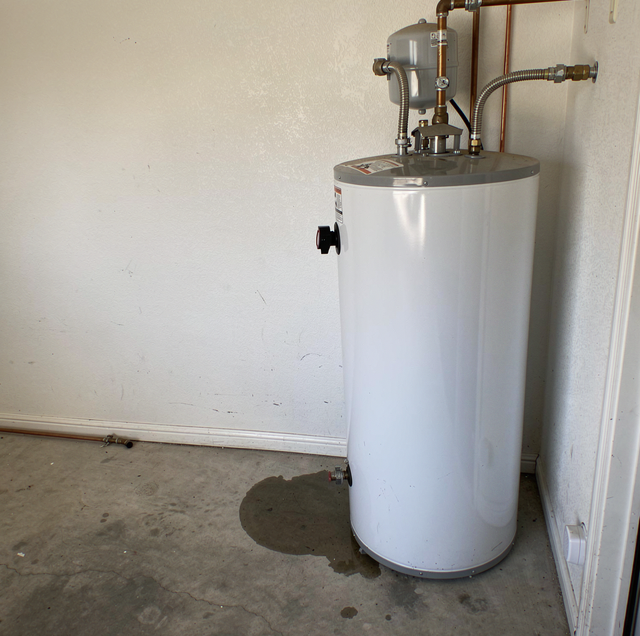
Twice during a repipe, somebody puts hands on your water heater.
The first comes early, when the unit is isolated, so the house can keep running hot water off the old pipe while the new lines go in around it. The second comes at the changeover, when those old connections come off for good, and the heater is tied into a system that did not exist the week before.
Between those two moments, most owners are asked nothing. The estimate covers piping, fixtures, wall openings, and a pressure test. The walk-through talks about which day the water goes off. The heater stands there through all of it, gets handled twice, and afterward looks exactly as it looked before, which is most of the reason nobody asks what happened to it.
Something did. Two connections were broken and remade, small parts were replaced or put back, and a question about the tank itself was either raised that day or never raised at all.
Quick Answer: A repipe breaks and remakes the two connections at your water heater. The connectors and the shutoff above the tank get replaced rather than reused, and the tank itself is a separate decision nobody makes for you.
What Happens at the Heater While the House Is Repiped
New piping is built alongside the system it replaces, run and held under pressure while the old pipe keeps feeding the house. Your heater spends that stretch on the old system, doing its usual work, which is why hot water is available through most of the project.
The changeover ends that. The water goes down and the two connections that matter come apart: the cold line arriving at the top of the tank, and the hot line leaving it. Both land on threaded fittings, and both are made up with a short flexible connector rather than rigid pipe pulled tight into the tank, so the heater can be worked on later without anybody cutting anything. Just above it, in the cold line, sits the isolation valve that stops water entering the heater without shutting the house down.
Those two connectors and that valve are what the supply work remakes, and they are not everything standing at that unit. The temperature and pressure relief line has to go back discharging where it discharged before. The drain pan and the line leading out of it are in the same position, and so are the seismic straps, which come off whenever the unit is moved. A thermal expansion tank, where one is fitted, shares that same short run of pipe. None of those four carry supply water to a fixture, which is exactly why they slip off a scope sheet. Ask which your estimate names.
Then the system is refilled, air works its way out at the hot taps, and the house runs on pipe that did not exist a few days earlier.
What a Flexible Connector Is, and Why It Comes Off for Good
A flexible water heater connector is not a piece of pipe. It is a short assembly: a corrugated or braided tube with a union nut swaged onto each end and a soft washer seated inside each nut. That washer is the part actually holding water back. It was compressed into the shape of one particular fitting on the day the heater went in and has been squeezed there ever since, so it seals that joint and no other. Break the union, and it does not go back to what it was. Tightened down again, it either weeps or gets crushed past where it was meant to sit, and neither announces itself while the plumber is still standing there.
The tube between the nuts has its own history. On a corrugated connector, the wall is thinnest in the valleys, which is where mineral settles and where every bend has been carried since installation day. On a braided one, the wear happens under the braid, out of sight by design. Either way, it was formed once, into whatever shape the space allowed, and has held that shape without moving. Straightening it to get a wrench onto the union, then bending it back, asks it to do the one thing it has not done in years.
Then there are the threads at the tank. A union made up once and left alone comes apart carrying whatever sealant and whatever mineral has grown into it, so remaking it onto the old connector produces a joint where nothing is new except the disturbance. What follows is rarely dramatic. It weeps at the union, at floor level, in a garage or a closet nobody opens daily, until somebody happens to find it.
The isolation valve above the cold inlet goes with them, for a reason of its own: it is the one part of this group whose entire purpose is to move, and the first thing anybody servicing that heater reaches for.
Ask early whether your heater is being moved for access. A unit that has to come out makes a different day than one the crew works around, and it changes when the tank question is worth raising.
Deciding Whether the Tank Goes at the Same Time
The connections get remade either way. The question is whether they are remade around the tank you already have, or around one you would otherwise have installed on some later morning.
Some heaters make this easy. If the unit predates the pipe being taken out, if it has already had a repair or two, if rust is weeping at a fitting or staining down the side, it is going to be replaced by somebody eventually and the only open question is which day. Settling it at the changeover means one water-off at that unit, one set of connections, one morning with the space cleared and a plumber already standing there.
A heater that came with the house, whose age nobody can name, is not yet in that group. It is the one to have looked at before the changeover date is set, because that look determines which paragraph it belongs in.
Most heaters are not in that position, and the honest answer for them is short. A sound water heater does not need to be replaced just because the pipe around it is being replaced. Nothing about new supply lines shortens or improves a tank's life. New connectors, a new valve, and the same unit carrying on is a complete outcome rather than a missed opportunity. If nobody can name a reason beyond the walls being open, there is no reason.
One case sits between them. Where a heater has to be drained and walked out so the crew can reach the wall behind it, everything at that unit is disturbed rather than only the two connections, and that is the day to ask whether the tank was already marginal.
| What is true of your heater | What that says about the same visit |
|---|---|
| It went in before the pipe now being removed | Strong case. The connections are open today |
| Nobody knows its age, because it came with the house | Have it looked at before the changeover date is set |
| It has to be drained and moved to reach a wall | Strong case if the unit was marginal. It is disturbed anyway |
| The household runs it out of hot water as it stands | A sizing question, and one for whoever quotes the unit rather than the pipe |
| It works, it is not old, and nobody has raised it | No case. New pipe is not a reason to replace it |
Whether the Tank Gets Drained Decides the Rest
Most changeovers do not drain the heater. Both connections sit at the top of the unit, so it can be isolated at the cold inlet and left standing full while work goes on around it. Draining becomes necessary when the tank has to be moved to reach a wall behind it, since a full one is far too heavy to walk across a floor, and it is a choice when somebody decides the unit is due for attention while the water is already off.
That one distinction decides the rest. Mineral coming out of the water settles to the bottom of a tank and lies there as a layer, and where the water is hard there is a great deal of it. A tank left standing full barely disturbs it. A tank drained and refilled disturbs it twice: draining pulls water out in a direction it does not normally travel, and refilling pushes it back in at speed, down the dip tube and across the bottom, which is exactly where the settled mineral lies. What lifts has one way out, the hot outlet, with piping installed a few hours earlier on the other side of it. That is why the first hot draws after a drained changeover can run cloudy or carry grit, and why aerator screens are worth a look before anyone signs off.
Where the unit is being emptied anyway, a flush is a reasonable use of that hour, and the argument for it is timing rather than maintenance. Flushing on a yearly cycle is its own subject with its own schedule. What matters on changeover day is the limit. A flush takes out loose sediment. It does not remove scale bonded hard to the bottom of a tank, hand back capacity that scale has already taken, or repair a broken dip tube, a spent anode, or a tank corroding through from the inside. And where sediment has hardened for a very long time, opening the drain connection can result in one that will not close again, which is why the decision to open it belongs to the licensed plumber at the unit.
A drained tank must be confirmed full before anything is brought back up to temperature, and water drawn off one is at storage temperature and will scald. That sequence belongs to the licensed plumber at the unit.
What New Pipe Will Not Do for the Tank
The limit is worth stating flatly, because a repipe is occasionally sold as though it reaches inside the appliance. New supply lines change the path water takes to and from the heater. They change nothing on the other side of the tank wall. Not the lining. Not the anode. Not the dip tube. Not what heats the water. Not the temperature and pressure relief valve, which is a safety device rather than a length of supply pipe. Not the capacity of a unit already too small for the number of showers taken in one hour of the morning.
So a household that ran out of hot water before the project runs out of hot water after it, and a tank leaking from the body leaks when the last wall closes. If a bidder ties new piping to better hot water, ask which part they mean. One version of that claim is about how long you stand at a tap waiting, a routing matter with its own answer; every other version is about the tank, which is kept or replaced on its own condition.
One Morning Holds Two Separate Questions
Everything at that heater comes down to two decisions that happen to fall on the same morning, and they are not the same kind of decision.
The first is barely a decision. The connections come apart because the pipe behind them is being replaced, and what goes back on is new because remaking a used union is not a saving. Nobody has to raise it. A crew that does it any other way has left the oldest components in the house sitting at the hottest point of the newest system.
The second has to be said out loud, because nothing in the job forces it. The tank either belongs in that visit or it does not, and for most households the honest answer is that it does not. But that answer is only worth anything if somebody actually asked. A heater kept because it is sound and a heater kept because the subject never came up are two different outcomes, and from where you stand the week afterward they look exactly alike.
So put the question on the table while the connections are still on the sheet. It is a short conversation, and easier over a drawing than with a crew already at the tank.
Frequently Asked Questions
The connections do not. There is still a cold line arriving and a hot line leaving, still made up so the unit can be serviced later without anybody cutting pipe, and they still come apart at the changeover. What drops out is the tank half of this article: nothing to drain, nothing settled at the bottom, no question about capacity at the same visit. What gets added is whatever isolation the unit carries at its own connections, worth confirming on the sheet rather than assuming.
Usually not, and the absence is normal rather than an oversight. Closing the cold inlet stops water entering the tank, which is all isolation requires, since whatever is already inside leaves through an open hot tap. Where a valve sits on the hot side, it is usually there because someone added it after the fact, and it gets the same treatment as everything else at that unit.
Cold water is back first, as soon as the refill is finished. Hot water lags well behind, because the tank fills first and then has to bring that fresh cold water up to temperature, starting from the coldest condition it ever sees. Plan the first shower well after the water is technically back on, and expect the second one that evening to be ordinary again.
They can, and sometimes they have to be, usually when a replacement unit is on order. Ask that the tie-in on the repipe day be made with new connectors and a new isolation valve, so the later visit is a swap of the appliance rather than a second rebuild of the plumbing above it.
Where the work is permitted, the inspection looks at the new piping, and the connections at the heater fall within that scope when written into the permit. Replacing the unit is normally its own item with its own sign-off. Your building department decides which applies, so ask early which permits the project carries.
No, and the old length is not evidence of the right one. A connector needs enough slack to reach both fittings without pulling on either, and enough room to make a gentle curve rather than a kink, which sometimes means a longer one than came off. Too much slack is its own problem, since a connector left looping against a wall rubs wherever it touches. Worth a look when the water comes back on: both ends should meet the tank without tension, and neither should carry the weight of the other.
Ask what happens at your water heater before the changeover date is set — a licensed plumber can walk you through the connections and say plainly whether the tank belongs in the same visit. Ser Plumbing repipes homes across the area, from repiping in Compton to Downey. Call (310) 953-3566.
