
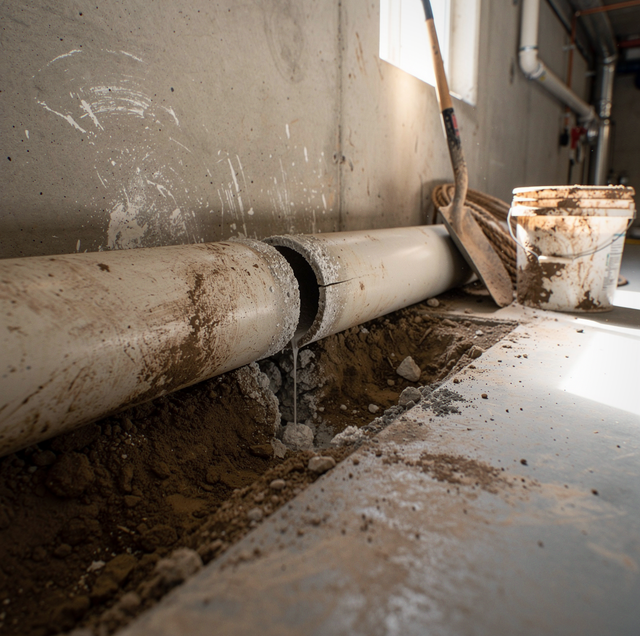
A sewer line with roots in it did not lose a contest of strength. Roots are opportunists underground, and the opening one used was already there before the tree ever found it. That order changes what a repair is actually aimed at: the root is the consequence, and the opening is the fault.
Roots Follow Moisture, Not a Weak Pipe
Underground, in dry soil, water is scarce, and any steady source draws roots toward it fast. A sewer line running full of wastewater is exactly that kind of source. But a root does not force its way through a solid, sealed length of pipe to reach it. It cannot generate that kind of force. What it does instead is follow the water vapor already escaping through a joint or a crack that exists whether or not a tree happens to be nearby: a hairline gap at a pipe connection, a spot where an old seal has given out, a break from ground movement. That drifting vapor is what a fine root hair senses and grows toward.
Put plainly, a sound, sealed sewer line is not something roots invade. The defect comes first, and the root only finds it. Which defect, and where along the run it sits, depends almost entirely on what the pipe is made of and how it was put together.
Where Older Clay and Cast Iron Pipe Already Has Openings
Laterals built from vitrified clay are assembled from short sections joined hub-and-spigot style, with each connection packed by hand rather than fused into one continuous wall. That packing, not the clay, is the weak point, and there is one at every section break.
Oakum and mortar joints: Packing that ages and shrinks at a different rate than the clay around it, so the seal dries out, contracts, or washes away and a gap opens at that joint. Because clay is cast in short lengths, a single lateral carries a whole row of these, not one.
Corroded wall in cast iron: A second failure path with no joint involved at all. Scale and rust build up inward over the years until a thinned spot finally corrodes through the wall, opening a hole in the middle of an otherwise intact section.
Cast iron carries hub-and-spigot connections too, so an older metal lateral runs both failure paths at once: the seams where sections meet, and whatever the interior corrosion has eaten through since. Either way, clay or cast iron, the opening is there before any root reaches it.
Where Newer Plastic Pipe Develops the Same Kind of Gap
Pipe installed more recently does not get a pass on this. ABS and PVC sections are joined with solvent cement that softens both surfaces and fuses them into one continuous wall, but only if the surfaces are properly prepared and the cement is applied all the way around the collar evenly. A joint that was under-primed, rushed, or knocked out of alignment during backfill can leave a seam that never fully welded, or one that draws apart slightly as the surrounding soil settles. A fitting nudged off-square opens a hairline gap that then behaves exactly like an aged mortar joint once moisture starts moving through it.
Two other places on a plastic line deserve the same attention. A saddle or a wye cut into an existing run to pick up a later addition is a field-made connection rather than a factory fitting, so it is only as good as how squarely it was cut and how evenly it was cemented. And the transition where new plastic meets an older clay or cast iron stub near the house is usually made with a rubber coupling and clamps: a mechanical seal that can loosen over time, rather than a welded one that cannot.
Orangeburg pipe, a bituminized wood-fiber material, fails a different way again, and its joints are not where it gives out. The wall itself deforms under the sustained weight of the soil above it, and a spot that deforms far enough eventually cracks. Whatever the material, the pattern holds. An opening has to exist first.
What a Root Does Once It Reaches the Opening
A fine root hair reaching a gap does not need much room to use it. It follows the escaping vapor through the opening, and once past it finds standing moisture and organic material, a far richer place to be than the soil outside. What happens next happens at the opening itself, not out in the middle of the pipe.
The hair thickens where it sits, which is inside the gap. A root that enters as a filament, the width of a thread, starts putting on wood in a space that cannot give way, so the growth loads the edges of the joint or crack outward. In a mortared clay joint, that pressure works against packing that was already dry and crumbling, so the gap widens along the path of least resistance. In a solvent-cemented seam, it pries at a bond that either holds or lets go rather than yielding gradually. In a corroded hole in cast iron, it pushes on an edge that is already thin and flaking, so the opening enlarges irregularly rather than along a clean line.
A widened joint rarely closes back up on its own once a root has grown in it, even after the growth inside the pipe is removed. The root gets removed. The enlarged opening does not.
How the Opening's Condition Sets What Happens Next
Two lines can hold the same amount of root and still be in very different trouble. The mat inside the pipe is what a household notices, since paper snags on it and grease congeals against it until an ordinary week's use starts backing things up. But the mat is the consequence. What the opening looks like once the growth is cleared out determines what comes next.
A hairline crack, or a joint that has lost only some of its packing, sits in a pipe that is otherwise holding its shape and its grade. The pipe is sound; one seal is not. An opening that widens until the two pipe ends no longer sit square to each other is a different condition, because the offset itself now catches waste on every pass, whether or not anything is growing through it. And an opening in a wall that has corroded or deformed is not really an opening in a sound pipe at all, since the material around it is going the same way.
That distinction is also why two cleared lines come back on different schedules. Growth resumes fastest where the entry is widest, and the moisture escaping through it is steadiest, so an established, wet gap repopulates sooner than a tight one that has only just begun to weep. The interval is set by the condition of the opening, not by how thoroughly the last clearing went.
What Clearing Restores, and What Only a Repair Fixes
A cutting head or a jetter strips out the mass and restores flow through that section, which is real work and often the right first move. It is not a repair because it leaves the opening the root came through exactly as it was, and an opening left open is one the next root will use.
A clearing that used a cutting head or a jetter but no camera run has dealt with the mass and not the opening. Ask for the footage and the footage mark; that number is what any later repair gets aimed at.
What closing it takes is decided by the condition described above, not by how much root came out. One sound joint in a square, well-graded pipe is a different job from a run whose wall has been giving way for decades, and only the second puts replacing the section on the table.
Frequently Asked Questions
No, and the more useful question is what opens the joint in the first place. Expansive soil does much of that work: clay-heavy ground that swells when it is wet and shrinks when it dries moves a buried line at its joints on a seasonal cycle, with no root involved at all. That is why the same joint can keep reopening after it has been sealed once, and why a line running under ground that is watered on one side and left dry on the other tends to give way at a predictable point rather than at random.
Foaming products, as a category, coat the roots exposed inside the pipe and can slow the rate at which growth returns for a while. They do not reach or seal the joint or crack the root grew through. There is a second limit worth knowing, too: a foam only touches what it can contact along the inside of the pipe wall, so the part of the same root still sitting out in the soil is untouched and keeps feeding growth back toward the entry. The mass inside gets managed. The plant on the other side of the wall does not.
How aggressively a given tree's roots chase moisture depends more on the individual planting, the soil, and the site than on species alone, so no tree can be called safe or risky by name. Two things matter more than the label on the trunk. One is proximity, since a root system generally reaches well past the spread of the branches overhead, which puts trees that look clear of the line comfortably inside range of it. The other is that a tree already taken down is not necessarily out of the picture, because a stump left in the ground can keep a live root system going for a time, and roots that are already inside a pipe do not withdraw when the trunk comes off.
A cutting head can leave a rough, fibrous scar at the cut edge rather than a smooth wall, and that texture snags new paper and grease faster than an undisturbed stretch of pipe would. Clearing of any kind, cutting or jetting, works on the mass rather than the entry point, so the interval between clogs is set by how fast growth resumes at the opening. That is why the interval tends to hold steady rather than lengthen, however many times the line is cleared.
No. A cleanout near the foundation is the usual entry for a camera and cutting equipment, but it is not the only one. A pulled toilet gives access below the closet flange, and a roof vent gives a downward run when no cleanout exists, or the one on the property has been buried. Which access gets used changes what can be seen: a run started at the roof passes the stack before it ever reaches the lateral, so it covers different pipe than a run started at grade.
A trenchless liner cures in place as a continuous, jointless sleeve inside the existing pipe, eliminating the very seams a root would otherwise use. What a liner cannot do is correct a belly or a section that has lost its round shape, since it takes the form of the pipe it cures inside, and that is the distinction that decides lining against pipe bursting.
Loop in a licensed plumber to pinpoint the exact entry point — before another clearing turns into another callback. Ser Plumbing hydro jets lines across the area, from hydrojetting in Downey to Lakewood. Call (310) 953-3566.
