
What a Sewer Camera Inspection Reveals Inside the Pipe
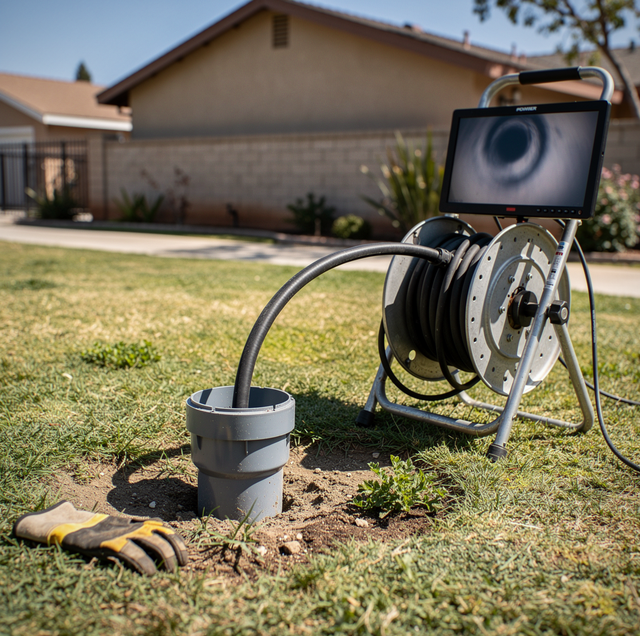
Quick Answer: A sewer camera inspection sends a waterproof camera on a flexible cable down the drain line so a plumber can watch the inside of the pipe on a monitor in real time. It reveals root intrusion, cracks and collapses, low spots that hold water, separated joints, grease and scale, the pipe's material, and where the line meets the city main, and a locator marks the exact depth and position of any fault it finds.
For most of plumbing history, diagnosing a buried sewer line meant guessing. A plumber read the symptoms above ground and confirmed the theory only after digging. A sewer camera inspection removes the guesswork by putting an eye inside the pipe, so the person deciding what to do next is looking at the actual defect instead of inferring it from a slow drain. Understanding the tool first makes the findings make sense, so start with how the equipment works before what it shows.
How the Camera and Locator Work Together
The camera itself is a small waterproof head, roughly the size of a large marble, ringed with LED lights so it can see in a pitch-black pipe full of water and waste. It is mounted on the end of a long, semi-rigid push cable, sometimes called a rod, that is stiff enough to be fed forward around bends but flexible enough to follow the pipe's curves. The cable spools off a reel, and the plumber pushes it in through an access point, usually a cleanout, a pulled toilet, or a roof vent, then feeds it down the line foot by foot.
What the head sees travels back up the cable to a monitor, where the plumber watches a live picture of the pipe wall scrolling past. Most reels track the footage paid out, so a defect can be logged as "about 42 feet from the cleanout," and most systems record the run so the video can be reviewed afterward.
The second half of the system is what makes the picture worth acting on. The camera head contains a small transmitter, called a sonde, that broadcasts a signal at a set frequency. Above ground, the plumber sweeps a handheld locator over the yard until it picks up the strongest signal, which marks the spot directly over the head. The locator reads both the horizontal position and the depth, so a crushed section 42 feet down the line can be pinned to an exact patch of lawn and a dig depth before a single shovel moves. Finding the flaw and finding where it sits underground are two different jobs, and the camera plus the locator handle both.
What the Camera Actually Reveals
Once the head is moving down a clean, water-cleared line, the inside of the pipe tells a detailed story. A trained eye reads several distinct problems, and each one looks different on the monitor.
Root Intrusion: Tree and shrub roots chase the moisture and nutrients inside a sewer, and they enter through the smallest opening, a hairline crack or a slightly loose joint. On camera, they show up as fine white or tan tendrils, sometimes a thin veil and sometimes a dense mat that fills the bore like a net. Roots are one of the most common findings in older neighborhoods with mature trees, and the camera shows not just that they are present but exactly where they are getting in.
Cracks, Fractures, and Collapse: The camera distinguishes a dirty pipe from a broken one. A longitudinal crack runs along the length of the pipe, a circumferential one wraps around it, and a full collapse shows as a section where the round bore has caved into a jagged, partly blocked opening or has lost its shape entirely. Seeing the difference between a surface stain and a structural fracture is the whole point of looking.
Bellies and Sags: A belly is a low spot where the pipe has lost its downhill slope and dipped, usually because the soil beneath it settled or was never compacted properly. Waste water pools in that dip instead of flowing through, so on camera a belly appears as a stretch where standing water covers the bottom of the pipe and does not drain away. Solids settle in that standing water and cause repeat clogs, which is why a sag is a structural finding, not a cleaning problem.
Offset and Separated Joints: Where two sections of pipe meet, ground movement can shift them out of line. An offset joint shows as a ledge where one pipe edge sits higher than the next, catching passing waste. A separated joint shows as a visible gap between two sections, which is both a snag point and an open door for roots and soil.
Grease, Scale, and Buildup: The camera also reads the softer problems. Congealed grease coats the pipe wall in a pale, waxy layer that narrows the opening. In cast iron and galvanized lines, mineral scale and corrosion build a rough, rusty crust, called tuberculation, that both restricts flow and snags debris. These findings often explain a line that clogs faster than its age alone would suggest.
Pipe Material and Age: The footage identifies what the line is made of, which tells the plumber how it is likely to fail and how much life it has left. Clay pipe reads as segmented tile joined every few feet, prone to root intrusion at every joint. Cast iron shows the rough, corroded interior of an aging metal line. Orangeburg, a tar-impregnated wood-fiber pipe used mid-century, appears as a dark line that deforms into an oval and blisters inward as it deteriorates, a material near the end of its service life wherever it is still in the ground.
The Connection to the City Main: Pushed far enough, the camera reaches the point where the private lateral meets the public sewer main. That connection matters because responsibility for the pipe usually changes there, and a problem on the homeowner's side of the line is a different job from one at the tap. Seeing the connection also confirms the line is continuous to the street.
Foreign Objects: Now and then the head finds something that simply does not belong: a lodged toy, a wad of flushed wipes, a chunk of construction debris left in the line, even a section of an old snake tip broken off years earlier. A foreign object is a fixable blockage rather than a structural failure, and identifying it saves an unnecessary repair.
Why It Separates a Simple Clog From a Structural Defect
The reason this matters is that two very different problems produce the same symptom at the sink. A wad of grease and a collapsed pipe both back up the house, but one is cleared with a cable in twenty minutes, and the other needs the ground opened. Without a camera, a plumber can only clear the blockage and hope, and if the real trouble is a sag or a fracture, the clog returns on a schedule.
Watching the inside of the line settles the question. If the camera shows a clean pipe with a plug of debris, it is a clog. If it shows a broken bore, a standing-water belly, or roots regrowing through a joint, clearing the surface will not hold, and the fix is structural. A camera turns a repeated guess into a single answer, which is the difference between paying to snake the same line four times and repairing it once.
When to Get One
An inspection earns its place in a handful of situations. Recurring backups that return within days or weeks of being cleared are the clearest signal, because a fast-returning clog almost always means something structural is catching waste every time it passes. Slow drainage across the whole house, rather than at one fixture, points at the shared main line and is worth looking at directly.
A sewer line is invisible and rarely covered by a standard home inspection, so a camera run before closing is one of the few ways to know whether the buried pipe is sound or a hidden liability. An older house with mature trees, or one with any history of drain trouble, is exactly where that look pays off.
The Limits of a Camera Inspection
A camera is a diagnostic tool, not a repair, and it has real boundaries. The line usually has to be cleared, and the water drained first, because a head submerged in murky, flowing waste sees very little. Heavy grease, mud, or a line running full can blind the camera until it is cleaned, which is why an inspection often follows a drain cleaning rather than replacing it.
The head can also only go where the cable can push it. A hard offset, a full collapse, or a tight double bend can stop the camera short, though that stopping point is itself useful information about where the trouble sits. And a camera reads only the inside surface. It cannot see a crack that has not yet opened through the wall or judge the soil condition around the pipe. It shows what is there to be seen, clearly and in place, which is far more than guessing, but it is one input a plumber weighs, not a verdict on its own.
A final word on safety: this is work for a professional, not a homeowner project. A cleanout can vent sewer gas, the access points are awkward, and reading the footage takes a trained eye to tell a stain from a fracture. Scoping the line and acting on what it finds are both pro tasks.
Frequently Asked Questions
The camera reads any pipe material, but what it looks for differs by type. In old clay tile, it hunts for offset joints and root intrusion at every seam, since roots exploit the mortared gaps. In cast iron, it looks for scale buildup and channeling along the bottom where the metal has rusted thin. In Orangeburg, a tar-and-fiber pipe used for a stretch of the mid-century era, it often finds blistering and an oval, collapsing bore. PVC and ABS are smooth and usually fail at a bad joint or a belly rather than in the pipe wall. Knowing the material tells the plumber which failure to expect before the head even reaches it.
A typical push-camera reel carries enough cable to run well past 100 feet, which reaches the city connection on most residential laterals. The practical limit is not the cable length but the pipe: a hard offset, a tight double bend, or a full collapse can physically stop the head, and where it stops becomes a clue to where the fault sits.
Yes, through the locator, not the camera picture. The sonde in the head transmits a signal that a handheld locator reads above ground, and that locator reports depth as well as horizontal position. A fault can be marked as, for example, five feet down at a specific point in the yard, which sets the dig before excavation starts.
No. The camera is a diagnostic tool with no cutting or clearing ability of its own, so the blockage has to be cleared separately, usually with a cable machine or a hydro-jetter, before or after the scope. The inspection tells the plumber which tool the problem actually needs rather than removing anything itself.
No, and this is a common mix-up. A sewer camera works in a gravity drain line that is open to air, not a pressurized supply pipe carrying clean water under pressure. Feeding a push camera into a live supply line is not how those leaks are found. Pressure testing and acoustic or thermal leak detection are the tools for a supply-side leak.
It can be, in two cases. Before buying a home, a scan checks a buried, costly pipe that a standard inspection skips, catching a failing clay or Orangeburg line before it becomes the new owner's problem. And on an older house with large trees, a periodic look catches early root intrusion while it is still a light veil, before it grows into a mat that blocks the line.
Book a camera inspection before a small backup becomes a dug-up yard — see exactly what your sewer line is doing underground. Ser Plumbing replaces cast iron sewer lines across the area, from cast iron sewer replacement in Downey to Lakewood. Call (310) 953-3566.
