
What Causes Sewage to Back Up Into the House — and What to Do
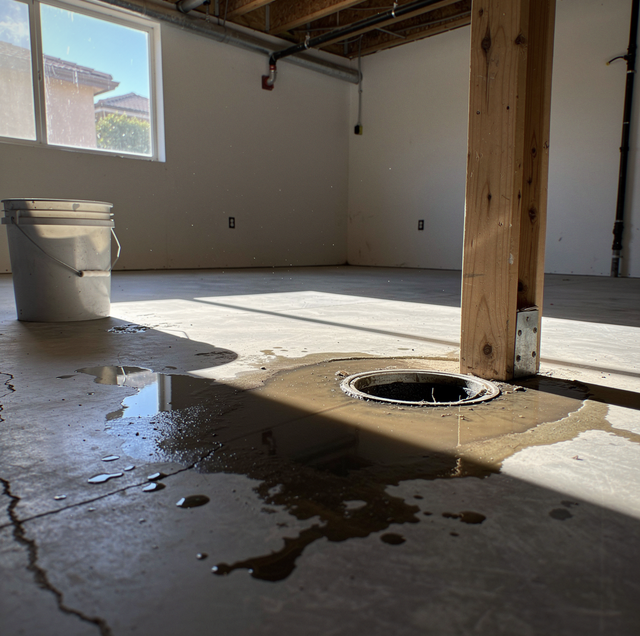
Wastewater that comes back up through a drain instead of going down is a different kind of problem depending on how much pipe sits behind it. Behind a single slow sink, there is one branch line and a limited amount of water. Behind a floor drain filling on its own, there is every fixture in the house.
That is why the same symptom, water moving in the wrong direction, can mean routine drain cleaning or an emergency. Sorting the two takes about a minute and no tools at all.
A One-Minute Count Before You Call
Walk through the house and check every drain. If one sink holds dirty water while everything else runs normally, the restriction is in that fixture's own trap or branch, and no other fixture shares that pipe. If two or more fixtures back up together, or a floor drain fills when nobody is using it, the restriction sits below the point where those branches meet and on the lowest level of the house, which points to the main line serving all of it. That count is the triage, and it is worth doing before anything else.
Note which fixtures backed up, which still drain normally, and how high the water came. Those three details narrow the search before anyone arrives, and they are the fastest thing to hand a plumber over the phone.
What a Full Branch Does and What a Full Main Does
A blocked branch fills, backs up into the one or two fixtures it serves, and stops. The volume is limited to what that branch holds plus whatever is running into it. Shut that fixture off, and the situation is stable.
A blocked main has no such ceiling. It collects everything from every fixture, every floor, and every branch, and holds it all until something opens. That is why a main line backup escalates while a fixture clog just sits there, and why it is the one that puts wastewater on finished flooring rather than in a bowl. The failure is not worse because the blockage is bigger. It is worse because the pipe behind it serves the entire house.
Everything the house sends down has to surface at the lowest opening below the blockage, usually a ground-floor shower pan or a floor drain sitting almost level with the slab. Three things follow, in order. First, stop using water anywhere in the house: no sinks, showers, toilets, dishwasher or laundry, because every use adds volume to a line with nowhere to put it. Second, keep people and pets out of the affected rooms and off wet flooring, since untreated wastewater poses a contamination hazard, and contact with it and standing water should be avoided rather than managed. Third, call a licensed plumber and describe what you counted. If water has reached outlets, appliances, or the burner compartment or control panel of a water heater, stay out of that area entirely and say so on the phone.
Cleanup waits until the line is clear because a still-blocked line will fill the same space again.
The Cleanout and What It Tells a Plumber
Somewhere on the property there is a cleanout, a capped fitting giving direct access to the building drain or the lateral. It is usually a threaded or push-on cap on a short vertical pipe, outside near the foundation or along the run toward the street, sometimes recessed in a box at grade.
A cleanout cap can be holding a standing column of wastewater backed up behind it, and loosening one releases that head at ground level all at once. Opening a cleanout is not a homeowner step.
The cleanout matters for what it settles. When a plumber opens it under controlled conditions, the state of the line at that access point answers the question the fixture count only narrowed. A cleanout standing full says the restriction is downstream of it, out toward the street. One that is dry or draining freely while fixtures inside are still backed up says the opposite, that the problem sits between the house and that point. Either answer determines where the work happens next, and it does so before anyone moves equipment or opens ground.
What Actually Fills a Main Line
A main line rarely blocks due to a single event. It narrows over time and then fails on a day when demand exceeds what the narrowed pipe can pass. Five causes account for most of it.
Root mass: Roots that have found their way into the line grow into a fibrous mat that catches everything passing through it, and they are the most common cause of a recurring main line blockage on older properties with mature trees near the sewer run.
Grease and solids: Cooking fats poured down a kitchen drain cool and cling to the pipe wall, and paper and solids catch on that coating. The restriction builds inward until the remaining channel is too small for a normal day's flow.
A collapsed or bellied section: Pipe that has cracked, deformed, or sagged out of its original grade holds standing water instead of draining, and solids settle in that low spot and stay. Soil movement, ground settling, and heavy loads over a shallow line all produce it.
A foreign object: Wipes marketed as flushable, hygiene products, and paper towels do not break apart the way toilet tissue does. One lodges at a joint or a bend, and everything after it accumulates against it.
A public-side surcharge: When the public system is running at capacity, sometimes during sustained heavy rain, flow can push back toward connected properties. In that case, the house line is clear, and the pressure comes from the other direction.
Pipe material sits underneath most of this. Older cast iron corrodes from the inside, and the rough, scaled interior it develops gives waste something to catch on where smooth pipe would pass it. Clay pipe was laid in short sections, so it has many joints, and joints are where roots find their way in.
How a Plumber Finds the Cause
On an active backup, the sequence is flow first, diagnosis second. Restoring flow stops the house from filling and buys the time to answer why it happened, which is a different question from where it is stuck.
Once the line passes water again, a camera inspection run through the cleanout shows the actual condition of the pipe and separates a maintenance problem from a structural one. A line that is sound but fouled is a cleaning problem and stays clear with periodic service. A line with root intrusion at open joints, a crushed section, or a belly holding water is a repair-or-replacement problem, and clearing it only resets the clock. Sewer line repair and replacement are separate services for that reason, and a backup that keeps returning after being cleared is usually treated as the second category, even though it is the first.
Because a main line backup does not wait for business hours, this is standard emergency plumbing work. In the meantime, the short list above holds: stop the water, keep everyone clear of it, and make the call.
Frequently Asked Questions
Not usually. It means the laundry line is the only fixture that loads the drain hard enough to expose a restriction further down. A washer does not drain by gravity; its pump discharges the whole tub in a short, forceful burst, so a partial blockage that a slowly emptying bathroom sink slips past will not pass that surge. Where the water appears tells you the rest. If the laundry standpipe itself overflows during the pump-out, the restriction sits in that branch. If a fixture in a different room backs up instead, it sits downstream of both.
Yes, and the discriminator is timing rather than location. A public-side surcharge arrives while the public system is under sustained heavy demand and eases as that demand falls, so the backup can settle on its own without anyone touching the line. A blockage on the property behaves the opposite way: it gets worse with every gallon the household sends down and does not improve until the line is opened. A camera run settles which one you have, because a full cleanout with sound and a clear pipe behind it rules out the house line.
No, and the reason is worth knowing before you plunge harder. A plunger acts on the fixture's own trap and the short run of pipe immediately behind it, using the water already in the bowl as the medium. A main line restriction sits far past that, below the point where multiple branches merge, so the pressure never reaches it and the only thing that moves is water sloshing between fixtures. Drain chemicals fare worse because they remain diluted in standing water and never reach the obstruction.
That pattern points at a partial restriction rather than a complete one. Overnight, when no water is being drawn anywhere in the house, a narrowed line has time to drain down on its own, so by morning everything looks normal. Then the first shower of the day sends through more volume than the narrowed channel can pass, and it fails again. An intermittent backup on a daily cycle is not a solved problem; it is an unsolved one that resets itself, and it usually means the pipe is being cleared without the cause being addressed.
It matters a great deal. Upper-floor fixtures backing up while the ground floor drains normally is the reverse of the usual pattern and points away from the main. The suspect there is the vertical stack carrying the upper-floor branches down to the building drain, or the vent portion of it above the roof, which can be blocked by debris or a nest. A stack or vent problem shows up as slow drainage and trap noise on the upper floors specifically, while the lower level behaves.
Not automatically, and that is why the camera goes in first. Hydrojetting scours the full circumference of the pipe wall with high-pressure water rather than punching a channel through the middle of a blockage, which is what makes it effective on grease coatings and root mats. But the pipe has to be sound enough to take it. A line with badly corroded cast iron, open or offset joints, or an existing crack is evaluated on camera before jetting is considered, because the condition of the pipe decides whether cleaning it or replacing it is the correct answer.
Sewage coming up through a floor drain is an emergency call rather than a wait-until-morning problem — a licensed plumber can restore flow and identify what filled the line. Ser Plumbing serves Paramount, Bellflower, and Lakewood. Call (310) 953-3566.
