
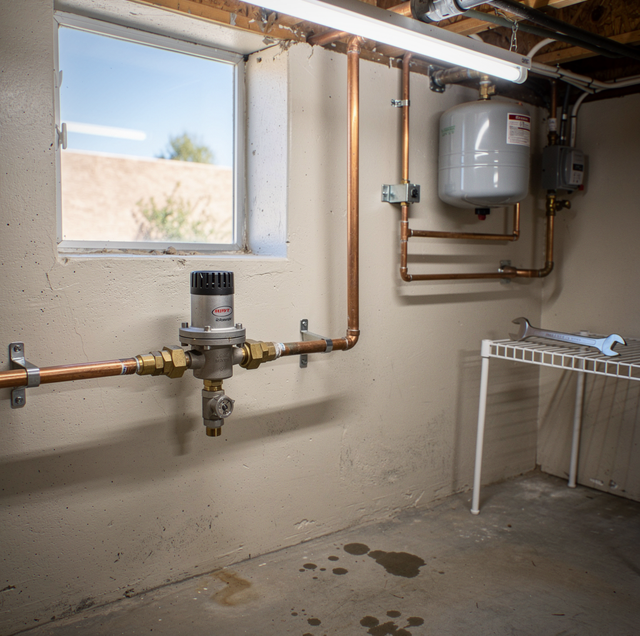
Most of the plumbing in a house is passive. Pipe holds water. Valves hold position. Nothing inside any of it moves unless somebody makes it move.
One component is not like that. Somewhere on the line where water enters the property sits a part that works every second of every day, adjusting against a supply that never holds still, and wearing while it does it. That part is the pressure regulator, and what it produces is the one number every fixture in the house lives at: the shower valve, the toilet fill valve, the washer's inlet, the joint behind the hallway drywall.
Almost nobody has that number. Reading it takes a gauge, a hose bib, and about a minute. And the reason to do it during a repipe is not that the water happens to be off. It is that the regulator sits at the one point in the system a repipe does not necessarily touch. Everything downstream of it is about to be new, while the part setting the conditions all that new pipe will live inside is the part most likely to be left exactly as it was.
Quick Answer: A pressure regulator steps down the incoming supply to a working level for the house. It is a wear part with a moving diaphragm and a spring; it fails quietly, and a repipe is the moment to measure it and decide.
What the Regulator Is Doing All Day
Water arrives at your property at whatever the utility system delivers to that spot, a figure set for the convenience of the system rather than of your house. It has to reach the far end of a zone and the top floor of the tallest building on it, so household plumbing is not built to run at that.
A pressure regulator, also called a pressure-reducing valve, sits just inside that boundary and delivers a lower, steadier pressure to everything behind it. Inside a typical one is a spring pushing one way, a flexible diaphragm sensing the house side, and a seat the diaphragm opens and closes against. When the house side rises toward the setting, the diaphragm pushes back on the spring, and the seat closes down. Open a tap, and the spring opens it again.
It does that constantly, at every toilet refill and every overnight move in the street figure. Which is the part most homeowners have never been told: a regulator is not a fitting. A fitting sits still and holds water. This one has a spring under load, a membrane that flexes, and a seat closing against another surface, and parts that move wear.
Why the Supply Side Was Never a Fixed Number
Ask what the street sends and the honest answer is a range rather than a value.
Where you sit on the system: a utility has to reach the highest and farthest customers in a zone, so customers lower down or nearer a pump receive more than they need. Two houses a mile apart on the same system are not handed the same figure.
The time of day: pressure in a distribution system rises as demand falls. Late at night, with the irrigation off and the neighborhood asleep, the figure climbs, often reaching its highest point while everyone in the house is asleep.
What the utility is doing: zones are rebalanced, pumps are replaced, a main is replaced, and a development is added at the end of a line. None of it is announced, and none of it shows at your fixtures.
So the supply side is a moving input, and the regulator stands between it and your plumbing. A house without a working one takes whatever the system is doing.
What Wears, and Which Way the Setting Moves
Three things inside the part do the work, and all three are consumable. The diaphragm is a flexible membrane that moves whenever the pressure behind it changes, and flexible materials, when cycled in hot and cold water, stiffen, then split or perforate. A hardened one stops reacting quickly; a torn one stops controlling at all. The spring sets the balance point the diaphragm works against, and a relaxed spring holds the house lower than it was left, which shows up as weak water everywhere rather than as damage. The seat is the one place inside the part where water is deliberately restricted, which makes it where minerals collect first. In hard water, scale builds up there, and a seat carrying deposits cannot close cleanly; grit released by work on a main can lodge in the same spot and hold it open.
That last one is the failure that matters because it is the only one that pushes in the wrong direction. A seat held open passes the street straight through to the house, and it gives nothing away at a tap, because high pressure feels like strong pressure. Nothing gives way that afternoon. The parts that will give way have simply started living harder than they were built to, and they report it one at a time over the years that follow, usually as something else's fault.
The other thing a worn regulator does is hunt. Rather than holding steady, it oscillates: opening, overshooting, closing down, sagging. That reaches you as a shower that wanders while nobody has touched a handle, or a faucet that pulses at the aerator. It is the one behavior on this page a household actually notices, and it is almost always blamed on the fixture.
None of this is a defect. It is a mechanical assembly doing mechanical work in mineral-bearing water, which is what a wear part is.
Do not turn the adjustment screw on top of a regulator. It changes what every fixture in the house runs at, and setting one properly means watching a gauge under load rather than guessing at a quarter turn.
What Sustained High Pressure Does, Part by Part
The mistake is to picture a burst. High pressure accelerates what would have happened anyway, reaching the weakest components first.
Flexible connectors and supply lines: the braided lines under sinks and behind machines are the softest thing in the system, and the parts that let go while nobody is home.
Fixture cartridges and seals: every faucet cartridge, toilet fill valve, and shower valve holds water back by pressing something soft against something hard. The harder the water pushes, the sooner the soft part gives up, which is how a house develops a habit of dripping faucets and running toilets.
Appliance inlet valves: a washer or dishwasher shuts a small electric valve against whatever the house supplies. High pressure shortens that valve's life and makes the shock of closing it harder to hear in the walls.
Joints: every connection holds by a mechanism engineered to a rating. A joint sitting above where it belongs fails not on the first day but after years of cycling, inside a wall.
The water heater: heated water expands and has to go somewhere. Where the regulator includes a check feature, and many do, the house becomes a closed system, so expansion pushes on the tank, the relief valve, and the piping instead of back toward the street. A thermal expansion tank is what answers that, and whether yours has one still holding its charge belongs on the same walkthrough.
What Shows Up in the House, and How It Gets Confirmed
Almost nothing in the left column looks like a regulator problem, which is this difficulty in one picture.
| What shows up in the house | What it suggests | How it gets confirmed |
|---|---|---|
| Faucets and toilets dripping again soon after a repair | Fixture seals holding back more than they were built to | A reading on the house side against one ahead of the regulator |
| A bang when a washer or dishwasher shuts its valve | Water stopping abruptly against a supply pushing harder than it should | A reading taken while the appliance cycles, under load |
| A shower that surges and sags with nobody touching a handle | A regulator hunting rather than holding steady | Readings watched over a period, not a single number |
| Water dripping from the discharge line at the water heater | Thermal expansion with nowhere to go, common with a check feature | A reading across a heating cycle, plus a look at the expansion tank |
| Ordinary water at midday, noticeably hard at night | The street rising as demand falls, with nothing trimming the peak | A reading left in place across a full day and night |
| Connectors or appliance hoses that have failed more than once | The house living above what those parts prefer | A reading at the point of entry, since a failed part gets blamed on itself |
A New System Behind an Old Regulator
A repipe replaces the piping and, done properly, every joint and fixture connection with it. What it does not change is the conditions those parts live in. Leave a worn regulator where it is and the new system inherits the old one's setting, its drift, and its habit of handing the house to the street in the middle of the night.
New work also removes the evidence. Fresh pipe and fittings are quieter and tighter than what came out, so the weeping stop is gone and the faucet that dripped at night has been replaced. The system stops complaining, and the thing it was complaining about has not changed. A run of early nuisance failures then reads as poor workmanship.
Which is the whole of the practical argument, and it is not an elaborate one. A regulator lives in the short stretch of pipe between where water enters and where the house plumbing begins, the same stretch a repipe reworks and where the main shutoff and the angle stops sit. On that one morning the water is down, those connections are apart, and somebody qualified is standing at them. On any other morning, all three of those have to be arranged from nothing. Ask whether the regulator is named on the scope sheet or only assumed, since silence usually means the existing one stays.
Ask for the reading itself, not a verdict. A figure, where it was taken, whether the house was running at the time, and the date, gives you something to compare against the next time the plumbing behaves oddly.
The One Thing This Page Cannot Tell You
No version of this page can say whether your regulator needs replacing, because that is not something an argument settles. It is a reading, taken at your address, and it is not one reading either.
A reading with nothing running reflects where the system sits. A reading with a fixture open says whether the part holds that setting under load. A reading left across a day and a night says whether the figure is steady or climbing while the neighborhood sleeps. A reading taken ahead of the part says whether the regulator is doing anything at all. Whether a given figure is acceptable is judged against a working range a licensed plumber applies, and which rules govern that at your address is a question for your building department rather than for a page like this one.
When it happens is the walkthrough, before the scope is written, while the answer can still change the scope instead of becoming a change order later.
Both outcomes are worth having. If the readings hold steady under load, the regulator stays, and you finish the conversation holding a figure your house has never had on paper. If they run high, wander, or fall away the moment a tap opens, it goes in with the pipe instead of becoming a visit of its own later on.
Which of those your house gets, this page has no way to know. Somebody has to come and read it.
Frequently Asked Questions
No. One is fitted where the supply arriving at a property exceeds what household plumbing should, so whether you have one depends on what your part of the system delivers rather than on the age of the house. If you do, it is usually a bell-shaped brass body in the first stretch of pipe after the water enters: near the main shutoff, in a front yard box, on a garage wall, or in the meter box.
Yes, and mechanically it is the same short run of pipe either way. The part goes in after the point of entry and ahead of everything it protects, which means a cut into that stretch and enough clearance left around it to reach the part later. What decides whether it belongs there is the reading rather than its absence. Plenty of houses have never had one and have never needed one. The reason anyone measures before a scope is written is the other kind: the house that never had one and turns out to be taking the street unfiltered.
Yes, and that is the failure people actually call about, because it is the one you can feel. A clogged seat, a blocked strainer, or a collapsed diaphragm can hold the whole house down, arriving as weak water everywhere, hot and cold, appearing gradually rather than overnight. Anything affecting a single tap is not the regulator. Pressure and flow are also different measurements, so pipe size will not answer this one.
They change where a reading means anything. Where a sprinkler branch leaves the line ahead of the regulator, that side can sit at street pressure while the house does not, so a figure taken at a hose connection there is not your house's figure. Treatment equipment sits downstream and adds losses of its own. Expect a plumber to ask which fittings sit on which side of what before trusting any reading.
Some models accept a repair kit with a new diaphragm, spring, and seat, and where the body is sound, and the model is still supported, that is a legitimate option on a house nobody is otherwise working on. Two things decide against it here: the brass body scales and corrodes from the inside too, and a part that has sat in mineral-bearing water for a long stretch often will not come apart cleanly.
It gets set, then verified, two steps rather than one. The plumber sets the part, then confirms the figure under load, because a setting that looks right with everything closed can behave differently as a tub fills. The setting is then locked so it cannot creep, and a locked setting is worth revisiting the first time the plumbing does something odd.
Have the incoming pressure measured before the repipe scope is written — a licensed plumber can take readings on both sides of the regulator and tell you whether yours stays or goes. Ser Plumbing repipes homes across the area, from repiping in Compton to Bellflower. Call (310) 953-3566.
