
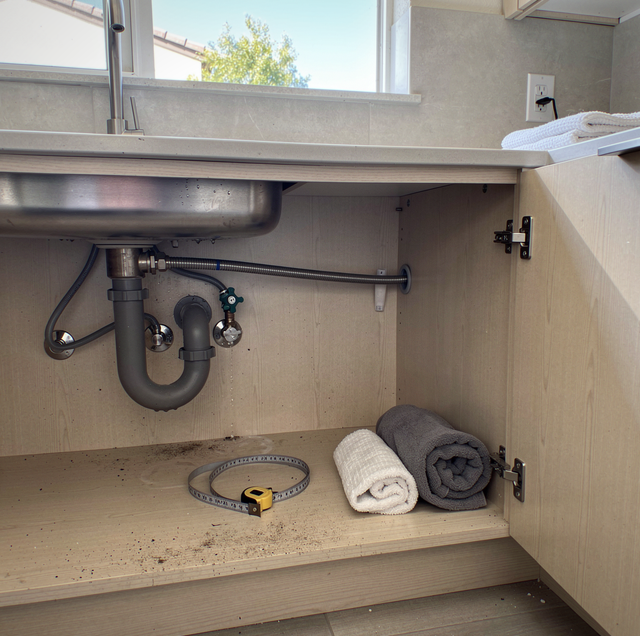
The box gives you three things: a horsepower number, a feed type, and a model name. None of them tells you whether the unit inside fits the space you are putting it in. That gets settled in the cabinet by the vertical space between the sink flange and the trap arm, by which bowl the drain runs, and by whether the old unit was plugged into a receptacle or wired straight into the wall.
Most buyers start with horsepower, because it is the number printed largest and the one a salesperson asks about first. It is also the decision that changes the least about your kitchen. The measurements decide which units are candidates. Horsepower picks among the survivors.
Quick Answer: Horsepower is the last of the five choices, not the first. Cabinet clearance, feed type, which bowl the unit hangs under, and how the old unit was connected electrically all narrow the field before motor size matters.
What Horsepower Changes inside the Grind Chamber
A disposal has no blades. The motor spins a flywheel at the bottom of the grind chamber, and the impellers on it throw food outward against a stationary grind ring. Particles work against that ring until they are small enough to pass through its openings and out the discharge with the water. Horsepower describes how much power the motor can keep delivering to the flywheel while the load resists.
Half and three-quarter horsepower are the two sizes the decision usually comes down to. The difference shows when the load spikes. A dense or stringy load resists the flywheel, motor speed drops, and if it drops far enough, the flywheel stalls and the overload trips. A motor with more output has more margin before that happens.
Manufacturers position the larger motor as the quieter, less jam-prone choice. Treat that as a product claim rather than something you can confirm on a shelf. Larger models are usually built with a larger housing and more sound insulation around the motor, and that construction is what the quiet claim rests on, not the horsepower rating alone. The jam claim rests on the stall margin above, which is real, but a bigger motor is not a unit that cannot jam. What goes down the drain still decides that.
Retailers size these units by household volume: light cooking toward the smaller motor, daily cooking and heavy prep toward the larger one. Useful as a rough sort, but it is a usage guideline rather than a measurement, and it says nothing about your cabinet. The larger housing also holds a larger grind chamber, so it takes more waste per load, which is the other half of what volume-based sizing targets.
The part of the horsepower question with teeth is physical. More motor generally arrives in a bigger housing, and that housing has to share the cabinet with the trap, the shutoffs, and whatever gets stored down there.
Feed Type Decides How the Unit Gets Switched On
Continuous feed is the familiar type. The unit runs as long as its control is on, and food goes into the chamber while the flywheel turns. Batch feed operates on a different logic: it runs only when a stopper is dropped into the sink opening and turned. The stopper completes the control path, so the chamber is closed the entire time the motor is moving. Nothing falls in, and nothing comes back out while it runs.
That closure is the reason to pick batch feed, and also what it asks in convenience. You load the chamber, seat the stopper, run it, lift the stopper, load again. A pile of prep waste results in several cycles instead of a single continuous pour.
The third piece of this decision is the control itself. An air switch places the control on the sink deck rather than the wall.
Three Measurements Decide Which Units Are Even Candidates
The first measurement is the total vertical room: from the cabinet floor to the underside of the sink flange. The unit hangs from that flange, so its full height plus the discharge elbow has to live inside that space with room left to work.
The second matters more, and it is the one people skip. Measure from the underside of the sink flange down to the trap arm, the horizontal length of drain running from the trap toward the wall stub. The disposal's discharge outlet sits on the side of the housing, partway down, and it has to end up above the trap arm inlet, because the line between them has to fall. A taller unit pushes that outlet down. Push it far enough, and the connection would run uphill, and a line running uphill will not carry ground food. It holds it.
Take all three measurements with the old unit still hanging in place. Once the mounting assembly comes out, the flange sits differently and the numbers you wrote down no longer describe the space the new unit has to occupy.
The third is horizontal: from where the discharge outlet will sit across to the wall stub, and front-to-back across the cabinet. The disposal body is offset from the drain centerline, so the discharge alignment must work without a stack of fittings that would drag the connection out of line. A model that fails any one of the three is off the list, regardless of its specifications.
Which Bowl of a Double Sink It Hangs Under
Both bowls of a double sink drain into a shared trap through a wye, and one trap arm carries everything to the wall stub. That geometry, not preference, decides which bowl gets the disposal.
Start with the wye. The bowl whose discharge reaches it with the shortest run and the cleanest fall is the bowl the unit belongs under; the other bowl keeps a basket strainer and tailpiece dropping into the same fitting. Hang the disposal on the far bowl, and the discharge crosses the cabinet, taking up vertical space, because the line still has to run the whole way. That lost fall is what eliminates a taller housing.
Then the dishwasher. A dishwasher drains through the disposal's inlet, and its hose is a fixed length that also requires a high loop before it reaches the disposal. The bowl closest to the dishwasher usually takes the disposal, simply because the hose reaches without crossing the cabinet floor. When the dishwasher sits opposite the shortest drain run, one of the two has to give, and that is worth settling before the unit is bought.
Corded or Hardwired Changes What You Buy
Plenty of disposals ship with no cord at all. The wiring compartment in the base accepts either a cord kit, a three-prong cord whose strain-relief clamps into the knockout in the cover plate so the cord cannot be tugged against the terminals, or a cable from a circuit that terminates at the unit. What you need depends on what is already in your cabinet, not on the model.
If the old unit was plugged in, there is a receptacle in the cabinet and a cord kit is the matching part. If it was hardwired, cable runs into the cabinet, and there may be no receptacle under that sink at all. Two paths from there: wire the new unit the same way, or have a receptacle added so a cord kit can be used. The second is a change to the circuit itself.
Shut off the circuit at the breaker before disconnecting anything under the sink. Adding a receptacle, moving one, or changing the switch that feeds it is an electrician's work, not a plumbing task, no matter how simple the connection looks.
An air switch changes this shopping list too, because its control module has to plug in somewhere, and a cabinet with no receptacle cannot take one until that is addressed. The plumbing side stays what it always was: the mount, the discharge alignment, and the dishwasher connection.
An Apron Sink Compresses the Whole Vertical Stack
A farmhouse or apron sink sits lower and deeper than a drop-in, and its front panel replaces part of the cabinet face. The basin bottom, and with it the sink flange, starts lower than a standard sink's, so everything hanging from that flange starts lower too: mounting assembly, unit body, discharge elbow.
Two things follow. The distance from flange to trap arm shrinks, so a housing that clears easily under a drop-in can put its discharge outlet level with or below the trap arm inlet. And because a deep apron basin usually meant the cabinet was cut and reinforced to support it, that framing takes space away from the cabinet interior.
So an apron sink pushes toward the shorter housing, which frequently means the smaller motor. It is the cleanest example of the cabinet choosing the horsepower rather than the other way around. If the drain height will not work with any unit that fits, the trap arm and the wall stub join the discussion, and that belongs before a purchase.
Take the Decisions in the Order They Bind
Measure first, because the measurements are the only part of this that cannot be negotiated. Sort out the electrical connection second, since a hardwired cabinet with no receptacle changes both what you buy and who touches it. Settle the bowl third, using the wye and the dishwasher. Pick the feed type fourth. Then choose horsepower, out of whatever is left standing.
Done in that order, the horsepower question answers itself, and turns out to be a smaller decision than the box on the shelf implies.
Frequently Asked Questions
Sometimes. The flange, its gasket, the backup ring, and the snap ring belong to one mounting assembly, and assemblies are not universal across models. The common pattern is a three-bolt twist-and-lock mount, and when the replacement uses the same pattern, the existing flange and ring stay in place while the new body twists onto them. A different mount family means the whole assembly comes out, and the flange is reset with a new gasket and sealant.
No. A batch feed unit is switched by its own stopper, so it needs neither a wall switch nor an air switch, and its receptacle can stay unswitched and always live. That is one of the quieter reasons batch feed gets chosen: a tiled backsplash or a window behind the sink can leave nowhere good for a control.
The button needs a hole in the sink deck or countertop. Some sinks arrive with a spare accessory hole that was never used, and that is the easy case. With no existing hole, one has to be made, and making it in stone is a different proposition from making it in stainless. Decide before a stone top goes in, not after.
Usually not. The splash guard is a replaceable rubber baffle. On some models it lifts out of the flange collar on its own; on others it seats into the mounting assembly and comes free only when the unit does. A torn guard lets splash-back and odor escape the chamber, but that is a part swap, not a new unit.
Yes, and the load goes to a specific location. The unit hangs from the sink flange through the mounting assembly, so a heavier housing pulls on the flange and the sink deck rather than resting on the cabinet floor. On a thin stainless sink, the mounting hardware carries all of it, one more reason the largest unit that fits is not automatically the right pick.
Most do, and you should use it. The elbow and its gasket are matched to that model's outlet and bolt pattern, so the elbow from the old unit will often not seal against the new housing. Not in the box: the trap, or the tailpiece and strainer for the second bowl.
Measure the cabinet with a licensed plumber before you buy a unit that cannot fit — you get the horsepower, feed type, and connection matched to the sink you already own. Ser Plumbing hydro jets lines across the area, from hydrojetting in Lakewood to Norwalk. Call (310) 953-3566.
