
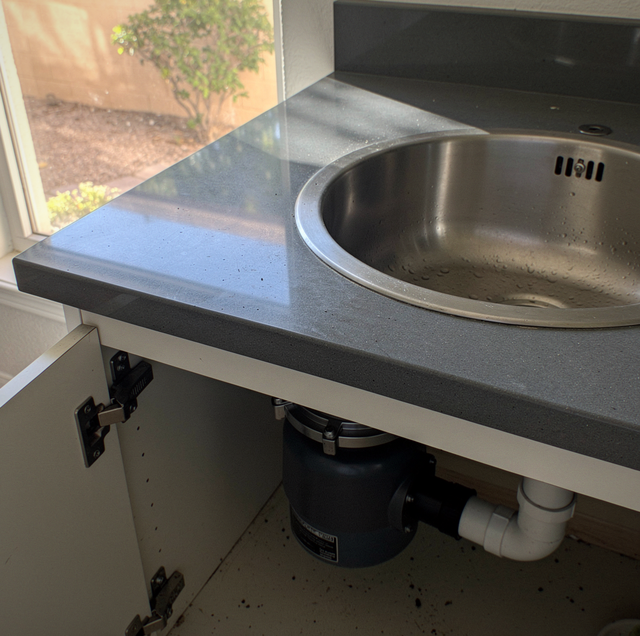
Quick Answer: A disposal swap reuses the flange and mount in place when the new unit matches that mount, and its outlet meets the drain arm. A seized flange or a low outlet means a new flange and a rebuilt drain.
Two kitchens, the same model of disposal going in under each sink. Under the first, the old unit twisted off its mount without a fight; the new one went up on that mount; the discharge met the trap on the first try; and the cabinet closed again. Under the second, the old sink flange would not leave the sink opening. By the time the new unit hung there, a fresh flange was bedded in the sink, the drain arm was re-cut, the trap was rebuilt, and the dishwasher hose sat on a spigot that had to be opened first.
Same appliance. Same box. Two jobs that share almost nothing once the old unit is off the mount.
What follows names the conditions that set the scope of a replacement: what holds the old unit in place, what the sink will tolerate, and what already lives in the cabinet. Scope is assessed on site, because most of it sits behind or above the old unit and cannot be seen until that unit is down. This is written for a swap that has already been decided on. Repairing instead, adding a first disposal to a bare cabinet, and going back to a plain drain are separate questions.
A Matching Three-Bolt Mount Keeps the Sink Flange Where It Is
Continuous-feed disposals hang the same way. A flange drops into the sink opening from above and beds against the sink. Underneath, a gasket, a backup ring, and a mounting ring draw up tight and lock, and the unit twists onto that collar and catches on three tabs. Its weight hangs on that ring, not on the drain plumbing.
When the replacement uses the same mount pattern, the flange and the mounting assembly never move. The old unit twists off, the new unit twists on, and the sink opening is never disturbed. That is the version of this job that stays short.
When the new unit uses a different mount, or when the existing mount is corroded, cracked, or missing hardware, the work moves up into the sink. The mounting ring comes off, the flange lifts out, the opening is scraped to bare material, a new flange is bedded, and the new mount is drawn tight. The sink stops being a surface the work happens under and becomes part of the work.
The model number sits on a label on the body of the old unit, usually facing the back of the cabinet. Reading it before the visit tells a plumber whether the mount pattern on a given replacement will carry over.
Which version it turns out to be is rarely known until the old unit is off.
A Flange Seized into the Sink Opening Has to Be Cut Free
A sink flange is held by two things: the mounting hardware that pulls it down and whatever it was bedded in. Older installs use plumber's putty, which starts soft and stiffens with age into a set ring of filler between metal and metal. Newer installs often use a rubber or fiber gasket, which stays pliable and releases cleanly.
Water finishes the job. In hard-water areas, the film in the seam between the flange and the sink leaves mineral scale, and a steel flange against a steel sink corrodes along that same seam. The two surfaces stop behaving like two surfaces.
Once the mounting hardware is off, a free flange lifts out with hand pressure and a tap from below, and the opening wipes clean. A seized flange does not lift, and pushing harder from underneath only loads the sink. The flange body is then cut so it collapses inward and draws out without loading the sink deck, and the opening is cleaned before anything new is bedded in.
That branch turns a swap into a rebuild of the drain opening, and a chipped or distorted opening, or a flange nobody stocks on the truck, means the opening is made good and the new flange bedded on a return trip.
The Sink's Material Decides How Much Force the Flange Can Take
A seized flange is not the same job in every sink because the sink absorbs whatever force is applied to it. Stainless is thin, and it flexes. Push a stuck flange up hard enough and the deck around the opening dishes upward with it. A new flange has to seat flat to seal, so a distorted deck weeps no matter how carefully the flange is bedded.
Cast iron under porcelain enamel does not flex, but the enamel at the rim of the opening chips. A chipped rim leaves a void under the new flange, and that void is where a slow drip into the cabinet starts.
Composite and fireclay sinks are both rigid and brittle. They tolerate no prying at the opening, and a crack that starts there does not stay small.
So on stainless, a stuck flange comes out under steady, spread pressure. On enamel and composite it gets cut and lifted rather than pried. Same flange, two methods, decided by what the sink material can absorb.
A Drain Arm That Sits High Against the New Outlet Gets Re-Cut
The discharge outlet is fixed at a height on the body of the unit, well below the tailpiece of a plain sink strainer. The trap and the drain arm running into the wall are wherever the previous plumbing left them.
Water leaves through that outlet and has to fall the whole way to the wall. If the new outlet lands above the existing drain arm, the trap takes up the difference and nothing gets cut. If it lands level with the arm or below it, the water has nowhere to fall, the trap sits full, and the sink drains slowly or backs up into the chamber.
A taller body pushes the outlet down toward the cabinet floor. A shorter one lifts it. Height is not the only thing that has to line up. The unit rotates in the mount to swing its outlet toward the wall, and where the mount sits and where the arm enters the wall decide whether the outlet reaches by rotation alone, or whether the run itself has to move.
Correcting it means rebuilding the run rather than reconnecting it. The drain arm is recut, the trap is reset at a new height, or the connection at the wall is opened and remade. Old chrome tubular parts rarely come apart without deforming, so tailpiece, trap, and washers go back as new pieces.
A Taller or Wider Unit Changes What Has to Move First
A replacement is rarely the same size as what came out, and in the cabinet, that shows up as work rather than a specification. Anything mounted to the cabinet wall behind the old unit- an angle stop, a filter head, a reverse osmosis tank- comes off and goes back on around the new body, and relocating a tank or a shutoff is its own piece of work. On a double-bowl sink, the second basin's tailpiece and trap sit across from the new body and often get reset to clear it, and the dishwasher hose is re-routed so nothing pinches it.
Which units fit at all is a buying decision, settled with a tape measure before the box is opened.
A Dishwasher Tie-In Needs the New Inlet Opened First
A disposal arrives with its dishwasher inlet closed. The spigot on the side of the unit is cast with a pre-scored plug sitting in it, and that plug is driven loose from inside the inlet port before the unit goes up, with the freed disc taken out afterward.
Power at the breaker goes off before anything under the sink is loosened, including the mounting ring. Never put a hand inside the grind chamber, even on a unit that is coming out and looks dead.
Left in place, the plug gives the dishwasher nowhere to drain. Knocked loose and left in the chamber, it rattles against the grind ring on the first run.
So the question in a cabinet with a dishwasher is whether the tie-in carries over. If it does, the plug comes out, the hose moves to the new spigot, and the routing stays as it was, whether the hose rises to a fitting on the sink deck or loops up under the counter before it drops. With no dishwasher, the plug stays shut.
Whether a cord feeds the unit into a cabinet outlet or by a cable run straight to the box on its underside decides what the replacement has to arrive with. Where the cabinet has no supply at all, or the one there is damaged, that piece belongs to an electrician rather than a plumber, which is a question of its own.
Frequently Asked Questions
A new unit ships with a full mounting assembly: flange, gaskets, backup ring, mounting ring, and the snap ring that locks the stack into a groove machined around the flange body. When the existing mount is reused, those parts stay in the box. When it is not, the old set comes out with the flange and the new set goes in.
Not the drain connection. The body is supported from below by hand or on a block set on the cabinet floor, while the collar is turned into the mount and the discharge is connected only after the unit is locked. A unit tightened to the trap first ends up hanging partly on the drain line, which pulls the mount out of square and loads a slip joint that was never meant to carry weight.
Not always. The spigot sits at a fixed height on the body, so a taller replacement lowers it and often places it on a different side once the unit has been rotated to meet the drain arm. A hose cut to length at the original install has no slack left in it, and a spliced extension at the disposal end is the joint that leaks first, so the hose gets replaced rather than lengthened.
It gets emptied first. The grind chamber holds standing water below the outlet, and a unit, tipped sideways on its way out, pours that water onto the cabinet floor. It comes down upright and drains into a bucket, and it is heavier than its size suggests, since most of the weight is the cast motor housing.
Not with a running tap. The basin gets plugged, filled, then released all at once while the joint is watched from below. A full basin puts real weight on the seal and drives water sideways into the seam, which a trickle never does. A flange that weeps only under a loaded basin passes a casual check and shows up later.
No, the dishwasher stays where it sits. Only its drain hose moves, disconnected at the disposal's inlet spigot and reconnected at the new one. The clamp is normally replaced because a clamp that has been tight on a hose for years leaves a compression ring pressed into the rubber and will not reseat evenly.
Start with what the old flange, the drain arm, and the cabinet will require — a swap gets scoped under the sink, not read off the box. Ser Plumbing flushes water heaters across the area, from water heater flush in Long Beach to Bellflower. Call (310) 953-3566.
