
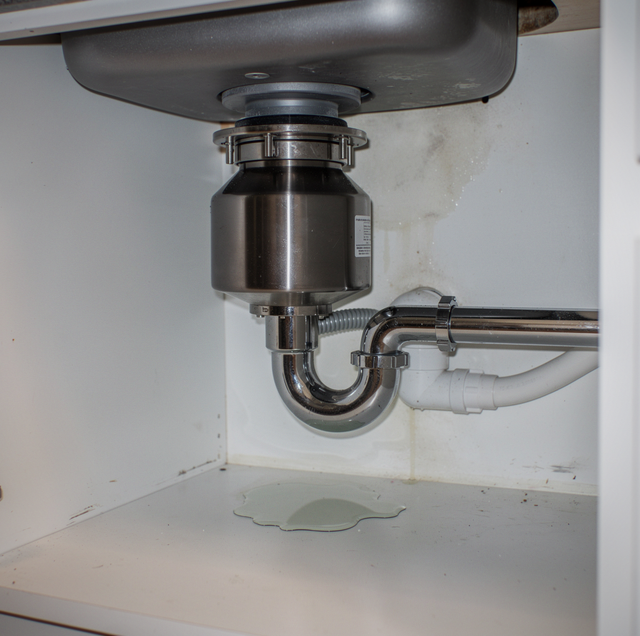
For most garbage disposal installations, you call a plumber. The work that decides whether the unit hangs straight, drains cleanly, and stays dry happens between the sink flange and the drain arm, and all of it is plumbing. An electrician enters the picture in two narrow situations: when the cabinet has no existing connection for the unit, and when a switch has to be added. Everything else belongs to the plumbing trade.
The confusion is fair. A disposal has a motor, plugs into something, and starts with a switch, which makes it read like an appliance, and appliances feel electrical. Look at what an installer actually spends the time on, though. A flange, a mounting ring, a stack of gaskets, a discharge tube, and a trap. Pipe, seal and fastener work from the first minute to the last.
What the Plumbing Side of the Job Covers
Strip the install down, and it comes apart in four pieces, none of which involve wiring.
The sink flange: A disposal does not sit on the cabinet floor, and it does not bolt to the wall. It hangs from the sink. A flange drops into the sink's drain opening on a bed of putty or a gasket, and everything else in the stack exists to pull that flange down tight against the sink deck. That compressed seal is what separates the water in the bowl from the outside of the unit, and it is the first thing set on any install.
The mounting assembly: Under the deck, the mounting hardware draws the whole stack up until the flange seats. The unit itself twists onto that mount and locks in place. Set the screws unevenly, and the flange sits crooked in the opening, which shows up later as a unit that rattles against the sink deck every time it runs.
Discharge alignment: The outlet on the side of the disposal body is fixed in height, though the port itself can be rotated around the body to face the trap. What cannot move is the height, so the tailpiece and trap between them get built to suit. The drain arm coming out of the wall sits wherever the original plumbing put it, and the run joining the two still has to fall toward the wall along its whole length, which is why a trap that came off the old sink rarely goes back on unchanged.
The dishwasher tie-in: Where there is a dishwasher, its drain hose connects to the disposal rather than the drain line, so that connection is part of the same job and is made at the same time.
Four pieces, four plumbing skills. Nothing on that list is an electrician's work, and nothing on it is optional.
Why an Ordinary Replacement Needs No Electrician
A disposal being replaced almost always connects to an existing connection. Many sink cabinets already have an outlet on the back or side wall, put there when the kitchen was built or when the first disposal went in, along with a switch on the wall by the sink. In that kitchen, the connection point does not move, nothing gets added to it, and nothing about it changes. The old unit comes off its mount, and the new one goes on.
What changes is everything on the plumbing side, and that is usually more than people expect from a swap. Where the water is hard, mineral scale welds the old flange into the sink opening and locks the mounting screws, so the hardware rarely comes out clean, and the sink deck needs to be scraped back to bare metal before a new seal will sit flat. Old putty has to come off completely. The trap gets rebuilt to meet the new outlet. The dishwasher hose gets checked at the fitting where it has been flexing for years.
Before a disposal comes off its mount, the power to it goes off at the breaker, and the switch stays off for the whole job. Never test, probe, or pull on wiring under a sink to find out what is connected.
That is the ordinary case. One trade, one visit, no wiring touched.
The Branch Where No Connection Exists Under the Cabinet
Open both cabinet doors and look past the trap at the back wall of the sink base. In a kitchen that never had a disposal, there is often nothing there. No outlet, no cord coming through the cabinet side, no box of any kind. The unit has nothing to land on.
That connection has to be created before anything can be hung, and creating it is electrical work. A plumber does not add outlets or run circuits, and what a given kitchen can carry is something an electrician assesses on-site, with the panel and the existing wiring in front of them. It is a narrow piece of work, but it is not plumbing, and no number of good intentions makes it one.
Cord or no cord: There is a second version of the same question. Some disposals are sold with a power cord already attached and simply plug in. Many arrive with no cord at all, and the connection gets made directly at a box under the cabinet instead. Which of those a kitchen already uses is worth knowing before anyone is booked, because a connection made directly, whether it is being created or changed, is an electrician's work, not a plumber's.
Once a connection exists at the cabinet, the job reverts to the ordinary case, and the entire remainder is plumbing.
The Branch Where a Switch Has to Be Added
A disposal has to be started by something, and in most kitchens that something already exists: a switch on the wall beside the sink, or a button set into the countertop. Where one is already there, nothing is being added, and the trade question never comes up at all.
The branch opens when there is no control anywhere. Some sink cabinets have a live outlet all the time, and there's nothing in the kitchen that turns it on and off. Putting a switch on the wall means opening the wall, and that is electrical work, just like installing an outlet. It belongs to an electrician, and it occurs independently of anything happening under the sink.
Why the Air Switch Stays on the Plumbing Side
An air switch is a button set into a hole in the sink deck or countertop, connected by a thin tube to a control module below. Pressing it displaces a small volume of air down the tube rather than sending any electrical signal through the button or the tube. Mounting and sealing that button is deck work, and the module plugs into the connection already sitting under the cabinet, which is why a kitchen with no wall switch is not automatically a two-trade job.
How to Tell Which Situation You Have Before You Call
Three things settle it, and all three are visible with a flashlight and no tools.
- Is there an outlet in the sink cabinet? Look at the back wall and both side panels, behind the trap and behind whatever is stored under there. You are looking for an outlet, or a cord already coming through the cabinet wall. Look only. Do not test it, do not pull on it, and do not open anything.
- Is there a control? A switch on the wall near the sink, or a button standing proud of the countertop. If a disposal is already installed and running, a control exists by definition, wherever it may be.
- Does a dishwasher drain into that cabinet? If it does, the tie-in is part of the plumbing scope and is worth mentioning when you book.
Yes, to the first two, and the job is end-to-end plumbing. No to either one and an electrician has a short piece of work at the cabinet or the wall before a plumber can finish. Photographing the inside of the cabinet, including the back wall and the trap, along with the wall beside the sink, gives a plumber enough to tell you which of those you are in before anyone is scheduled.
Frequently Asked Questions
A batch-feed unit is started by its own stopper rather than by a control on the wall or counter, so a kitchen with no control at all can take one without adding a switch. Either type is installed by the same trade, and the choice changes the control, not who does the work.
No. Moving an outlet is the same electrical work as adding one, and it stays with the electrician. It comes up more often than people expect, because a disposal's factory cord is short and is not built to be extended, so the connection has to sit within its reach. The disposal cannot move to meet the outlet instead, since it hangs from the sink opening and nowhere else.
That depends on the counter. A hole in a stainless sink deck or a laminate top is sink work and stays with the plumber. Cutting a fresh hole through granite or quartz is a countertop fabricator's job, done with a diamond core bit and water, because a dry bit chips the surface, and the chips do not polish out. Neither version is an electrician's work.
Not the trade, but it changes the hardware. A stainless deck is thin, and the flange that comes in the box is sized for it. A fireclay or cast-iron sink has a much thicker deck, and a standard flange can run out of thread before the mounting stack pulls tight, so an extended flange gets used instead. That is a plumbing part on a plumbing stack, and none of it moves the job toward an electrician.
Two things that are easy to miss. A new disposal arrives with its dishwasher inlet sealed by a molded knockout plug, which is driven out and the loose plug removed from the chamber before the hose goes on. Left in place, the dishwasher will not drain at all. The hose is then routed one of two ways, through an air gap fitting at the sink deck or a high loop under the counter, so sink water cannot run back down it.
The electrician. An empty sink cabinet is easy to work in, and the same cabinet with a disposal body, a trap, and a dishwasher hose crowding it is not. Once the connection and the control are in place and working, the plumbing side is an ordinary install, and nothing has to come back apart later to make room.
Send a photo of what is under your sink before you book anyone — one call sorts out whether your disposal job is plumbing scope or needs an electrician first. Ser Plumbing repairs drain lines across the area, from drain line repair in Downey to Long Beach. Call (310) 953-3566.
