
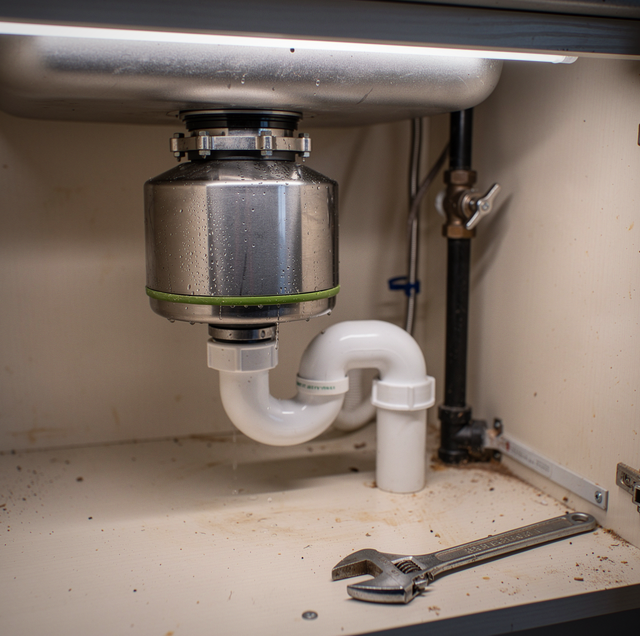
A failing garbage disposal puts three options on the table, not two: repair it, replace it, or remove it and go back to a plain drain with a basket strainer, the way the sink worked before a disposal was ever installed. The usual first question, how old is your disposal, is the wrong one to start with. Age matters only at the margins. What actually decides between the three outcomes is the specific way the unit is failing, and a jam behaves nothing like a burned-out motor even though both can leave you standing over a dead disposal.
That distinction is worth sorting out before you call anyone. A repair that should have been a replacement does not hold. A replacement on a disposal whose only fault was a leaking fitting puts a full swap in place of a reseal that would have held. And some homeowners, once they're staring down a failed unit anyway, decide they'd rather not have a disposal at all. All three are legitimate outcomes. The failure mode tells you which one fits.
| What's Actually Happening | Age of the Unit | What It Usually Means |
|---|---|---|
| Jam or a leaking connection | Under about 5 years | Repair |
| Leak from the housing itself | Any age | Replace |
| Burned-out motor or weekly resets | Any age | Replace |
| No clear fault, just old | Past roughly 8-10 years | Leans replace |
| You don't want a disposal again | Any age | Remove |
Where a Jam or a Loose Fitting Leaves the Motor Untouched
What belongs in this decision is simpler: a jam, once cleared, and a leaking connection, once resealed, both leave the disposal's motor and housing untouched. A connection leak means water is escaping from a fitting the disposal is bolted to, not from the disposal itself, so tightening or resealing that joint fixes the actual source without opening the unit at all. On a disposal under about five years old, both faults point the same direction: the motor, bearings, and housing are still sound, so replacing the whole unit over a jam or a loose fitting swaps a small, fixable problem for one that didn't need fixing.
A Leak From the Disposal's Body Itself Ends the Unit's Service Life
A leak from a connection is a fitting problem. A leak from the disposal's body is not a fitting problem at all: water is escaping through the housing that holds the grind chamber and the motor together, not through a joint a wrench can retighten.
Exactly where on the housing that leak shows up is a separate question; what matters for this decision is what it means once it's confirmed. The housing is a sealed, cast unit, and once it's compromised, there's no gasket or sealant rated to keep water from a running motor from getting inside. Repairing a body leak isn't a smaller version of replacing the disposal. It's not a repair option at all because there's no single part to swap that would leave the rest of the unit intact. A body leak skips repair entirely and goes straight to replacement, regardless of how the disposal was running the day before it started leaking.
When the Motor Is Gone, There Is Nothing Left to Repair
A confirmed burned-out motor is a replacement, not a repair: the windings that drive the disposal's spin have shorted internally, and on a sealed under-sink appliance, there is no way to reach them without swapping the whole unit. A disposal that has to be reset on a predictable weekly schedule is the same failure earlier in its course, and it carries the same verdict.
Age Past Eight to Ten Years Tips a Borderline Case Toward Replacement
Age by itself was never the deciding factor, but it changes what a given fault is likely to mean. A rubber gasket compresses and hardens with every hour it spends wet and every hour it spends dry between uses, and the seals at the mounting ring and the discharge line wear the same way. On a disposal that's five years old, a first jam or a first leaking connection is an isolated event, and the rest of the seals still have working life in them. On a disposal that's crossed roughly the eight-to-ten-year mark, that same jam or leak is showing up on hardware that's been cycling the whole time, and whatever failed first usually isn't the only part close behind it. That's the real reason age tips a borderline case toward replacement: not a countdown on the calendar, but the wear-and-tear on an older unit that a repair has to compete against.
What a Replacement Involves, Once the Verdict Is Replace
Whichever failure mode leads you to replacement, the swap itself follows the same pattern. The mounting location, the drain path, and the electrical connection are usually already in place; the work is removing the old unit, matching the new one to what the kitchen puts on it, and sealing every joint the old unit had. The dishwasher's drain line ties into a knockout plug on the side of the disposal, and that connection gets tested under running water before the job is called finished, not just eyeballed.
Removing the Disposal for a Standard Drain
Not everyone replacing a failed disposal wants another one installed in its place. Converting back to a plain drain removes the disposal entirely and closes the sink opening with a basket strainer instead of a disposal flange, the same fitting used under sinks that never had a disposal to begin with.
A disposal taken out for good leaves a live electrical connection under the cabinet. It gets capped or removed by an electrician rather than left hanging behind the new trap, and the breaker stays off until that is done.
Because a disposal's discharge sits at a different height than a strainer's, the tailpiece running from the strainer down to the trap has to be cut to the right length. Reusing the disposal's old drain arm almost always leaves the joint at the wrong angle or too short to reach. The dishwasher is the part of this job people forget about. Its drain line was tied into a knockout plug cast into the side of the disposal, and once that disposal is gone, that connection is gone with it. The dishwasher drain has to be rerouted to an air gap or a high loop, tied directly into the drain line below the new strainer rather than through an appliance that's no longer there. Skipping that step is how a disconnected dishwasher drain gets discovered only when the dishwasher runs, and the water has nowhere to go.
Frequently Asked Questions
Yes, once its hose has been moved onto the new drain line. What gets missed is how the high loop is held up: a hose only laid against the underside of the counter slides back down over a few months and stops breaking the siphon, so it gets strapped or clipped to the cabinet wall at its high point. An air gap mounted on the sink deck maintains its height and has no equivalent failure.
A blanking cap. Once the disposal is gone, the button has nothing left to start, but the hole it sat in still runs straight through the deck. A stainless or matched-finish cap seats in that same opening on its own gasket, the way an unused sprayer hole gets closed. Left open, it takes sink water down into the cabinet.
Rarely, because it usually was left with the sink when the disposal first went in. Even when the old one is still in a drawer, its rubber gasket has taken a permanent set and won't compress evenly a second time, so a new strainer with a fresh gasket is fitted instead. Its locknut then draws down against the cleaned sink bottom rather than over the putty ring left by the disposal flange.
Mounting rings are fairly standardized, but the discharge tube, the short pipe that carries ground waste out toward the trap, isn't always positioned the same way from one brand to the next. Switching to a different brand than the one that failed usually means reorienting that discharge tube to line back up with the trap arm, where a same-brand replacement often bolts into the existing alignment without adjustment.
Usually yes, though for a different reason than a jam. Grinding happens between the spinning flywheel and a stationary grind ring lined with fixed teeth, and if that ring's teeth have worn smooth, the disposal keeps running normally but stops breaking food down. That is a worn grind ring, and because it sits inside the sealed housing, there is no path to it without replacing the unit. A confirmed worn ring is still a replacement.
Not always. A sound existing mount is usually reusable, and where the replacement uses the same mount pattern, the new unit twists straight onto it. A corroded mount, or a unit sitting on a different mounting system than the replacement uses, gets replaced along with the disposal rather than forced to fit.
Have the failure mode named before anything is ordered — repair, a new unit, or no disposal at all. Ser Plumbing repairs sewer lines across the area, from sewer line repair in Long Beach to Bellflower. Call (310) 953-3566.
