
Quick Answer: A humming disposal and a silent one are different problems. Humming means power is arriving and something is jamming the flywheel. Total silence means power never reaches the motor, or the motor itself has failed.
No hum, no click, no vibration against the sink basin: nothing at all. That absence of sound is itself a clue, and it points somewhere different than the disposal that hums and strains but won't spin. A unit that hums is drawing power; the motor is trying to turn, and something mechanical is stopping it, usually a jam around the flywheel. A disposal that makes no sound at all isn't fighting anything. Either electricity never reaches the motor, or the motor has received the power and has nothing left to give.
Working out which one happened means checking the power path in order, from the wall inward: the switch or air switch at the counter, the reset button on the unit's underside, the cord and the outlet under the cabinet, and finally the motor windings. A break at any single point produces the identical symptom at the sink, so skipping a stage or guessing at the end of the chain usually means redoing the work.
Tracing the Silence Back Through the Power Path
A garbage disposal needs an unbroken circuit to run. Power leaves the breaker, passes through a switch of some kind, travels along a cord to the unit, and energizes the windings that spin the flywheel. Break that circuit anywhere, and the result at the sink is the same: nothing happens.
Turning off a wall switch or air switch does not always cut power to the disposal; some units stay live at the outlet. Shut off power at the breaker before touching the cord, the outlet, or the reset button.
Each stage is harder to rule out than the one before it. The switch or air switch is easiest: press it and see whether anything downstream responds. The reset button is next, since a tripped reset produces the same total silence as a dead switch. The cord and outlet come after that, and the motor windings are the last stop, because nothing about them can be judged until every stage ahead checks out.
When the Air Switch Itself Is the Failure
Most disposals installed with a countertop button rather than a wall switch run on an air switch, and that setup has three separate components. Any one of them can fail while the disposal itself is completely fine.
The button on the counter isn't wired at all. Pressing it pushes a small volume of air down a thin tube that runs from the button, through the countertop, and down to a power module mounted under the sink near the disposal. That module is a pneumatic switch: a puff of air moves a diaphragm inside it, which closes the electrical contacts that complete the circuit to the disposal's cord. The button, the tube, and the module each fail differently.
The button's membrane can wear out or lose its seal with age, so pressing it no longer pushes enough air down the line to register at the module. The tube can kink behind the cabinet wall, split from age, or work loose from the barbed fitting at either end, breaking the air path even though the button and the module are both fine. The module itself can fail if the diaphragm no longer moves, even when a full puff of air reaches it. Three unrelated parts share one job, so an air switch that won't fire doesn't necessarily mean the disposal itself needs attention.
A disposal wired to a standard wall switch skips this stage entirely. If that's the setup and the switch produces nothing, the fault lies in the wall switch or the wiring feeding it, which is the responsibility of a licensed electrician rather than a plumber.
When the Reset Button Will Not Stay In
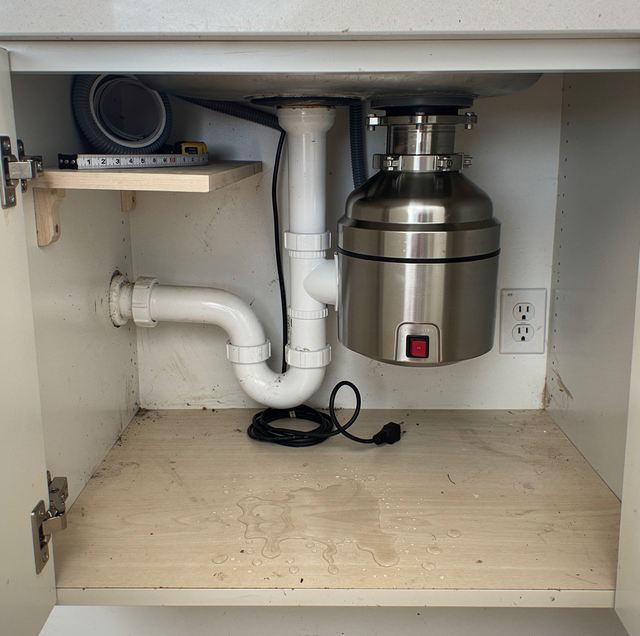
If the switch or air switch checks out and the disposal still gives nothing, the next stop is the reset button on the underside of the unit, the small red button most disposals carry. It isn't a power switch. It's a thermal overload: when the motor draws more current than it's built to handle for even a moment, heat builds up in the windings fast enough that a bimetallic strip inside the reset trips and breaks the circuit before that heat causes lasting damage. The button physically pops outward when that happens, and a disposal with a tripped reset produces the same total silence as one with no power reaching it at all.
Pushing the reset button back in restores the circuit if the condition that tripped it is gone. A jam that's been cleared, a one-time overload from a hard start: reset it, and the disposal runs normally.
A reset that won't stay in is a different signal. If it pops back out the moment you release pressure, or trips again as soon as the unit runs, the overload condition is still present. Once a plumber has confirmed the chamber is clear and the flywheel turns freely, done with the breaker off and a hex wrench at the bottom of the unit rather than by hand in the chamber, a reset that still will not hold means the motor is drawing too much current on its own: a winding that's begun shorting internally, or a bearing dragging hard enough to load the motor even without an obstruction. A reset button that won't hold, with the chamber already clear, isn't a reset problem. It's the overload protection doing exactly what it's built to do in response to a failing motor.
The Cord and the Under-Cabinet Outlet
With the switch and the reset both ruled out, the next link is the physical connection between the wall and the unit: the cord and the outlet it plugs into under the sink. A disposal runs off an outlet in the cabinet, often controlled by the wall switch or the air switch module rather than staying live all the time. A cord worked loose from its outlet, a cord pinched during other work under the sink, or an outlet that's gone dead all interrupt power before it reaches the disposal, producing the same silence as a bad switch or a tripped reset.
Testing or repairing that outlet, the wiring behind it, or the circuit it sits on is an electrician's work.
What Silence at the Motor Windings Means
If the switch or air switch works, the reset holds, and an electrician has confirmed the outlet is delivering power, the fault has narrowed to the motor. Inside the sealed housing, the windings are coils of insulated copper wire wrapped around the motor's core. Power flowing through those coils generates the magnetic field that turns the flywheel.
The insulation coating on that wire keeps each turn of the coil electrically separate from the next. Heat, age, and moisture intrusion around the shaft seal degrade the insulation over years of use, and once it breaks down enough, the winding shorts internally. A short like that doesn't always announce itself with a hum or a struggle; it can simply stop the motor from generating rotation, with power confirmed present right up to the unit and nothing happening past that point. A seized bearing behaves differently: the shaft is locked, but the windings still energize, so the unit hums and then trips its reset rather than going silent. Silence with power confirmed at the unit points at the windings themselves.
The motor housing is not something to open to confirm any of this. It is a sealed, non-serviceable component, and reaching into a grind chamber to check it is never worth the risk.
Why a Garbage Disposal Smells Burned
A burned smell around a silent disposal is close to a verdict on its own. When copper winding insulation overheats beyond the point of simple degradation, it chars rather than simply failing electrically, producing a sharp, acrid, plastic-like odor unlike anything else that comes out of a kitchen sink. That's different from the smell most disposals develop from ordinary use: a dull, organic odor from food residue trapped in the grind chamber and grind ring, built from what's ground and rinsed through rather than from anything electrical.
A sharp, acrid, electrical burning smell means stop. Shut the breaker off and leave it off. Do not press the reset button and do not try the unit again. Burned winding insulation is a failed motor on a live circuit.
A scorched, electrical smell paired with total silence means the winding insulation has already failed and burned, not just shorted. There's no repair path back from that: the motor is a sealed unit, and burned windings don't get rewound or reset to working order. Paired with the rule that a burned-out motor signals replacement, a silent unit that smells burned delivers the verdict on its own before a technician even opens the cabinet.
Frequently Asked Questions
A batch-feed disposal doesn't use a wall switch or air switch to start grinding. The stopper itself is the switch: dropping it into place and turning it engages a mechanism that completes the circuit, so a stopper that's misaligned, warped, or not fully seated can produce the same silence as a bad switch, even though the air switch, cord, and motor are all fine.
Yes. Under-sink outlets are sometimes wired on the same circuit as the dishwasher or another nearby GFCI-protected outlet, and a trip anywhere on that shared circuit can cut power to the disposal even though its own switch, reset button, and plug all check out fine on inspection.
It's possible. Many disposals connect to their power cord through a twist-lock or quick-connect fitting at the unit itself, separate from where the cord plugs into the wall outlet. That connector can work loose during other work under the sink, like a trap swap or a supply line repair, and interrupt power the same way a bad outlet would.
It can. A unit sized too small for how heavily a kitchen uses it runs closer to its overload limit on a regular basis, which shows up as a reset button that trips more often than it should on a healthy unit.
A thermal overload is a bimetallic strip, and it won't latch again until it has cooled back below the temperature that tripped it. Pushing the button the instant it pops often gets nothing, or a button that springs straight back out, which reads as a dead unit when it is only a hot one. Several minutes with the breaker off separates a cooling delay from a fault that is still present.
It shortens the chain. A hardwired unit has no cord and no outlet stage at all; its supply lands inside a junction box under the cabinet, so the path runs switch, reset, motor, and nothing in between. It also removes the one stage that can be checked by eye: a cord seated in its outlet, and that box is opened only by an electrician.
Stop resetting a silent disposal — its power path gets walked in order, from the switch through to the windings. Ser Plumbing installs sewer cleanouts across the area, from sewer cleanout installation in Bellflower to Lakewood. Call (310) 953-3566.
