
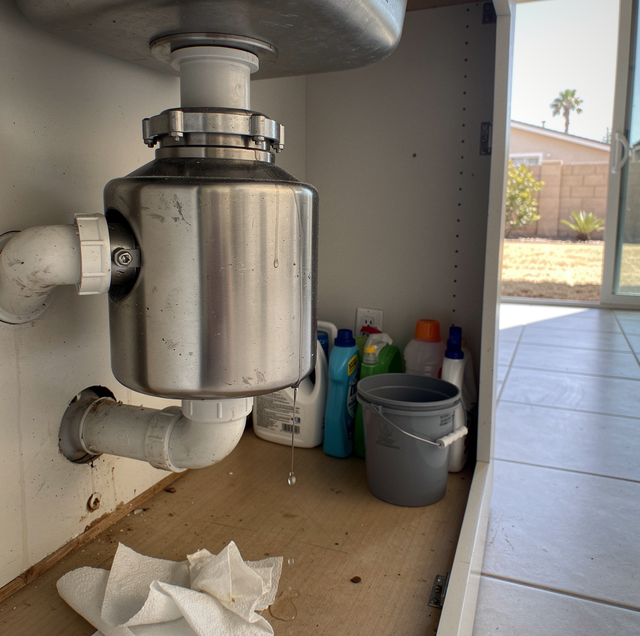
Quick Answer: Water at the bottom of a disposal almost always starts higher up, at the sink flange, the dishwasher connection, or the discharge outlet, then runs down the housing. A leak starting at the seam is the one origin that ends the unit.
A garbage disposal only has a handful of places where water can get past a seal. At the top sits the metal sink flange, seated in the drain opening and drawn down against the unit's mounting assembly. Below that, on the side of the housing, is the fitting where the dishwasher's drain hose connects. Below that, again, is the discharge outlet, a short metal tube bolted to the unit that carries ground waste to the trap. And at the very bottom sits the housing itself, a sealed metal shell with a factory seam, plus the panel that holds the reset button.
Every one of those points sits on the same vertical column, stacked one above the next. Water that gets past a seal anywhere on that column doesn't stay where it started. It runs down the outside of the housing, following ridges and screw heads, until it drips off the lowest point it reaches, which is almost always the bottom of the unit. That is why a puddle under your disposal tells you almost nothing about where the leak actually began. The drip point and the leak point are often two different places on the same housing.
Before touching the underside of the disposal, cut power at the breaker, not the wall switch. A switch flipped elsewhere can start the unit while your hand is against the housing, and some units stay live at the outlet.
With the power off, working through that column from top to bottom shows exactly where the water begins.
The Sink Flange, Where Water Enters at the Top
The flange is the metal ring visible from inside your sink, sealed to the sink's underside with plumber's putty and held by the disposal's mounting assembly. That putty forms a compression seal between the flange and the sink metal. If it dries out, shrinks, or was never fully seated when the unit went in, water from the sink basin seeps between the flange and the sink lip and runs down the outside of the mounting ring onto the top of the housing.
A dry paper towel shows a weep faster than eyeballing a wet-looking metal surface. Press it directly against each connection point rather than just looking, since a slow leak can be invisible on already-damp metal.
A flange leak appears as moisture right at the top of the unit, often as a wet ring around the mounting collar, before it ever reaches the bottom. It is one of the more common causes because the seal resists the constant flexing of a sink that gets loaded and drained throughout the day. The same mounting assembly also carries the splash guard, the rubber flap that keeps water and food waste from bouncing back up into the sink; a cracked splash guard is not itself a source of leaks, but it is replaced during the same reseal.
The Dishwasher Inlet Fitting on the Side
A step below the flange, on the upper side of the housing, is the fitting where a dishwasher's drain hose connects. On a unit with a dishwasher hookup, that hose clamps onto a nipple molded into the side of the disposal's upper chamber. If the hose clamp has loosened, or the hose itself has cracked near the connection, wastewater from the dishwasher's drain cycle leaks at that fitting instead of continuing on to the trap.
This origin has a timing that tells the others don't. A dishwasher inlet leak typically occurs only during the dishwasher's drain cycle, not when the sink is used alone. If your cabinet floor stays dry during normal dishwashing but shows moisture after the wash cycle finishes, the inlet fitting on the side of the unit is the first place to check. Where the drain hose runs through an air gap or a high loop before it reaches this fitting, the leak can just as easily be the hose failing along its own length as the connection at the disposal, so the fitting is only the first thing to rule out, not the only one.
The Discharge Outlet and Its Gasket
Below the dishwasher fitting is the discharge outlet, the short metal tube bolted to the side of the disposal that carries ground waste out to the trap and drain line. A flanged gasket sits between the tube and the disposal's outlet port, compressed by the bolts that hold the tube in place. Vibration from the motor and repeated tightening during past repairs can flatten, crack, or shift that gasket enough that water weeps out at the seam every time the sink drains.
A discharge leak tends to appear as moisture along the bottom edge of the tube, then down the housing toward the cabinet floor, which puts it visually close to the shell seam and the reset area, even though it starts well above them. Because the gasket is a single, replaceable part and the tube's alignment can be adjusted without touching the housing, a leak at the discharge outlet is a reseal rather than a sign the unit itself has failed.
Finding the True Point of Origin
The fastest way to separate these origins without removing anything is a dry paper towel test, worked from the top of the unit down. Press a dry paper towel against the mounting ring just under the flange, run water in the sink for a short stretch, and check the towel. If it's dry, move to the dishwasher fitting on the side and repeat, running the dishwasher briefly if that's the connection in question. Then check the discharge tube where it bolts to the outlet. Whichever towel dampens first, working in that order, marks the real point of origin, because every point below it will show moisture too once water has had time to run down the housing, even though it never leaked there.
Where the water is hard, mineral scale often forms right at these seams and fittings; that crust can hide a slow weep at a glance, which is another reason a dry paper towel, not just a look, is what actually catches the drip.
| Where the towel dampens first | What it usually means |
|---|---|
| At the flange, under the sink | Putty or mounting seal needs reseating |
| At the dishwasher fitting | Hose clamp or hose needs replacing |
| At the discharge tube | Outlet gasket needs replacing |
| Nowhere above, only at the seam or bottom panel | The housing itself is compromised |
The Shell Seam and Reset Button Area at the Bottom
If the dry paper towel test comes up dry at the flange, the dishwasher fitting, and the discharge tube, and the only moisture is at the seam where the housing was assembled, or around the panel that holds the reset button, the leak is coming from the shell itself. That housing is a single sealed unit from the factory. It isn't built to be opened, resealed, or repaired the way a gasket or a putty seal is.
A leak at the shell seam means the metal housing containing the grind chamber and the motor has been breached, whether from corrosion working its way from the inside of the housing outward or from a factory seam that has finally given way under repeated vibration from the motor.
The reset button panel sits at the same low point on the underside, which is why moisture there is so often blamed on the button itself. It's usually just the lowest surface water that reaches it after starting elsewhere on the housing.
Frequently Asked Questions
Not every drip under a disposal is a leak. A cold supply line running near a warm disposal body can collect condensation on a humid day, and that moisture drips onto the same low points a real leak would reach. If every connection point stays dry to the touch during a paper towel check, but water still appears beneath it, check the cold line just above the disposal for condensation before assuming the housing has failed.
The flange seal is part of the mounting assembly, which also holds a rubber backup gasket beneath the mounting ring, separate from the putty seal at the flange itself. Because both the putty and that gasket have to seat evenly for the seal to hold, and the mounting has to come off to reach either one, this repair is typically handled by a plumber rather than as a from-under-the-sink fix.
Not always, and the hose clamp is worth ruling out before the hose itself. The spring-style clamps that ship on many dishwasher hoses lose tension as they heat and cool through every wash cycle, so a connection that was tight at install can weep years later with no crack anywhere in the hose. A worm-drive clamp is fitted in place during the repair, since it can be retensioned rather than replaced outright.
The discharge tube's outlet gasket and the trap connection just below it sit close enough together that a leak from either one can look the same by the time water reaches the bottom of the cabinet. A dry paper towel pressed against the union nut on the trap, checked separately from the towel at the disposal's outlet flange, is what separates a trap leak from a discharge leak, since the two are repaired differently.
Not by itself. The reset button sits behind its own small rubber gasket or boot, and that seal can weep on its own if it's aged or cracked, independent of anything happening elsewhere in the housing. Moisture at the reset button panel is a location, not a diagnosis. It only indicates a housing failure once the flange, the dishwasher fitting, and the discharge tube have all been checked dry above it.
Adding a few drops of food coloring to a cup of water and pouring it slowly down the drain while watching each connection point can confirm a source the paper towel test left ambiguous, since tinted water makes a thin weep easier to see than a plain wet spot. It works best as a follow-up check rather than a first step, since it takes longer to set up than pressing a towel against each fitting.
Get a disposal leak pinpointed to its true source — a reseal and a replacement are very different jobs. Ser Plumbing handles burst pipes across the area, from burst pipe repair in Norwalk to Compton. Call (310) 953-3566.
