
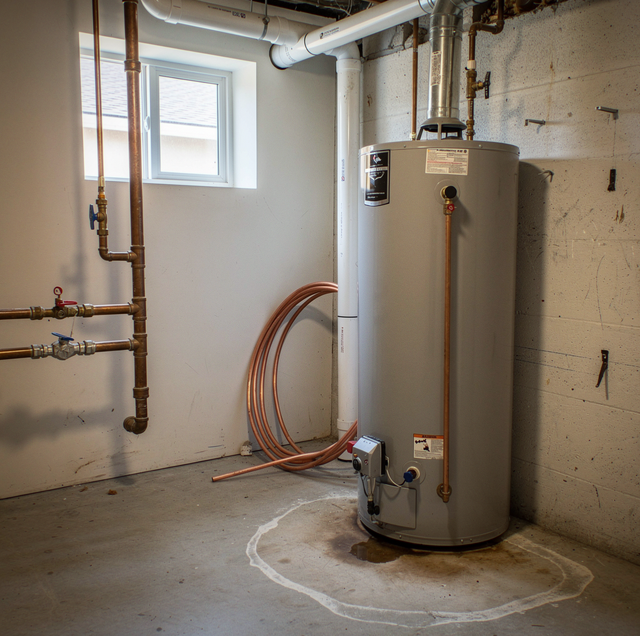
The same mineral does two opposite things to a water heater, and which one depends on whether the appliance holds water or moves it. Calcium and magnesium arrive dissolved and invisible; heat drops them back out as a hard, chalky solid that bonds to the nearest hot metal. Which metal that turns out to be decides everything after.
In a storage tank, the solid sinks, forming a crusty bed across the floor between the burner and the water it is meant to heat. In a tankless unit, there is no floor to settle on, so the mineral plates onto the wall of the narrow, coiled passage the water runs through, thinning the channel.
One insulates. The other constricts. Descaling is the scheduled service that removes it in both cases, and what it buys has less to do with how fast hot water arrives than with how long the appliance survives.
Where Scale Forms and Why It Lands There
Scale is never evenly distributed throughout an appliance. It builds where energy enters the water: the bottom of a gas tank directly over the burner, the sheath of an electric element, the wall of a tankless exchanger passage. Those are the hottest surfaces in the unit, and the hottest surface is where mineral leaves solution first.
Sediment, the Glass Lining, and How a Tank Fails
A settled bed conducts heat poorly, and once it covers the floor of a gas tank, it sits between the flame and the water. That much is familiar. What shortens the appliance's life is what happens to the steel caught in between.
Heat still enters that steel; it can no longer leave into the water at the same rate, so the tank bottom runs hotter than the design assumes. Inside, the tank carries a thin glass coating fused to the metal, and that coating is the only thing keeping water off the steel during the unit's working life. Glass and steel expand at different rates, and the coating is brittle. Hence, a plate that runs hot, cools, and runs hot again eventually crazes, opening fine cracks in precisely the area sitting over the sediment.
Wherever the lining opens, water reaches bare steel, and corrosion starts there, in a spot nobody can see and nothing reports. The tank keeps working, gives no symptom at any fixture, and thins underneath until the wall gives up and a leak appears. A tank rarely fails at the top where the fittings are; it fails at the floor, where the sediment was. A leaking tank is a replacement rather than a repair, so that one mechanism is most of what a flush is protecting. The burner running longer to reach the same temperature is the smaller half of the story.
Electric Tanks, Buried Elements, and the Anode Rod
An electric tank has no flame underneath, so the lining is not cooked from below and the failure takes a different route. Heat comes from elements projecting through the tank wall into the water, and the lower one sits close to the floor, where the bed builds.
An element is designed to be surrounded by water because moving water carries heat away from its sheath quickly enough to keep the sheath intact. Packed mineral does not. So replacing a burned-out lower element without clearing the floor drops a new part into the conditions that ended the last one, which makes that repair a flush with a part in it.
The anode rod is a separate thread in the same story: Sediment does not consume an anode, but a deep bed can bury its lower end and take that section out of service while the rest of the rod still works. The tank then offers less protection than its owner has reason to think, and nothing in how it behaves says otherwise. A flush is the visit where the rod can be evaluated at all, and clearing the bed restores what the bed was covering, not what is already gone.
Inside a Tankless Exchanger, Plating Does the Opposite
A tankless unit stores nothing. Water runs through a narrow coiled passage while a burner heats it, so the design moves a lot of energy into a small volume of fast-moving water, with no reservoir to absorb a mistake.
Scale plates onto the inside wall and do two things at once. It narrows the channel, so less water moves through per second at the same supply pressure, and it insulates the wall, so heat crosses into the water more slowly than the unit expects.
The unit notices because a tankless heater constantly measures incoming temperature, outgoing temperature, and flow, and then modulates its burner based on those readings. Facing a plated exchanger, it fires harder to reach its outlet target, driving the wall behind the deposit hotter than intended, while restricted flow can drop below the minimum rate the unit needs to fire at all, causing the burner to drop in and out during an ordinary draw. Manufacturers assign fault codes to overheat and flow conditions, and a unit posting them in routine use is reporting that the passage is no longer the size it was built to be.
That is the useful difference in character: a tank tolerates neglect quietly for years and then fails once, at the floor, without warning, while a tankless unit complains early and specifically. Left alone, hot spots on that wall do damage no cleaning reverses.
The Flush Itself, Tank and Tankless
Both versions are service visits, and the appliance itself is the reason.
On a Storage Tank
The heater is taken out of operation for the visit, and the job is defined by whether the bed on the floor actually leaves the tank. A settled bed does not float, so a tank simply allowed to empty draws clear water off the top and leaves the crust where it was. That is the difference between draining a heater and flushing one, and it is why a flush that runs clear on the first pass has usually not reached the floor.
The drain valve is the known risk on an older tank. Scale packs around the seat, so a valve untouched for years may not open fully, and once opened may not reseal. Part of a competent visit is arriving prepared to replace it rather than discovering that with a full tank of hot water.
A water heater holds water at scalding temperature under household supply pressure, and an old plastic drain valve can shear off rather than open. That is why a flush is a scheduled service call, not a weekend project.
On a Tankless Unit
A tankless unit is descaled through service valves on its hot and cold connections, so whether those valves were fitted at installation decides the entire job. With them, the exchanger is treated in place, and the appointment stays a maintenance visit. Without them, the connections have to be opened up first, and that is a plumbing change rather than maintenance: worth knowing before booking, because it is the most common reason a scheduled descale turns into a longer appointment.
What the visit accomplishes is narrower than it sounds. The deposit leaves as liquid rather than debris, so nothing has to be scraped or taken apart, and the passage returns to the dimension against which the unit's own sensors were calibrated. That is why a unit that had been dropping in and out of firing often stops afterward: the sensors were right all along, and what changed is the thing they were reading.
How the Interval Is Actually Set
There is no universal number that fits every house. Manufacturers publish their own maintenance schedules and, in many cases, make following them a condition of warranty coverage, so a unit still under coverage follows its own terms first. A yearly service is the common baseline those schedules land on. Four things move a given heater off it.
Hardness of the supply: More minerals per gallon mean more are left behind per gallon heated, so two identical heaters on different water scales at different speeds.
How much hot water the household uses: Volume through the heater is volume of mineral through it, and a household that has grown since installation is scaling it faster than the day it went in.
The temperature the heater holds: Hotter water precipitates mineral faster, which is why a setting chosen for one reason quietly affects another.
Whether it has ever been flushed: A heater untouched for years carries a hardened bed that behaves nothing like the loose sediment in a maintained tank, so that first visit is a different job.
Type moves it as well: tankless manufacturers generally call for descaling more often than tank manufacturers call for flushing, because a film thin enough to be invisible on a tank floor is a measurable share of an exchanger channel. So does evidence, since a tank rumbling through a heating cycle or a tankless unit posting flow codes is reporting its own condition, and that beats a date.
What Descaling Cannot Recover
Descaling is maintenance, not repair, and the difference gets sharp once a heater is already in trouble. It does not reverse corrosion: with the lining crazed and steel rusting behind it, clearing the sediment above changes nothing about the thin spot already there. It does not renew an anode rod, which is replaced rather than cleaned. It does not resurrect a burned-out element, though a clear floor keeps the next one from the same end. And it does not undo overheat damage in a tankless exchanger, because metal that ran hot behind a deposit stays damaged once the passage is clear.
Descaling buys time by keeping the appliance in the condition it was engineered for: a tank floor that hands heat to water instead of trapping it, and an exchanger passage the size the drawing called for. That is a smaller promise than a heater that lasts forever, and it is the one that holds up.
Frequently Asked Questions
No, and the reason is a failure mode most owners never see. A softener out of salt, or running an exhausted resin bed, stops softening silently: pressure, flow, and temperature all stay normal, so nothing at any fixture announces it, and the heater scales at the untreated rate until somebody notices. Manufacturers also set their maintenance terms on their own schedule and generally do not waive them for a softened house.
It can. A recirculation setup uses either a dedicated return line or a crossover valve fitted under a far fixture to keep hot water moving toward the taps. The trade is that the heater sees far more water in a day than the household actually draws, and a tankless unit on a loop fires many more times to hold that loop warm. More heated water through the same passage leaves more mineral behind.
Usually. Tankless units have a cold-water inlet screen, a small filter at the incoming connection that catches grit and pipe debris and clogs on its own timetable regardless of scale; it gets pulled and rinsed while the unit is open anyway. The service valve caps carry gaskets that get replaced once they harden, since a weeping valve drips onto the unit itself rather than the floor.
In one respect, yes. A condensing model adds a secondary heat exchanger that extracts more heat from the exhaust, cooling the flue gas sufficiently for water vapor to condense out. That condensate is acidic, so these units drain it via a dedicated line, often routed through a neutralizer cartridge whose media first raises the pH. A blocked condensate line shuts a condensing unit down even with a spotless exchanger.
Not automatically. Heat exchangers are sold as service parts for many models, so replacing one is a genuine repair rather than a whole-unit swap. What determines it is whether the model is still supported with parts, how old the unit is relative to its warranty term, and whether the water that ruined the first exchanger has been addressed.
Out through a hose to a drain, which matters more than it sounds. Tank flush water carries gritty sediment that settles in a laundry sink trap and stays there, so it needs a discharge point that can be rinsed out afterward. Heaters in a garage or closet often sit below the nearest drain, and gravity will not move water uphill, which is worth raising when the visit is booked. Units over finished space also have a drain pan with its own line, which a technician usually confirms is clear while there.
Reach out about a descaling flush for your tank or tankless water heater — regular service clears mineral buildup before it does damage that a flush can no longer undo. Ser Plumbing flushes water heaters across the area, from water heater flush in Downey to Lakewood. Call (310) 953-3566.
