
Quick Answer: While the walls are open, the branches worth adding are the ones whose destination is already fixed and whose retrofit would mean opening a wall again. Everything else gets a valved, labeled cap or a no.
The calls arrive on a schedule, and it is always the same schedule. A house gets repiped in the spring. By the fall somebody is asking for a water line out to the garage, or to the far corner of the yard, or into the wall behind a refrigerator being replaced with one that makes ice. Six months earlier each of those lines was a tee, a short run of pipe and a fitting, made on a day a crew stood in that wall already. Now each is its own visit, its own opening and its own patch.
Nothing went wrong on those jobs. The pipe came out, the test held, the walls went back. No one had the other conversation. A repipe gets planned around what is being removed, and the scope sheet says nothing about what the same open wall could also carry, because nobody asked. The one week in a house's life when that is an easy question is the week it goes unasked.
It goes unasked partly because the advice on this subject is written for a remodel, where one room is stripped to the framing, and the list comes off a floor plan. A repipe opens several rooms shallowly instead, so an addition belongs on your list only if it sits near a run the crew is already pulling or a fixture already disconnected.
What Stub and Cap Actually Means
A branch starts with a tee cut into a run that is going in anyway. Off that tee comes a short length of the same pipe the rest of the house is getting, then a valve, then a cap or plug from the same fitting system, set with the same tool on the same day. It is pressurized with the rest when the system is tested, which is where its two new joints prove themselves, and then it sits, closed at its valve, until somebody extends it. A capped branch may sit for a decade, so it goes in as permanent pipe, not a placeholder.
Which gives every candidate three answers, and the middle one is the one people forget.
Finish it now: the need is certain, and the end of the line is fixed by something that will not move, such as a wall or an appliance space. The branch gets carried to a stop or a connection.
Stub and cap it: the need is likely, but the last few feet are unsettled, usually a model or a room layout.
Leave it alone: the line is already there, and nobody noticed, or there is nothing behind the idea but a maybe pointed at a wall. A stub aimed at a guess is not an open option. It is a pipe somebody explains later.
The Two Kitchen Lines
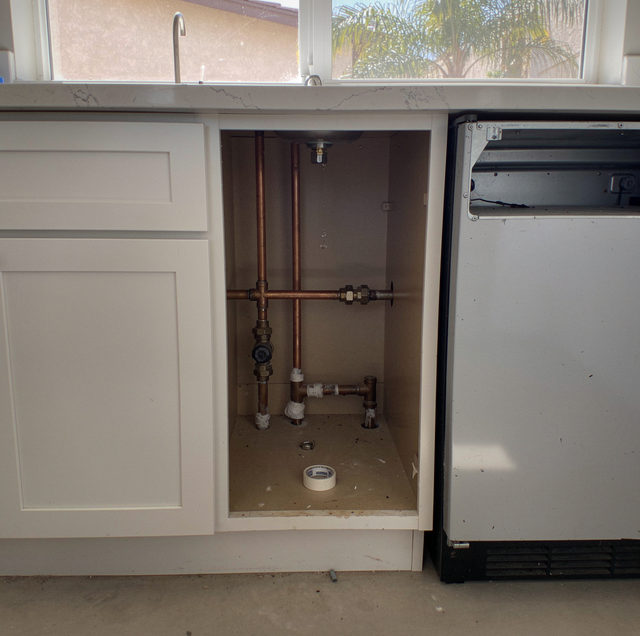
A refrigerator that makes ice or pours water needs a small cold line running to the wall behind it, ending at its own shutoff, and older kitchens generally do not have one. The retrofit is what makes it worth deciding now: with the room finished, a line is run from the sink cabinet and through the backs of the cabinets between there and the refrigerator space, landing at a valve behind an appliance that weighs as much as a refrigerator. During a repipe, it is a branch off the cold run already crossing that kitchen, ending at a valve beside the appliance that a person can reach.
The dishwasher is the other one, and only half of it is supply work. The piece to settle now is the hot valve under the sink, set where a machine can be connected later without rework. Drainage goes through an air gap or a high loop into the disposal or the sink drain, and a disposal will not take that hose until its knockout is removed. None of that needs open walls, so ready the hot side and let the rest wait.
Refuse a piercing saddle valve on a refrigerator line, no matter what a delivery crew offers. It clamps onto the pipe and punctures it with a needle, and those needle points corrode, clog, and weep behind an appliance nobody moves.
Hot and Cold at a Garage or Laundry Wall
A utility sink is the addition people want most and defer longest. Cold is usually close by, since that wall often already carries a hose bib or the laundry valves. Hot is the half that gets hard later, because on plenty of houses it never had a reason to reach that wall, and bringing it there afterward means a line crossing the house through finished ceilings.
Drainage decides whether the sink itself ever happens, since it needs a drain with fall and a vent behind it, tied into waste piping that sits where it sits. Where a drain is there, finish the supply. Where it is not, a valved and capped hot and cold pair keeps the option alive. The washing machine valves and hoses deserve the same pass, since rubber hoses are among the few parts in a house that fail when nobody is home.
One More Exterior Hose Bib, and Where It Earns One
Where a house's hose bibs sit was decided by where the plumbing happened to be, not by where anybody waters. The test for a second one is behavioral: notice which direction the hose gets dragged, and how far, to reach the side yard, the back corner, or the gate.
While the cold lines are being run, a bib on another wall is a branch to the exterior face and one penetration through it. Afterward, it is either an open exterior wall or a length of pipe run along the outside of the house, which is what most added bibs actually look like. Finish this one instead of capping it, since a cap inside an exterior wall gives you nothing usable.
The Hot Branch at a Toilet Wall
Toilets are fed cold, and nothing a toilet does on its own asks for anything else, so hot water has never had a reason to reach that wall. It is one of the few spots in a finished bathroom where hot water is absent outright rather than merely awkward to tap.
Anything later fitted there that wants warm water runs into that absence. The cold half needs nothing from anybody: it comes off the toilet's own supply through a tee at the stop under the tank, so a spare cold stub there would be pipe with no job. The hot half is the one with a deadline, because adding it afterward means opening the wall between the toilet and wherever hot water already reaches. During a repipe, with a hot run already crossing that bathroom, a hot branch to that wall, valved and capped, is short and reachable.
A Loop Left for Softening or Filtration
Water treatment equipment sits at the point of entry, on the main line, usually on a garage or exterior wall. It is not part of the distribution piping, which is why it goes unmentioned during a repipe and why it belongs here.
Adding a softener or a whole-house filter later means cutting into a live main, building a loop out of it, and taking the house off water for the length of that work. During a repipe, that section is already open. What gets left behind is a pair of valved stubs where the equipment would stand, one leaving the main and one returning to it, with a bypass so the house keeps running while nothing is connected. Hard water is the usual reason people come back to this, on a schedule that never suits a repipe.
Under-sink filtration is the exception, reverse osmosis included, since it runs off the cold line already under that sink.
Isolation Valves for Work That Has Not Happened Yet
Every repipe already ends in a shutoff where water enters the building and a stop under each fixture. The valves worth raising are the ones in between, installed for somebody who does not work on your house yet. A valve at the base of the branch feeding a bathroom group means that bathroom can be worked on while the kitchen keeps water. A valve on the branch heading outdoors means a broken bib does not take the house down at eight on a Saturday. A valve on each capped stub prevents it from entering the live system until it is extended. On a run being built anyway, each is one fitting; afterward, each is a cut into finished pipe somebody has to reach first. A valve sealed inside a wall cavity is a fitting nobody will ever turn.
Keep every capped branch shut at its own valve rather than live to the house. Water held in a closed branch goes nowhere, and a stub left open joins that still column to the supply the household drinks from.
Add Now, Stub and Cap, or Leave Alone
| Candidate | The call | Why it lands there |
|---|---|---|
| Cold line for a refrigerator ice maker | Finish now | Retrofits go through cabinet backs or open the wall |
| Hot valve for a dishwasher space | Finish now | Already under that sink; drainage is separate work |
| An additional exterior hose bib | Finish now | A cap in an exterior wall gives you nothing usable |
| Branch isolation valves | Finish now | One fitting now, a cut into finished pipe later |
| Hot and cold at a garage or laundry wall | Stub and cap | Drainage decides whether the sink ever happens |
| Hot branch to a toilet wall | Stub and cap | That path closes with the drywall |
| Softener or filter loop at the point of entry | Stub, valve and bypass | Later means cutting a live main |
| Cold supply at a toilet wall | Leave alone | Already fed cold; the tee goes on at the stop |
| A line toward a spot with no plan behind it | Leave alone | A stub aimed at a guess ages into a mystery |
A takeoff for a future second dwelling sits outside this list, sized to that building's own permit.
One House, Several Stubs, One Record
A repipe can leave five or six of these in a single house, which turns the exercise from marking a pipe into keeping a list. Every stub gets a valve and a durable tag, and the tags only work if the same information is also in one place. One page, written the week the walls are open, naming every branch left in the house and where each one ends, is what a later plumber and a later owner will actually work from.
The Day the Decision Closes
Every choice above stays available on the terms described here until one day, and it is not the day the crew drives away. It is the day the openings are closed.
Before that morning, adding a branch is a tee, a length of pipe, a valve and a cap, agreed in a sentence and installed in about as long as it takes to say. After it, the identical branch is a scheduled visit, cut walls, dust barriers, a patch, and a paint match. The pipe is the same on both sides of that day. Nothing around it is.
So this walkthrough isn't something to read and nod along to. It is a list to go through out loud with whoever is designing your repipe, before the route is drawn, with a yes, a cap, or a no beside every line. A no is a perfectly good answer, and most houses produce several. What is not an answer is never reaching the line at all, because an item nobody raised does not stay pending. It closes with the wall, at the same hour as the ones you did consider.
Frequently Asked Questions
A capped stub draws nothing, so until it is extended, nothing changes on tap. Once a branch is finished, simultaneous use matters rather than the count of outlets. An ice maker fills slowly and is invisible against a shower. A hose bib is the opposite: run wide open, it is among the heaviest single draws on the house.
The idea is identical, and the hardware is not. In copper, the branch is a tee joined into the run, with a cap fitted at the end, soldered or pressed to match the system. In PEX, it is a tee and a cap in whichever fitting system the house was piped with. The cap behaves differently in each when the day comes: a soldered or pressed copper cap is cut off, while a PEX cap comes out of its fitting the way any other joint does, which is why the end of a capped PEX branch is usually left a little longer than it needs to be.
Short, ending near its valve, unless the destination is fixed by the structure. Length charges you twice. The run has to be supported and protected along its whole length even though nothing is using it, and it commits to a position nobody has chosen yet, so it lands wrong and gets cut back later by somebody who has to remake the end.
Add the month and year, which is the item everybody leaves off and the one that tells a future plumber whether the branch belongs to the current system or an older one. Then think about the medium and the mounting rather than the wording. Tape and a marker go blank in an attic faster than anyone expects, and a tag hung on the pipe travels with whatever section gets cut. Fix it to the valve body, because the valve is the part nobody removes.
Solid backing, which is the piece available only while the wall is open. A bib takes sideways force every time a hose is yanked around a corner, and one anchored to nothing but pipe and drywall works itself loose and spins. Fastening it to a block set between the framing and sealing the penetration outside is minutes now and a wall opening later.
While the openings are still there, usually yes, but it is no longer a decision that stops at a sentence. The two new joints were not in the test that already passed, so that section has to be brought back up and held again, and where an inspection is involved, the sequence is something to work out with your plumber rather than assume. Raise it the same morning you think of it. A drywall crew books ahead of the person who would have to run the test a second time.
Ask for a stub-out walkthrough before the repipe route is drawn — a licensed plumber will walk the house with you, name every branch worth adding or capping, and leave each one valved, labeled and photographed. Ser Plumbing repipes homes across the area, from repiping in Downey to Lakewood. Call (310) 953-3566.
