
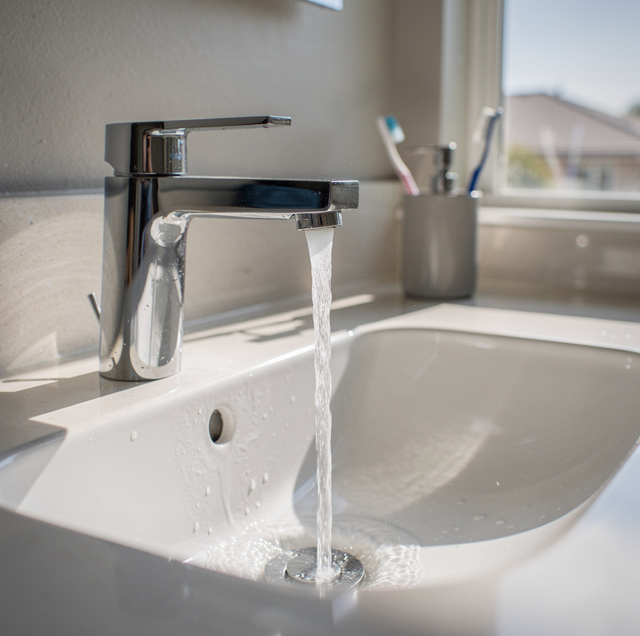
You have counted it. Hand under the tap at the far bathroom, water running cool, then not quite cool, then finally hot, and somewhere in there you started counting. The next morning you counted again and landed on the same number. Not close to it. The same. Then you counted at the kitchen sink, same house, same water heater, and the number was nothing like the one down the hall.
That repeatability is the useful part. A wait that varies day to day depends on the heater or on how much hot water the house has already used. A wait that repeats to the count at one fixture, while another fixture keeps its own separate count, points at something fixed: something the same size every time, emptied every time, before hot water can reach you.
Quick Answer: A repipe makes hot water arrive faster only where it shortens the route to a fixture or right-sizes the branch feeding it. Same route, same length, same heater location, and the new pipe reads the same at the tap.
Why Hot Water Takes So Long to Arrive
Open a hot tap, and hot water does not flow from the heater toward you. The pipe between the heater and that fixture is already full, and it has been sitting there since the last time anyone used it, giving up its heat to the wall, the attic, the slab, whatever it runs through. That cooled water has to leave before hot water can arrive.
So the wait is not really a measure of distance, even though it feels like one. It is a measure of volume: how much water the run holds, and how fast you are moving it out. Open a tap partway, and the same water takes longer to clear.
Why the Count Repeats at One Tap and Changes at Another
The run to your far bathroom holds a certain amount of water, and that amount is the same on Tuesday as on Monday. Same length, same diameter, same volume to push out, same count.
The kitchen sink sits on a different run: different length, often a different diameter, a different set of turns. Different volume, different count. One heater, one house, two answers, and neither is a fault. It is also why curing the wait at one tap can leave another exactly as it was: there is no house-wide wait to fix, only a wait per run.
Four Things Set the Wait, and a Repipe Touches Two
How long the route is: not the straight-line distance from heater to fixture, but the path the pipe actually takes, including the trip up into the attic and back down, and any detour the original installer had to make.
How wide the pipe is on that run: a wider pipe holds more water along every foot of its length, so more cooled water has to leave first. A run that comes back wider than it was can lengthen the wait at that fixture rather than shorten it.
Where the heater sits: everything else is measured from it. A heater at one end of a building means the fixtures at the other end start every draw with the longest push.
How fast the fixture moves water: the standing volume leaves at the rate the outlet passes it, which is why the same run clears sooner at a fixture that draws heavily and drags at one opened partway.
New piping can change the first two. It cannot change the third, because moving a water heater is its own project rather than a line on a repipe. The fourth belongs to the fixture rather than to the pipe.
When Repiping Really Does Shorten the Wait
Two cases, and both turn on design rather than on the pipe being new.
The first is a rerouted run. Older systems often take the long way to a fixture because the route followed the existing framing, or was extended when a room was added and nobody redrew the path. Replacing pipe along that same path preserves the detour exactly. Drawing a new, direct route removes it, and the volume standing in the line falls with the length.
The second is a last leg that comes back narrower than it went in. Where a large line ran all the way out to one fixture, it was holding more cooled water than that fixture ever pulled through, and less water standing there is less to push out.
Ask a bidder which runs get a new route and which get replaced along the existing path. Only the rerouted ones can change what you count at the tap, and the answer will differ fixture by fixture.
When Repiping Changes Nothing at All
There is a version of this work that produces sound new pipe and an identical wait, and it is the ordinary outcome for anyone who bought a repipe expecting faster hot water.
If the new lines follow the old routes, at the same lengths, in the same sizes, from a heater that did not move, nothing that governs the wait has changed. The pipe is new and no longer the leak risk it was, which is worth having. The tap will still read what it read before. That is a repipe answering the question it was asked: the condition of the pipe, not the geometry of the route.
The Long House With the Heater at One End
One layout produces this complaint reliably. A single-story house spread long and low on a concrete slab, water heater in the garage at one end, bathrooms strung toward the other. The kitchen, near the garage, gets hot water quickly. The bathroom at the far end pulls a long line of cooled water through the ceiling every time, in a house where nothing is wrong.
That geometry is also why a repipe gives such uneven results here. With a slab underfoot, the new lines run overhead through the attic, and the route drawn up there is a fresh drawing rather than a tracing of the old one. Some runs come out shorter than what they replaced, because a direct overhead path beats a line that wandered. Others come out the same, or a little longer, because up and over is no shortcut between two points already close together.
When the Pipe Was Never the Problem
Four situations where new pipe cannot help, because the pipe was not what made you wait.
The heater is at the far end of the building: distance is distance, and no pipe material shortens it.
A failed dip tube: the tube that carries incoming cold water down to the bottom of the tank. When it breaks up, cold water enters at the top and leaves with the hot, so what arrives is lukewarm and fades quickly.
A tank loaded with sediment: hard water leaves minerals at the bottom of the tank, taking up space that used to hold hot water and sitting between the burner and the water above it. Less hot water, delivered less steadily, reads at the tap as a wait.
A recirculation system that is off or set wrong: if the house already has one, it exists precisely to defeat this wait. A loop switched off, or scheduled for hours nobody is home, hands you the full wait back with the hardware sitting right there.
All four are found at the heater and its controls rather than in the walls, and all four require a licensed plumber.
Does Turning the Water Heater Up Help?
No, and the reason is worth following, because it is the first thing most people try.
A thermostat sets the temperature of the water stored in the tank. It does not change how much cooled water is standing in the line between that tank and your tap, and it does not move that water along faster. The wait is untouched. What changes is the end of the wait: the water that finally arrives is hotter than it was, and past a point hot enough to injure before a hand can be pulled back.
There is a second effect that makes it feel like it worked. Hotter stored water stretches further before the tank runs out, so a long shower lasts longer. That is capacity rather than speed, and it gets reported as the heater arriving sooner.
A thermostat turned up to chase a shorter wait does not shorten it and does raise the risk of burning at every tap in the house. Have the setting and any mixing hardware checked by a licensed plumber instead.
What Causes the Wait, and Whether New Pipe Moves It
| The cause | What it means at the tap | Does a repipe change it |
|---|---|---|
| The run takes an indirect path | The line holds more water than the distance needs | Yes, if the new route is drawn shorter, not copied |
| The branch is wider than the fixture needs | More cooled water leaves before hot water arrives | Yes, if that last leg comes back narrower |
| The heater sits at the opposite end | Every draw begins with the longest push in the house | No. Piping does not move the heater |
| The route is already direct and right-sized | The wait is what that geometry produces | No, and new pipe will read the same |
| A dip tube or a sediment-loaded tank | Water arrives lukewarm, or arrives and fades | No. That is the heater, diagnosed separately |
| The fixture passes water slowly | The same standing volume takes longer to clear | No. That is the outlet, not the run |
| A recirculation loop is off or set wrong | The lines are cold despite the hardware | No. The control is the fault, not the pipe |
Shortening the Run Is the Part a Repipe Holds
Everything above comes back to one lever new pipe actually has: the volume standing in the run. Draw the route shorter, and there is less of it to move. That is why the design determines this, not the material.
One other mechanism exists, and it is not a repipe. A hot water recirculation system keeps water moving through the hot piping, so what comes out of the tap when you open it is already hot rather than cooled. It shortens nothing; it changes what is waiting there. It is separate work with its own hardware and controls, and whether a house suits one is a question for a licensed plumber.
What Changes After the Repipe, and What Does Not
Set the expectation before the work, and set it fixture by fixture.
What will change: the pipe will no longer pose a leak risk and will no longer put anything of its own into your water. Where a run was rerouted shorter, or sized down to what it feeds, the wait at that fixture gets shorter, and you will notice it the way you noticed the wait in the first place, by counting.
What will not change: the wait at any fixture whose new route came out the same length, the wait at a far bathroom where the heater stayed in the garage, and anything the tank itself is doing. New pipe is not a heater repair, nor is it a recirculation system.
What could get slightly worse: a run that comes back wider than it was, which is worth naming before it is built rather than discovering at the tap afterward.
So buy a repipe for the condition of your pipe, and for a routing you asked for and saw drawn. If a shorter wait for hot water is the main thing you want, say so at the walk-through, while the route is still on paper.
Frequently Asked Questions
Two things shift at once in colder months. The water entering the heater is colder, so the tank has to work harder to keep up. The spaces the hot lines pass through are colder too, especially in an attic overnight, so more heat leaves the standing water between draws and more leaves the moving water on its way to you. The first draw of a winter morning is the slowest one of the day.
Not on the first draw of the day, because insulation does not reduce the volume sitting in the line waiting to be pushed out. What it changes is how long that water stays hot afterward. Use a fixture, come back a while later, and the line has not gone fully cold, so the second wait is shorter than the first. Insulation matters more on a house with a recirculation loop, which fights heat loss the whole time it runs.
The same mechanism running in reverse. The cold line is also full of standing water, drifting toward the temperature of whatever it passes through: an attic in the afternoon, a slab in summer. The first part of the draw is that water, and true cold arrives once the line clears. It is the plainest proof that what you wait for at any tap is what is in the run, not what is in the heater.
Because they are not on the same length of pipe, even a few feet apart. A shower usually tees off closer to the trunk line, while a vanity often sits at the end of a smaller branch that carries on past it. The final connection at each fixture holds very little water either way, so almost the whole difference is decided upstream, by where each branch splits off.
It would shorten that run and lengthen every other one, so it trades your worst wait for several new ones, and the fixtures nobody counted at become the ones you stand and count at. A heater placed centrally is a compromise between every run rather than a cure for the longest. Moving one is also its own project rather than a line on a repipe: what it involves for venting, for drainage, for clearance around the unit, and for electrical supply is set by your building department and confirmed on the permit. Worth raising when a garage is being converted anyway, and not something a repipe absorbs on its own.
Usually because a fixture moved and the pipe followed it the long way. A shower relocated to the far wall tends to get an extension of the existing branch rather than a fresh route from the heater, adding length to a run that was already the longest in the house. A large tub filler looks like it should add to the wait and usually does not. It gets a wider line, which holds more cooled water, but it also passes water far faster than a basin tap, and the wait is the standing volume against the rate it leaves at. The rate rises faster than the volume does, so the count at a high-flow filler normally comes out shorter, not longer.
Ask for a route-by-route walk-through before the repipe is designed — a licensed plumber can name which runs come out shorter and which stay exactly as they are. Ser Plumbing installs recirculation pumps across the area, from hot water recirculation in Compton to Bellflower. Call (310) 953-3566.
