
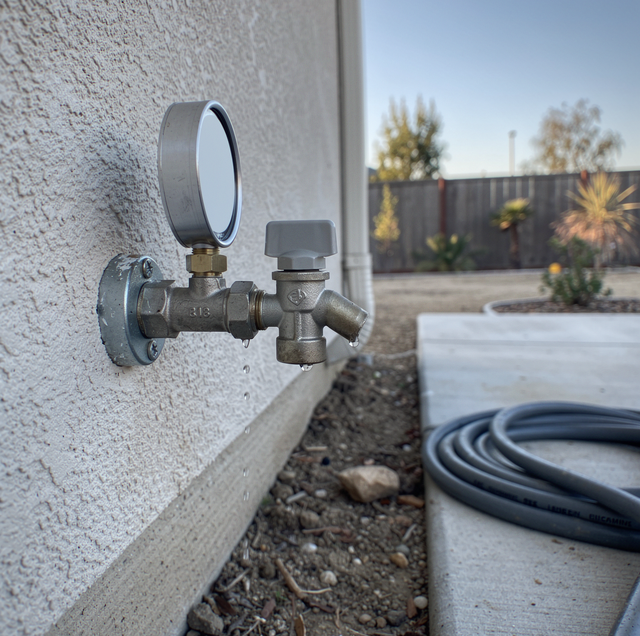
Quick Answer: Whole-house low pressure usually traces to one of a handful of causes on the main line: a failing pressure-reducing valve, a main shutoff or meter valve that is not fully open, corrosion narrowing old galvanized pipe, a hidden supply leak, truly low city pressure, or a restrictive whole-house filter or softener. A pressure gauge on an outdoor hose bib tells you fast whether the pressure really is low. Normal is roughly 40 to 80 psi, and a reading under about 40 confirms the problem is real.
When the kitchen faucet dribbles but the shower runs fine, the problem lives at that one fixture. When every tap in the house has gone weak at the same time, the shower, the bathroom sinks, the outdoor hose, the story changes completely. A problem that shows up everywhere at once almost never starts at a single faucet. It starts somewhere on the main supply line, upstream of the point where the water splits off to feed the individual fixtures.
That single distinction, whole-house versus one-fixture, is the most useful thing you can figure out before you touch anything. It tells you whether you are chasing a clogged aerator on one spout or a valve, a pipe run, or a supply issue that affects the entire home.
How Water Gets to Every Fixture, and Where It Gets Choked
Water enters your home through one main line. Just past the meter, it usually passes through a main shutoff valve and, in most homes, a pressure-reducing valve. From there, a single trunk line carries the flow into the house, then branches off to feed each bathroom, the kitchen, the water heater, and the outside spigots. Everything downstream of that split is fixture-specific. Everything upstream of it is shared by the whole house.
A pipe that carries water is a lot like a straw for a thick milkshake. A wide, clean straw lets the drink move freely, but pinch it anywhere along its length, or coat the inside with residue, and every sip after that pinch is weaker, no matter how hard you pull. A restriction on the main line does the same thing to a house: because all the water passes through that one shared section, anything that narrows or throttles it starves every fixture at once. That is why the "everywhere weak" pattern points you upstream, and why the fixes are different from what you would do for a single slow faucet.
The Six Things That Drop Pressure Across a Whole House
A failing pressure-reducing valve (PRV): This is the bell-shaped valve sitting where the main line enters many homes. Its job is to take the higher pressure coming from the street and step it down to something the home's pipes and fixtures can handle safely. Inside it, a spring and a diaphragm hold that setting. Over the years, those internal parts wear, and a tired PRV can drift downward, quietly choking the pressure to the entire house well below where it should sit. A PRV that has failed low is one of the most common reasons a whole home goes soft at once.
A partially closed main shutoff or meter valve: This one is deceptively simple and often overlooked. After plumbing work, a water heater swap, or a move-in where someone touched the valves, the main shutoff or the valve at the meter can get left only partway open. A valve that is three-quarters closed throttles the whole house just as surely as a bad PRV, and it costs nothing to rule out.
Corrosion and scale in old galvanized pipe: Homes plumbed decades ago with galvanized steel develop rust and mineral scale on the inside walls of the pipe. That buildup slowly narrows the usable diameter of the pipe until the effective opening is a fraction of what it was. Because it happens over years, the drop is gradual and easy to live with until it becomes severe. This is a whole-house, slow-motion version of the pinched-straw problem.
A hidden or underground supply leak: Water escaping from the supply line before it reaches your fixtures bleeds off pressure that the whole house should be getting. A leak in a slab or in the underground run between the meter and the house is especially sneaky because you may never see the water. It can show up as low pressure paired with a water bill or meter that keeps moving even when nothing inside is running.
Truly low municipal supply: Sometimes, the pressure arriving from the street really is low. A utility may reduce main pressure in an area, or your spot on the system simply delivers less than it once did. When the incoming supply is the limit, no amount of work inside the house raises it past what the street provides.
A restrictive whole-house filter or water softener: Whole-house filtration and softening equipment sits on the main line, so anything that clogs it restricts flow to the entire home. A sediment filter cartridge that is overdue for changing, or a softener with a fouled internal valve, can pinch the main just like a partly closed valve. This is one of the more common causes in homes that have treatment equipment installed.
There is also a seventh pattern worth separating out, because it narrows things fast: if the cold water runs fine everywhere but only the hot is weak, the restriction is not on the main supply at all. It is on the water-heater side, which is covered below.
How to Diagnose It Yourself, Step by Step
Before calling anyone, three checks tell you a lot.
Confirm the pressure is actually low: Buy an inexpensive water pressure gauge with a hose-thread fitting, screw it onto an outdoor hose bib, and open the spigot fully. A normal home reads somewhere in the range of 40 to 80 psi. A reading below roughly 40 confirms the whole-house pressure really is low and that you are not imagining it. This one number is the difference between a real problem and a fixture that just needs an aerator cleaned.
Check that the valves are fully open: Walk to the main shutoff and to the meter valve and make sure each is turned all the way to its open position. On a ball-type valve, the handle should sit fully parallel with the pipe. This costs nothing and rules out the partly-closed-valve cause immediately.
Check the whole-house filter, if you have one: If there is a sediment filter or softener on the main line, look at when the cartridge was last changed. A clogged filter is an easy homeowner fix and a frequent cause. Replacing an overdue cartridge sometimes restores pressure on its own.
What Is Homeowner-Safe and What Needs a Pro
The safe homeowner checks are the ones above: confirming the shutoff and meter valves are fully open, changing a whole-house filter cartridge, and running the gauge test on a hose bib. None of those requires opening the pressurized system.
Beyond that, the work moves into pro territory. Adjusting or replacing a PRV, tracing and repairing a slab or underground supply leak, repiping corroded galvanized lines, and diagnosing a main-line or municipal-supply problem all involve the pressurized main and specialized tools. A licensed plumber can measure pressure at multiple points, isolate whether the loss is before or after the PRV, and confirm whether the limit is your equipment or the incoming supply before anything gets replaced.
Whole-House Cause Versus a Single-Fixture Problem
Keep the two categories separate, and the diagnosis stays simple. If every fixture is weak, look upstream at the shared parts: the main shutoff, the PRV, the pipe runs, a whole-house filter, or the city supply. If only one fixture is weak while the rest of the house is normal, the cause is almost always local to that fixture: a clogged aerator on the spout, a partially closed stop valve under that sink, or a kinked supply line, and none of the whole-house causes apply. Running the gauge test and noting how many fixtures are affected sorts nearly every case into the right bucket before any parts get bought.
Frequently Asked Questions
Screw an inexpensive pressure gauge onto an outdoor hose bib and open the spigot fully. A normal home reads about 40 to 80 psi, and a reading below roughly 40 means the whole-house pressure really is low, rather than it being your imagination. Pressure can also swing by time of day as municipal demand rises and falls, so taking a reading in the morning and again in the evening shows whether the city supply itself is the variable behind the drop.
It is the bell-shaped valve where the main line enters the house, and it steps the city's high pressure down to a safe level for your pipes and fixtures. When its internal spring or diaphragm wears out, the valve can drift too low and starve every fixture in the house at once. A PRV usually lasts about 7 to 12 years, and it has an adjustment screw on top that a plumber can turn to raise the pressure back up before deciding the whole valve needs replacing.
That slow pattern points to scale and corrosion building up inside older galvanized steel pipes, which narrows the inside diameter of the pipe until flow drops throughout the house. The restriction is worst at threaded joints and along horizontal runs, where sediment settles, and the fittings collect the most buildup, so the tightest chokepoints are often at the connections rather than mid-pipe. It worsens so gradually that people usually do not notice until it has become severe.
Yes. The main shutoff or the meter valve is sometimes left only partway open after a repair or a move, which throttles the entire house. An older gate valve, the kind with a round wheel handle, can also fail internally when the stem detaches from the gate inside, so the handle turns fully open while the gate stays dropped and throttles flow. Confirming that those valves are turned fully open is one of the first and easiest things to check, and it costs nothing to rule out.
If pressure is low everywhere and your water bill or meter shows usage while everything inside is shut off, a hidden or underground leak may be bleeding off pressure. Steady low pressure with no extra usage points instead toward the PRV, the pipes, or the incoming city supply.
If the cold runs fine but the hot is weak at every tap, the restriction is on the water-heater side rather than the main supply that feeds the whole house. Common culprits there are scale built up in the tank, a clogging heat-trap nipple at the heater, or a valve at the heater that is not fully open.
Run the gauge test, then call for a pressure check — get every fixture back to full flow instead of guessing at the cause. Ser Plumbing repipes homes across the area, from repiping in Bellflower to Compton. Call (310) 953-3566.
