
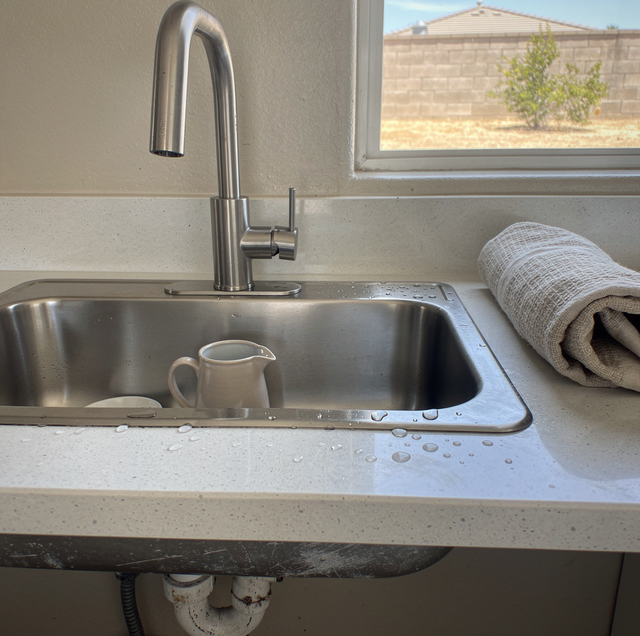
A faucet is usually chosen from a photograph. It shows up, the box comes open, and the first thing that goes wrong is a number nobody wrote down: the vertical gap between the spout's mouth and the bowl's bottom. On a shallow bar basin, a low spout can leave so little room that a pitcher will not stand up under it. Over a deep laundry basin, a spout that looked tall in the listing sits so far below the rim that a five-gallon bucket has to be tipped on its edge to fill. Nothing is broken. The faucet simply does not fit the basin it was carried to.
Bar and laundry basins are where this happens most, because neither behaves like the kitchen or vanity bowl a typical faucet is designed around. One is small and shallow, often tucked into a corner with a wall close on two sides. The other is deep and wide and usually sits low, with a shelf or a window above it. A faucet that suits one is frequently wrong for the other, and the reasons are physical rather than stylistic. Each measurement below decides, on its own, whether a given faucet will work on the basin already in place.
Spout Height and What Sits under It
Two different measurements are both called "height," and only one of them governs what you can fill.
Overall height: Deck to the highest point of the faucet, including the arc of the spout and the top of a raised handle. This number decides whether the faucet clears a windowsill, a shelf, or a cabinet above the basin.
Clearance under the spout: Deck to the underside of the outlet, measured straight down. This is what limits the size of the thing you can hold under running water, and on an arched spout it is always the smaller of the two.
What you can stand under the spout is that clearance plus however far the bowl drops below the deck. A shallow bar basin contributes almost nothing to the total, so the spout has to supply the height on its own. A deep laundry basin does most of that work itself, which is why a modest-looking spout can still fill a tall bucket set down inside the bowl.
The ceiling matters as much as the floor. Bar basins commonly sit under an upper cabinet or open shelving, and laundry basins often have a window or a storage shelf directly above. A high arc spout that swings into a window casing, or a handle that will not lift because a cabinet bottom is in the way, is a fit problem discovered after the mounting nuts are tight.
Height also drives splash, since water falling farther arrives faster and spreads more. A deep basin absorbs that energy in its walls. In a shallow bar bowl, a tall spout can throw a fine spray onto the counter at full open, which is why a low or medium arc often suits a small bowl better than a dramatic one.
Reach, and Where the Stream Actually Lands
Reach is the horizontal distance from the center of the faucet body to the center of the falling stream. It is a separate specification from height and is the one that determines where the water goes.
The measurement to take at the basin is from the center of the mounting hole to the center of the drain. Match the faucet reach to that distance, and the stream arrives over the drain opening instead of somewhere else.
Too short: Water lands on the near slope or the front wall of the bowl and runs down it. In a deep basin, that is only untidy. In a shallow bar bowl, water striking a wall near the rim can climb it and spill over the front edge.
Too long: The stream lands past the drain toward the back of the bowl, or on a small bowl it can hit the far rim. On a corner-mounted bar faucet, an overlong reach can cause water to spill outside the bowl entirely at one end of the spout's swing.
Height and reach interact. A taller arc carries its outlet back over the deck as it rises, so the same nominal reach puts the stream closer to the near wall of the bowl than a low spout would. That is why a tall spout with a short reach is the pairing most likely to splash.
If the spout swivels, the useful question is where the stream lands at each end of the swing, not at rest. A laundry basin usually wants the swing to cover the full width of the bowl; a bar basin close to a wall may run out of room first.
Take the deck thickness first, because it is the one number a listing will not give and a short shank cannot be adapted around. Measure the whole sandwich the shank passes through, counter plus basin rim, not just the counter.
Hole Count, Centers and Deck Thickness
The deck decides what can physically bolt to it.
Single hole: One opening, with the faucet built as a single body carrying a lever or a knob. Most small bar faucets are made this way.
Centerset: Three holes, the outer two commonly four inches apart center to center, with the faucet mounted as one piece on a shared base.
Widespread: Three separate pieces, a spout and two handles, with the outer holes commonly around eight inches apart and some range of adjustment between them.
Two hole: A pair of openings, common on molded laundry basins built to take a two-handle faucet at a fixed spacing.
Going down in hole count is possible. A single-hole faucet can be set on a three-hole deck using an escutcheon plate, a flat cover that sits under the faucet base and spans the outer openings. Going up is not: three holes cannot be made from one, and a widespread set cannot be squeezed onto a centerset deck.
Deck thickness is the measurement that gets skipped. The threaded shank must pass all the way through the deck while still leaving enough thread for the mounting nut and washer to grip. A thin stamped basin rim and a thick stone counter sit at opposite ends of that range, and some faucets ship with a shank short enough that a thick deck leaves nothing to tighten against. A few models offer extension kits; many do not.
Access is its own dimension. Those mounting nuts get turned from below, in whatever space exists under the basin, and a shallow cabinet or a basin pushed tight to a wall limits how a wrench can be swung.
Threaded Spouts on a Laundry Faucet
Many laundry faucets end in a male hose thread rather than an aerator. The threads are the same style found on an outdoor hose bibb, commonly three-quarter inch, though the specification is worth reading for a given faucet rather than assumed.
The thread is there so a hose can go on. A length of hose on the spout lets you fill something the basin cannot hold, rinse across the room, or send water to a floor drain instead of over the rim, and brush attachments, quick connect couplers, and screw on hose adapters all land on the same threads.
That fitting is why the outlet has no aerator. A normal faucet ends in one: a small screened insert that mixes air into the stream, shapes it into a soft column, and catches grit. A hose-threaded spout usually has none, because an aerator would sit in the way of a hose connection. The outlet is a plain bore, and the stream leaves it solid and unshaped, which means more splash in a shallow bowl and nothing screening debris out of the water. Some spouts take a removable aerator that threads on when no hose is attached and comes off when one is.
The spout body changes with it. Carrying an exposed thread makes the end thicker and squarer than a decorative one, and the tube itself is usually straight and heavy rather than tapered. Many hose-threaded laundry spouts either do not swivel or swing through a limited arc, because a hose hanging off the end pulls on the spout. The threads are exposed to knocks, and a plastic adapter cross-threaded onto brass will chew them.
A bar faucet almost never has this outlet. It is a laundry duty feature, and it is one of the clearest dividing lines between a faucet meant for a utility basin, and one meant for a small counter basin.
Valve and Handle Type for Utility Duty
A basin like this is used with wet, soapy, or gloved hands, and its faucet is cycled fully on and off many times rather than set to a specific temperature. Both halves of the choice follow from that.
A quarter-turn ceramic valve runs on two polished discs, one fixed and one turning against it, moving from closed to wide open in a quarter of a turn, so the handle motion is short and the feel is a clean stop at each end. A compression stem instead screws down to press a rubber washer against a seat, and needs several turns to cover the same ground. A container being filled wants the water on now and off now, and that difference in handle travel is the one the hands actually notice.
Handle style follows the same logic. A lever can be worked with the forearm or the back of the wrist when both hands are full, while a cross or knob handle needs fingers and a grip, and turns slippery once it is wet. A single lever sets temperature and volume in one motion, which is the easiest thing to manage one-handed, though it puts the handle above or beside the spout, where the height ceiling matters again.
Some bar basins are piped cold only, in which case a two-handle faucet leaves one side permanently idle. Verify what is actually piped to the basin before choosing.
What the Supply Side under a Small Basin Offers
The last dimension is underneath, and it is the one that turns a simple swap into a longer job. Three things down there decide where the connection can be made, and all three have to agree with each other.
The angle stops come first, the small shutoff valves on the hot and cold supplies, commonly carrying a three-eighths-inch compression outlet. Where they sit decides where the connection has to be made and which way the riser bends to get there. The supply risers are the flexible connectors that run from those stops up to the faucet, braided stainless or similar, and their length is fixed once they are bought, so a stop set far to one side or low on the wall may need a longer one than the old faucet used.
What the riser lands on at the top is the third thing. Older and two-handle designs often present threaded shanks, commonly half-inch male, that a riser screws onto, while many current single-hole faucets instead arrive with captive hoses already attached at the factory. Those hoses are a fixed length and cannot be adjusted, so the stop has to be within reach of them rather than the other way around.
Space is easy to underestimate. Under a bar basin, the cabinet is shallow and shared with a trap. Under a laundry basin, the stops often sit up on the wall behind, above rim height, where a riser has to curve a long way to meet the shank at a workable angle.
A seized angle stop can feel closed and still pass water. Before anything under the basin comes apart, close both stops, open the faucet, and confirm the flow actually stops rather than merely slows.
Every one of these numbers exists before the faucet is chosen and none of them change afterward. The deck has the holes it has, the drain sits where it sits, and the stops are where the plumbing put them. A faucet that answers all of them works regardless of how it looks.
Frequently Asked Questions
Yes. Besides a base plate, there is a hole cover: a finished button on a threaded stud with a rubber washer, dropped into the unused opening and pulled down tight by a nut from underneath. Covers are sold in finishes meant to match common faucet trim, and they are the usual answer when the spare hole sits off to one side, where a wide plate would look wrong.
A swiveling spout turns on a pair of O-rings seated in grooves near the bottom of the spout tube, held into the faucet body by a retaining clip or a collar nut. Once those O-rings flatten or dry out, water escapes at that joint, so the drip appears at the collar or runs down the shank and shows up under the basin instead. The valve cartridge is not involved, and changing it accomplishes nothing.
No. What leaves the outlet is set by the supply, not by how high the spout arcs, and a tall spout can even feel weaker under the hand because the stream has more distance to spread out before it reaches the bowl. The type of outlet skews that judgment further than height does. With no aerator in a hose-threaded laundry spout to shape or slow it, the same supply that feels soft through an aerated bar faucet feels hard and heavy out of the utility one. Comparing two spouts of the same kind, it is the height the water falls from, not the shape of the spout, that decides how it lands.
Wall-mounted faucets exist and are specified differently. The critical number is the center-to-center distance between the two wall inlets, not deck hole spacing. What that changes for everything else is where the measurements start from: spout height is taken from the basin rim rather than from a deck, so both of the numbers this article turns on have to be re-derived against that rim. Clearance under the spout becomes the gap above the rim, with the bowl's own depth added below it, and reach is measured out from the wall face rather than from a mounting hole. A deck mount spec sheet does not carry across.
The seal on a hose-thread connection is a flat rubber washer inside the female fitting, pressed against the flat end of the male thread. The threads themselves do not seal anything. A drip at that joint almost always means the washer is missing, hardened, or pushed out of its seat, and thread tape will not help. Replacing the washer is the repair.
Handles need it too, and the clearance has to be checked at the handle's travel rather than at rest. A lever's arc sweeps backward as it opens, so the obstruction that stops it is usually behind the deck rather than above it: a backsplash, a raised basin edge, a wall the faucet sits tight against. The number to take is from the back edge of the handle hole to that obstruction, with the handle imagined at full open rather than closed. A faucet measured only in its closed position can bolt down cleanly and then refuse to reach full flow.
A faucet that fits is decided at the basin rather than in the listing — a licensed plumber can take those numbers before anything is ordered and make the connection once it arrives. Ser Plumbing clears drains across the area, from drain cleaning in Downey to Long Beach. Call (310) 953-3566.
