
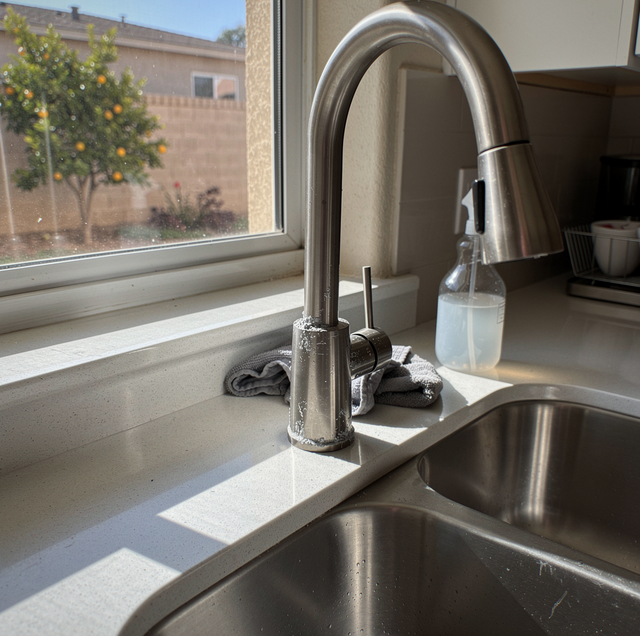
Quick Answer: The white haze and chalky ring on a new faucet are calcium and magnesium left behind as water evaporates. The deposit is hardest to remove where hot water dries, and it also collects inside the faucet.
A faucet installed only weeks ago already shows a change on its surface. What used to be a light haze near the base of the spout, gone with a single pass of a thumb, is now a raised, chalky ring that survives a first wipe and needs real pressure with a cloth or a fingernail to work loose. The finish itself hasn't dulled. What's sitting on top of it has simply gotten thicker and better anchored than it was in the first week, and it's building fastest at the exact spots where water sits longest before it dries: the base of the spout, the rim of the aerator, the underside of the handle.
The Two Minerals Behind Every Water Spot
Dissolved calcium and magnesium: these are the two minerals responsible for almost everything people call hard water. They enter the water as soluble bicarbonates as it moves through rock and soil upstream of a home, and in that dissolved form they're invisible; a glass of hard water and a glass of soft water look identical. The minerals become visible only after the water carrying them is gone, leaving them behind on a surface.
How much of these minerals a given household's water carries depends on the source feeding that water system and any treatment applied upstream of the meter, not on anything about the faucet itself. That's why a brand-new fixture can show heavy buildup within weeks in one home and take months in another a few streets over, even with the same faucet model installed the same way. The mineral load is a property of the water supply; the faucet is just the first place it becomes visible.
Two fixtures on the same supply line can also scale at different rates depending on how often they're used and how quickly they dry between uses. A faucet that runs constantly throughout the day and gets wiped dry will rarely accumulate a film faster than a nearby fixture that's used less but dried off after each use.
What Makes the Minerals Come Out of Solution
Evaporation is the mechanism. As long as water is moving or standing in liquid form, the dissolved minerals stay dissolved. The moment water sheets across a surface and starts to dry, the water leaves and the minerals it was carrying don't; they're deposited exactly where the last bit of moisture evaporated. That's why the ring forms at the base of the spout and around the aerator rim rather than somewhere in the middle of the faucet body that rarely gets wet.
Warm and hot water speed this along. As water heats up, dissolved calcium bicarbonate shifts more readily toward calcium carbonate: a harder, chalkier form that clings to a surface rather than rinsing cleanly away. That's part of why the buildup around a kitchen faucet used mostly for hot water can outpace an outdoor hose bibb fed from the same supply line. Neither fixture is treating the water any differently; the temperature at each one is doing different chemistry to the same dissolved minerals.
A faucet that's brand new shows this earliest and most visibly for a simple reason: the underlying finish has no old buildup, no water spots, and no wear to hide the first traces of new deposit. A ten-year-old faucet with a permanent haze already baked into worn chrome won't show a new week's worth of scale nearly as clearly as a finish that started out flawless.
How Different Finish Types Show It Differently
PVD finishes: physical vapor deposition bonds an extremely thin metal layer onto the faucet body in a vacuum chamber, producing finishes such as matte black, brushed gold, and brushed nickel that manufacturers often market as more resistant to spotting and staining than standard plated finishes. Whether that holds up under a given household's actual water use is not something any manufacturer backs with a guarantee; treat spot-resistance claims as marketing language to weigh against the specific finish's care sheet, not as a promise that deposits won't form.
Electroplated finishes: A standard chrome or nickel layer is bonded over a brass or zinc base through an electric current rather than a vacuum process, and it's generally thinner and less uniform than a PVD coating. Deposits tend to catch first at machining seams, thread lines, and the edge where the spout meets the escutcheon plate, since those spots are never perfectly smooth to begin with.
Living or unlacquered finishes: An unlacquered brass or copper faucet is sold on the premise that it will darken and shift color with handling and exposure over time; manufacturers present that shift as the intended look, not a flaw. Mineral deposits sitting on a finish that's actively changing color can leave the surface looking blotchy in a way that's hard to separate from the patina underneath, and no manufacturer publishes a way to tell the two apart at a glance.
What matters is that every finish type, chosen for whatever reason, rests on the same evaporation process described above.
The Parts You Cannot See Collect It Too
The finish is the part anyone can see and wipe. Every part behind it handles the same water and collects the same minerals, out of sight.
Aerator screen: The fine-mesh screen inside the aerator at the tip of the spout is the narrowest point that water passes through, so it's also the first place where flow slows down. Mineral flakes catch in the mesh and build up gradually, producing sputtering, an uneven stream split into odd jets, or a noticeably weaker flow from a fixture that's otherwise brand new.
Cartridge: Inside the faucet body, the cartridge that controls on/off and temperature can grow stiff or harder to turn as mineral flakes accumulate around its O-rings and internal seats. A faucet that felt smooth on day one and now takes real effort to operate is often reporting the same buildup that's visible on the outside, just doing it from the inside.
Spray head nozzles: On a pull-down or pull-out kitchen faucet, the spray face has a cluster of small openings that shape the water into a stream or a fan. Mineral crust narrows those openings unevenly, so the spray comes out angled, split, or thinner on one side rather than shutting off completely.
Check valve: Some faucet designs include a small check valve that lets water flow only one way. Deposits settling inside it can slow the valve's seating, though this is far less common than aerator or cartridge buildup and usually shows up only after other symptoms are already obvious.
A drip that continues at a steady rate whether or not the faucet has just been cleaned, or dark flecks in the water rather than crust on the metal, is a different fault.
What Removes Deposits Safely and What Damages a Finish
Two different approaches for removing mineral deposits are not interchangeable. An acidic descaler, whether a dedicated lime-and-scale remover or plain white vinegar, dissolves calcium carbonate chemically by breaking it back down so it rinses away. An abrasive pad, steel wool, or abrasive powder removes the deposit mechanically by scratching it off the surface, along with a microscopic layer of whatever it's sitting on.
An abrasive pad or a strong acidic descaler can permanently scratch or dull a PVD, matte, brushed, or living finish. Check that finish's own cleaning instructions first; damage doesn't come back the way a rinsed-off deposit does.
The safer default on a finished faucet is a soft cloth with whatever cleaner the manufacturer's own care instructions for that finish actually name, given time to sit and loosen the deposit rather than scrubbed harder to force it off faster. Never combine cleaning products to make a stronger mix; some common household chemicals react with each other in ways that are far more hazardous than the mineral deposit either one is meant to remove.
When the Water Itself Is the Thing to Address
A faucet that scales again within days of being cleaned, especially when the same pattern appears on other fixtures in the same home, points past that one faucet and toward the water supplying them all. Cleaning the same fixture on a repeating short cycle is treating the result rather than the source.
A whole-house water softener treats the minerals before they reach any faucet at all, and a water filtration or reverse-osmosis system addresses water quality at the point it's actually used. Either is a supply-side option rather than a fix for haze that's already on a fixture today. A softener works by ion exchange, running the supply through a resin bed that swaps calcium and magnesium for sodium or potassium, while a reverse-osmosis unit pushes water through a membrane at one fixture, leaving every other tap in the house on the untreated supply.
Frequently Asked Questions
Yes. Trapped mineral grit can lodge between a ceramic-disc cartridge's two polished discs, or between an O-ring and its seat, holding those surfaces microscopically apart. Hence, the faucet no longer shuts off completely. The result looks identical to a cartridge that wore out with age, but it started as scale caught inside the cartridge rather than ordinary wear.
Touchless faucets add an infrared sensor window and a small solenoid valve inside the base. A thin mineral film forming on the sensor window itself, separate from any buildup on the spout, can cause the sensor to trigger late or not at all, which may read as an electronic fault but is often just a film that needs wiping off the glass.
Fill a small plastic bag with the descaling solution listed on the product's label, slip it over the fixture, and secure it with a rubber band or a strip of tape so the part stays fully submerged. Leave it for the time stated on the product's own label rather than guessing, then rinse the fixture thoroughly with clean water — provided that finish's own care sheet allows a descaler at all, since the bag holds it against the spout's outer surface as well as the screen.
A pull-down or pull-out faucet has a separate small valve, called the diverter, that redirects flow between the spout and the spray head. When mineral flakes lodge inside the diverter rather than in the nozzle openings, the spray head can remain stuck in spray mode even after all visible nozzle holes have been cleared.
A softener only treats water that passes through it after it's installed; it doesn't remove deposits already crusted onto existing fixtures. Most residential units also regenerate on either a timer or a meter that tracks gallons used, so how soon fully softened water actually reaches a given faucet depends on that regeneration setting rather than the installation date alone.
Aerators are stamped with a flow rate in gallons per minute, and swapping a heavily scaled original for a replacement rated differently can change spray pattern and water flow even after the clog itself is gone. Matching the rate stamped on the original keeps the fixture performing the way it did when it was first installed.
Clear the mineral buildup before it wears down the parts inside — professional faucet repair and installation. Ser Plumbing flushes water heaters across the area, from water heater flush in Downey to Long Beach. Call (310) 953-3566.
