
Quick Answer: A repipe replaces the pressurized piping inside the house, from the point of entry out to every fixture. A main water line replacement replaces the buried run serving the house from the utility's main. Different locations, different failures, different work.
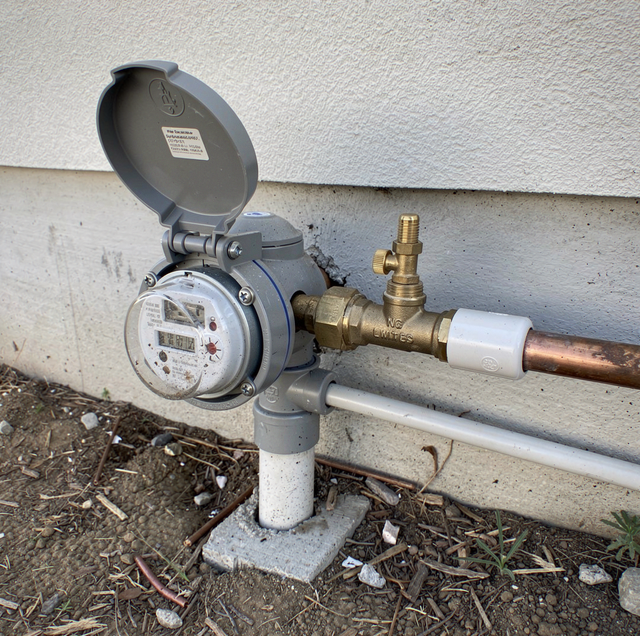
Everything upstream of the meter box at the front edge of your property is delivery. Everything downstream of it ends at your taps. One job replaces piping on one side of that lid. A different job replaces piping on the other. They happen in different places, are proved by different tests, and, in most people's heads, share a single name.
Almost nobody knows which side of the box their problem is on, and it is not for lack of attention. Water failures announce themselves at the fixture. A shower that lost its push, a stain spreading across a ceiling, every tap in the house weakening at once: all of it reaches you indoors, whether the cause sits in a wall you can touch or in the ground outside.
Where One Job Ends, and the Other Begins
Water reaches a tap through a chain of pipe with a few named parts, and the comparison is easier once they sit in order.
The utility's main: the large line under the street, serving your property and everyone else's.
The service line: the buried run leaving a connection on that main, traveling to the meter box, then continuing to the wall where the pipe enters your building. One length of pipe doing one job, interrupted midway by the meter. This is what people mean by the main water line.
The point of entry: the wall or slab edge where the buried pipe surfaces and becomes house plumbing, usually within reach of a shutoff valve and a pressure regulator.
Interior distribution: everything past that point, hot and cold, trunk to branch to fixture. Replacing that network is what a whole-house repipe means.
The comparison turns slippery right here. The physical split and the responsibility split are two distinct lines and do not always coincide. Which portion of the buried run your water provider maintains and which is yours to replace is set by the provider rather than by the plumbing, and providers do not all set it the same way. Confirm it with yours instead of assuming.
Before you accept a quote for either job, call your water provider and ask which portion of the run between their main and your house they take responsibility for. Providers differ, and the answer changes what the job includes.
Four Things Get Called the Main
Much of the confusion is vocabulary. Four things carry the word, and only one is the pipe most homeowners mean. The utility's main is theirs, under the street. The main water line is the service line above. The main shutoff is a valve rather than a pipe, at or near the point of entry. The sewer main carries water away rather than delivering it. So when a neighbor says they had the main replaced, ask which pipe and which side of the meter before assuming it was the job you are weighing.
How a Service Line Fails
A service line is a simple thing in a hard place: one pipe, one path, no branches, buried its whole length, carrying the demand of the house through a single bore. When it fails, it fails as a ground leak, and the signs are outdoor signs.
Ground that stays soft or wet in a line when nothing has been running. Water surfacing at a curb, a walkway edge, or a seam in a driveway. A stripe of lawn greener than what surrounds it, following a route you never mapped.
Indoors, the tell differs from anything a wall leak produces. The whole house weakens at once rather than one bathroom, and it stays weakened instead of coming and going. A continuous rushing sound carries at the point of entry with every fixture closed, and metered usage climbs while nobody changed a habit.
What it does not do is just as useful. It does not discolor the first draw at one sink and leave the others clean, and it does not put pinholes in a bathroom wall one year and a laundry wall the next. Being buried, it can leak a long time without touching the structure, which is why it gets found by a meter rather than by damage.
If the register still creeps after the house shutoff is closed, water is escaping in the ground between the meter and that valve. A buried leak left running undermines soil and slab edges long before anything shows indoors.
How the Piping Inside the House Fails
Interior piping fails the opposite way: gradually, in pieces, and in plain view.
Restriction builds inward from the pipe wall, so delivery fades over years rather than dropping in a week, and the fixtures farthest from the entry feel it first while a sink near it still seems fine. Discolored water on the first draw, clearing once the tap runs, is interior evidence, and so is a hot side performing worse than the cold in the same rooms.
Then the pattern that decides most repipes. A pinhole in a bathroom wall gets repaired. Eight months later another opens in a different room, at a joint nobody touched. No single leak proves anything. Three of them in three places over a couple of years is the pipe saying the material has reached the end of its service across the whole system.
Interior failures also do their damage where you live: ceilings, cabinet floors, baseboards, flooring. Where the damage lands is often the fastest way to know which half is talking to you.
What You Notice, and Which Job It Points To
| What you notice | Which job it points to | How it gets confirmed |
|---|---|---|
| All fixtures weakened at once, and stayed | Buried run into the house | Readings at the point of entry, then at a far tap |
| Register moves with every fixture closed | Loss past the meter | Close the house shutoff, watch again |
| Soft ground or water surfacing outside | Buried run | Leak location equipment, worked from the surface |
| Continuous rushing at the point of entry | Usually the buried run | Listen with the house shutoff closed |
| Discolored first draw that clears as it runs | Interior piping | A cut section examined, hot against cold |
| Pinholes in different rooms over a few years | Interior piping | The pattern, read against material and age |
| One fixture weak, the rest normal | A branch, stop, or supply connection | Isolate the branch, check the stop |
How Each One Gets Confirmed
Neither job should be sold on symptoms alone, and the tests that settle them are not the same.
Readings at more than one point: A single number at one hose bib tells you almost nothing. What a plumber wants is a comparison: what the supply delivers at the point of entry, and what survives to a far fixture under load. Healthy at the entry and poor at the far tap puts the problem inside the walls. Poor at the entry puts it outside them, and the meter and service line together set a ceiling no interior work can lift.
The meter test, in two stages: This is the most useful thing a homeowner can watch, and it separates the two jobs cleanly. Close every fixture and appliance, then watch the register. Movement means water is leaving the system past the meter. Now close the main shutoff at the point of entry and watch again. Still moving means water is escaping between the meter and the valve in the buried run. Stopped means the loss is inside.
Leak location on a buried line: Once the loss is known to be outside, what remains is finding where along the route it sits, and that happens from the surface before anything is opened. Listening equipment picks up the sound a pressurized leak makes through soil and paving, and readings from two points are compared to narrow the spot.
What does not belong here: A sewer camera is a drain and sewer tool. It cannot travel a pressurized water line and has no part in diagnosing a supply problem.
Interior evidence: Inside, confirmation is physical: a section of pipe cut out and examined, the hot network isolated from the cold at the heater, and the repair history read whole rather than one leak at a time.
What Doing Both in One Visit Actually Changes
When the evidence points at both halves, doing them together changes four practical things.
One shutdown: The house loses water for a changeover once rather than twice. Interior work can be run and pressure tested alongside the live old system, and a new buried run can usually be laid and tied in the same way, so one water-off window covers both.
One permit conversation: Permits and inspections are decided by your building department rather than by which of the two jobs you call, and both commonly fall within what gets permitted. Two scopes can still carry separate inspections, but the conversation happens once.
One mobilization: One crew, one set of access arrangements, one disruption to your ground and your walls, one restoration instead of two.
A clean transition where the two meet: The point of entry is where the buried run hands off to the house. Replace both sides together, and that handoff is made new-to-new, with the main shutoff and the fittings at it settled once. Replace one half alone, and the new work terminates against the old, joining pipe of one age and often one material to pipe of another. That junction becomes the thing the system leans on.
When Replacing the Service Line Buys You Nothing
The honest half of this comparison is the case against doing both, and it is stronger than the sales version admits.
If the buried run is sound, replacing it won't deliver anything you can feel. It will not improve flow at a far bathroom, because that loss is being spent inside the walls. It will not stop pinholes, because pinholes are a property of the pipe they appear in. It will not extend the life of interior piping by a day.
A service line with no leak history, a clean meter test, and healthy readings at the entry is a pipe that says plainly it is not the problem. Age alone is not a finding, nor is a crew already on site. That a wall is open is a good reason to ask the question. It is not an answer to it. The discipline runs in reverse too: a house repiped a few years ago does not need repiping again because the buried run failed. Each half earns its own replacement on its own evidence.
What Happens When the Wrong Half Gets Replaced
Replace the inside while the buried run is failing, and fix the sequence from there. The walls close on new pipe at every fixture, the test holds, and the shower reads exactly as it did the week before, because the restriction was never in a wall. Some months on the ground give up the leak it was holding, and a second project starts: the house down again, the ground opened, a new buried run tied into an already new interior system. Nothing installed was wrong. It answered a question nobody had asked.
Replace the buried run and leave the interior alone, and the sequence runs the other way to the same place. Full supply arrives at the point of entry for the first time in years, then enters the same narrowed, thinned, decades-old runs it always did, and the far bathroom performs as it always has. Then the harder part. An old pipe behind a strangled service line has been operating at reduced pressure and slower flow, and restoring both can bring to the surface a weak spot that was being spared. A pinhole in the weeks afterward is not always a coincidence.
Neither outcome comes from bad work. Both are real jobs, competently done, on the half of the system that was not asking for them, which is exactly what makes them easy to walk into. And both are settled in the same half hour, before anybody quotes anything: one closed valve and two looks at a register.
Frequently Asked Questions
It turns on whether the leak is an event or a condition. A puncture from an outside force, on a line otherwise in good shape, is a repair. Age-driven failure is different: a line that opened because the pipe is finished will reopen elsewhere along the same run. Ask which your plumber is seeing, and what supports it.
There are usually two authorities rather than one. Your building department decides which permits and inspections the work on your property requires, and your water provider sets separate requirements for anything that touches their connection or is done in the public right-of-way. The two do not substitute for each other, so ask who is pulling what.
Copper, polyethylene tubing made for burial, and PEX rated for underground use are the common choices, and the pick is a soil and site question rather than a preference. The material on the buried run need not match what goes inside: a copper repipe behind a polyethylene service line is joined by a fitting rated for exactly that.
Call your water provider first, for reasons unrelated to responsibility. They can shut off the water at the box, which a homeowner generally cannot, and they can tell you whether the wet spot is on the portion they handle. If it is on your side, you have gained a shutoff. If theirs, you avoided sending a plumber to a pipe that was never yours.
Only if the reading at the point of entry was low to start with. One component gets overlooked more than any other: the pressure regulator just inside the house. Regulators fail, drift out of adjustment and clog, and a failed one holds the whole house down no matter what pipe feeds it. It is a small part, and confirming it before either large job is time well spent.
They are counted in different units, which is why the two schedules rarely match. The interior job scales with fixtures, separate runs, and the number of wall and ceiling openings the routing requires. The buried job scales with the distance from the connection to the house and with whatever lies on that route.
Find out which side of the meter your problem is on — have a licensed plumber take readings at the supply, run the meter test, and name the pipe that is actually failing. Ser Plumbing repipes homes across the area, from repiping in Lakewood to Downey. Call (310) 953-3566.
