
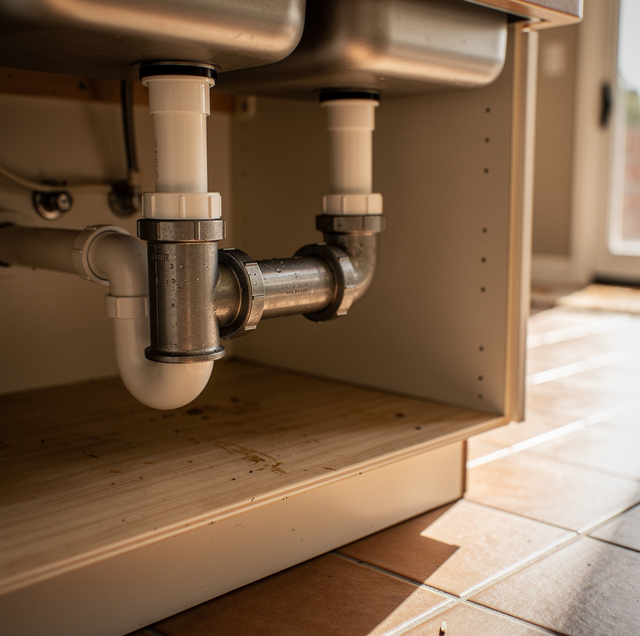
Quick Answer: A double-bowl drain runs two tailpieces into a continuous-waste tee before a single trap. A single bowl needs none of that merging, so the tee, the waste arm, and often the trap itself are rebuilt to reach a single relocated opening.
A single-bowl sink looks like a simple swap next to the double-bowl one it replaces: measure the counter opening, pick a bowl that fits, and drop it in. What that picture leaves out is everything below the counter. A double-bowl sink was never plumbed as a single drain with two holes. It was plumbed with two separate drain paths that meet at a fitting and share a single trap. Take away one of those paths, and the fitting that joined them has no job left to do.
That gap between how a single bowl looks above the counter and how its drain has to work below it is where a simple-sounding upgrade turns into real plumbing work. None of it is complicated on its own, and your kitchen does not need anything unusual for it to happen. It is only a surprise if you walked in assuming your new bowl would just reuse whatever pipe was already sitting there.
The Tee That Joined the Bowls Has No Job Left
Look under a double-bowl kitchen sink, and past the two strainer baskets, there is a fitting called a continuous-waste tee where the two tailpieces come together. One inlet takes the drain line from one bowl, the other inlet takes the line from the second bowl, and both flows leave through a single outlet that drops down to the trap. That fitting is what lets two separate basins run to one trap instead of two.
Before choosing a single-bowl sink, look under the cabinet and note where the trap and the wall stub-out sit relative to the two drain openings above them. That starting position is what any relocation plan has to work from.
A single bowl has one tailpiece, not two. There is nothing to feed the tee's second inlet, and a continuous-waste fitting is not built to run for years with one side capped and forgotten; the whole point of the part is to combine two lines, not to seal one off. When your double bowl becomes a single bowl, the tee comes out along with the old sink, and what goes back in below your new drain opening is a simpler fitting sized for one line rather than two.
Continuous Waste Versus an End Outlet
Continuous waste is the general term for that two-inlet horizontal fitting, and it comes in multiple layouts. Where a double bowl has no disposal, the two tailpieces are close to the same length, and the drop to the trap sits centered between them. Where a disposal sits on one side, its horizontal discharge tube already extends from the unit at its own height and angle, so the drop to the trap is set off at one end of the fitting rather than the middle. Plumbers describe that offset version as an end outlet: one inlet close to the outlet, the other inlet feeding in from farther away.
Whether your old assembly used a centered drop or an end outlet determined where your existing trap sits today, which matters for the next question: whether your new opening lines up with that trap at all.
Why the New Opening Rarely Lands Where the Old One Did
A double-bowl sink has two drain holes, each centered over its own basin. A single bowl has one, centered over the basin's own footprint, which is a different point in space than either of the two holes it replaces, and often different again from where the trap was sitting underneath the old tee. The trap followed whichever inlet arrangement the old continuous-waste fitting used, not the midpoint of the whole sink, so there is no guarantee that your single bowl's centered opening falls anywhere close to it.
This is a drain-routing question, separate from whether your new sink also requires a different opening cut in the counter above it. That half is decided by the bowl's outside dimensions, not its drain position, and it is its own question. Below the counter, once the new opening's location is set, the plumbing has to run from that point to wherever the trap and the wall stub-out already sit, and that path rarely involves reusing the old one in a straight vertical drop.
The Waste Arm's Fall to the Trap Gets Rebuilt, Not Reused
The horizontal pipe that carries water from the tailpiece down into the trap is the waste arm, and it must be continuously angled downward from the strainer end to the trap end, with no flat or uphill stretch anywhere along it. When the drain opening sits in a new spot, the waste arm's two endpoints both move: the top end follows the new tailpiece, and the bottom end has to reach whatever point the trap ends up at. A pipe cut and angled for the old positions does not simply slide over to match new ones a few inches away; the length and the angle both change, so the old run gets replaced rather than repositioned.
The room available for that fall is bounded at the top by the underside of the sink and at the bottom by the height of the stub-out where the trap arm meets the wall. Neither of those two points moves with the sink, so the drop the waste arm has to work inside is set before any new pipe is cut.
Where the Trap Ends Up When One Bowl Becomes a Center Drain
The trap has to sit beneath the point where the waste arm delivers water to it, which means it moves whenever the drain opening does. If your old double-bowl assembly used an end-outlet fitting because a disposal sat on one side, the original trap was likely already off to that same side, not centered under the sink. Converting to a single-center bowl, with or without keeping a disposal, asks the trap to shift toward the middle of the cabinet from where it was sitting before.
Where a disposal occupied one of the two bowls, removing that bowl removes its drain path entirely, and what becomes of that unit is a separate decision the drain routing does not answer on its own.
On the outlet side, the trap connects to a trap arm that runs out to the wall stub-out, and that stub-out is generally the one point in the whole assembly that does not move with the sink. So the trap arm is what absorbs most of a sideways shift: it gets longer, shorter, or re-angled to close the gap between wherever the trap landed and the fixed point in the wall, without the wall connection itself changing.
What a Vent Is Actually Protecting, and Why Sideways Is Not Free
A vent lets air into the drain system at a fixed connection point, and the reason a trap needs that air is its own subject, covered elsewhere. What matters for a conversion is the geometry: a trap gets real protection from that connection only while it sits within reach of it, and the connection itself does not move just because the sink above it changes shape.
Shift the trap sideways to meet a relocated drain opening, and the distance between the trap and that fixed vent connection changes too, whichever direction it moves. Move it closer, and nothing about the vent's job gets harder. Move it farther, and the same vent connection now covers more pipe than it was built to, which is why relocating a drain opening is not just a matter of running more pipe under the sink. The vent tie-in is part of what has to be checked against your new layout, not an afterthought that finishes once the trap and waste arm are cut to fit.
Frequently Asked Questions
More than the raw distance does. A shift left or right by the same distance from the wall changes the angle the trap arm must take, but not the amount of fall it needs. A shift toward or away from the wall changes the trap arm's length, and a longer arm has to give up more height over its run to keep falling the whole way. Two moves of the same number of inches can land very differently on the assembly below depending on which direction they went.
No. The branch line the trap arm ties into was already sized for a kitchen sink, and a double-bowl sink and a single-bowl sink are the same fixture on that line regardless of how many basins sit above it. What changes with the conversion is only the trap arm's length and angle as it reaches the same branch connection from wherever the trap now sits, not the size of the line it reaches.
Sometimes, and sometimes not. A slip-joint extension can accommodate a modest offset along a single straight line between the old and new positions. What it cannot do is absorb a move that shifts sideways and toward or away from the wall at the same time, since that is a change in heading, not just distance. A diagonal move like that calls for a new pipe run with an actual offset fitting, not a longer version of the old one.
Not as a permanent arrangement. A conversion normally deletes the tee altogether rather than adapting it, because a single bowl has nothing to merge and the fitting's second inlet serves no purpose once the bowl feeding it is gone. Blanking that inlet with a slip-joint cap is something a plumber may do to test a rebuilt run before the trap goes back together, not a finished assembly, and the tee comes out in favor of a plain extension sized for one line.
At the same fitting the trap arm enters. Behind the wall, the trap arm meets a fitting whose lower branch continues down as the drain and whose upper branch continues up as the vent, so the two are opposite ends of a single connection rather than separate pipes meeting farther along. That is why the fitting itself does not move when the sink above it changes: it is part of the wall rough-in, not part of the assembly under the cabinet.
Fall, not distance on its own. A trap arm has to drop all the way to the wall, so the farther the trap sits from the vent connection, the lower the trap's outlet ends up relative to that connection. Once the arm has fallen far enough that the trap's outlet drops below the level of the vent takeoff, the arm can run full and siphon the seal, rather than letting air in behind the water. That relationship is what gets measured against the new trap position, and where it does not work, the answer is a routing change rather than a longer pipe.
Bring your new sink's drain position into the conversation before the old one comes out — matching the trap and vent to where it lands is simpler to plan than to correct. Ser Plumbing repairs water heaters across the area, from water heater repair in Downey to Long Beach. Call (310) 953-3566.
