
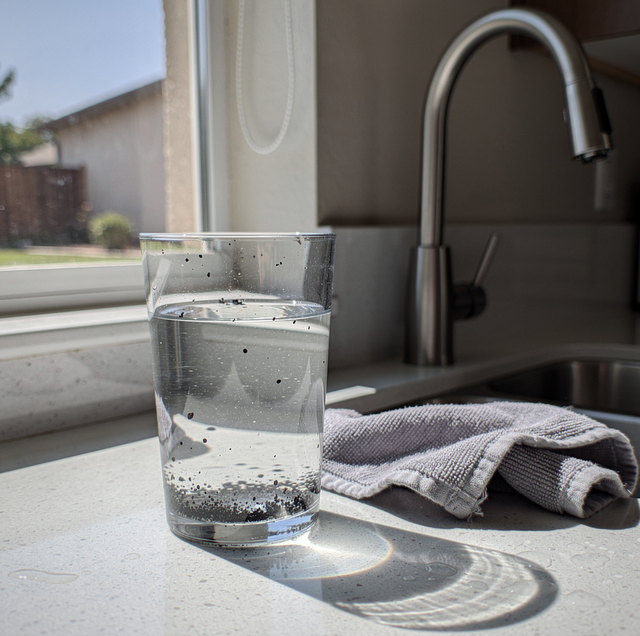
Quick Answer: Two quick checks place the source before you touch a single part: whether the specks show up in hot water, cold water, or both, and whether the material smears like rubber or breaks apart like grit.
Fill a clear glass straight from the tap and hold it up to the light. If dark flecks settle at the bottom, or if the aerator screen at the tip of the spout has come away with a rim of black residue caught in its mesh, that material is a clue, and rinsing it away throws out the evidence. What it looks like and what it does when you handle it point back to exactly where it started.
Black specks are not a single problem with a single fix. They can come from a rubber part breaking down somewhere in the line, from mineral scale letting go inside a pipe or fixture, from the water heater tank itself, or from something upstream that reaches every faucet in the house at once. The material tells the story before a wrench ever comes out.
Hot, Cold, or Both: The First Split That Narrows the Source
Before touching anything, run the hot side alone for a short stretch, then the cold side alone, and note which one is carrying specks. Cold water at a kitchen or bathroom faucet comes straight from the supply line and the fixture's own internal parts, with no tank in between. Hot water takes a longer path: through the same supply line, into the water heater tank, and back out before it ever reaches the faucet.
That single distinction sorts the problem into two very different categories. Specks in cold water only, or in both hot and cold, point at something on the supply side or inside the faucet itself. Specks that show up exclusively in hot water, with the cold side running clear every time, put the search on the hot side of the system: the tank itself, or the hot supply connector and the faucet's hot-side internals, which sit downstream of the heater and run hotter than their cold-side twins. Running both sides separately, more than once, is worth the extra effort — a single stray fleck from disturbed sediment can make one test look misleading if it is not repeated.
Smear or Crumble: What the Material Tells You
Once hot, cold, or both is settled, the second question does the rest of the work. Pinch a few flecks between a finger and thumb and rub them together. Material that smears into a soft black streak under light pressure is a degraded rubber part. Material that breaks apart into smaller, sharper pieces under the same light pressure is more likely mineral scale or sediment, though rubber that has hardened with age can crumble too, so treat a crumbling sample as a lead rather than a verdict.
Judge the flecks against a plain white surface, not inside the glass. Tip the sample onto a white saucer or a paper towel, since glass tint and overhead lighting can make gray mineral grit read as black.
Rubber that is still soft deforms and spreads under pressure instead of fracturing. Mineral scale is largely calcium carbonate, brittle enough that pressure breaks it into smaller grains. Rubber that has oxidized and hardened behaves more closely to the scale, which is why a smear confirms rubber, but a crumble does not rule it out. Neither test takes more than a few seconds, and together they narrow four possible sources down to one or two before any part comes off the fixture.
The table below lines up the two questions.
| What You Notice | Likely Material | What It Rules Out |
|---|---|---|
| Smears into a soft streak | Degraded rubber (washer, O-ring, connector) | Not scale or sediment |
| Breaks apart into grit | Mineral scale or sediment | Not a soft rubber part |
| Only in hot water | Tank sediment or tank lining | Hot only |
| At every fixture at once | Whole-house source | Both, everywhere |
Rubber Breaking Down Inside a Supply Connector or Washer
Faucets and the supply lines feeding them carry rubber in several places at once: the washer under an older two-handle stem, the O-ring that seals a cartridge, and the flexible core inside a supply connector where it meets the angle stop. Chlorinated water and ordinary age both act on that rubber. The surface softens, then starts giving up small pieces instead of holding its shape.
Because rubber deforms rather than snapping, what comes loose tends to be soft and rounded, and it smears rather than crumbles. It shows up as a few flecks at a time rather than all at once, and it can appear on either side, since rubber sits in the line both ahead of the water heater and downstream of it, in the hot supply connector feeding the faucet. A faucet repair that replaces the washer, the O-ring, or the connector itself removes the source directly, rather than leaving it to keep shedding.
Mineral Scale and Sediment Working Loose
In hard-water areas, dissolved minerals do not stay dissolved forever. As water sits or moves through narrow passages inside a cartridge, an aerator, or a length of pipe, some of that mineral content comes out of solution and clings to the surface as scale. That scale layer thickens month over month until a piece breaks free and travels the rest of the way to the tap.
Sediment works on a different principle but starts from grit rather than dissolved minerals: fine particulate that settles in low spots in the line and gets stirred loose by a change in flow or pressure. Both mineral scale and sediment share the same handling test, breaking apart into smaller pieces rather than smearing, and both tend to look gray or white rather than true black, though pipe residue or oxidation can darken the color enough to be mistaken for something else. The fix depends on where the scale has formed: an aerator can be cleared, a cartridge can be replaced, and a line carrying heavy sediment may need a broader look.
A Hot-Only Pattern Points to the Water Heater
If the cold side runs clear every time and the hot side keeps producing specks, the source is not the faucet at all. Inside the tank, a bed of settled sediment or a corroding tank lining can shed material into the hot-water path before it ever reaches a fixture, and no amount of faucet repair can address either. That is a water heater issue rather than a faucet issue, and it is diagnosed at the tank rather than at the fixture.
Specks Showing Up at Every Fixture in the House
A single faucet with specks points at that faucet's own washer, cartridge, or connector. Specks at every fixture in the house, kitchen, bathroom, and laundry all at once point somewhere upstream of any individual fixture, since no single washer or cartridge feeds the whole house at the same time.
An aerator screen is often the first place anyone notices the problem, simply because it is the last strainer before the water leaves the faucet and it catches material that has already traveled the length of the line. Close the faucet handle and shut off the water at the angle stops under the sink before removing the aerator, so nothing is under pressure while the part is off. Clearing it removes what has already collected, but it does not touch whatever is still generating new material upstream, and weak flow at a single fixture without any specks is a restriction problem rather than a shedding one. When the pattern spans every fixture from a single shared source, the repair has to address that source rather than any one fixture.
Frequently Asked Questions
That is a water-quality question, not a plumbing diagnosis, and it is not one a plumbing inspection can settle. Your water utility publishes an annual water quality report, sometimes called a Consumer Confidence Report, that lists what the supply has been tested for and is the right place to look for that answer. A plumbing inspection can tell you which part of the system is shedding material and why.
Standing water in the supply line, not just the tank, lets fine grit settle to the low points. The first heavy draw after several unused days lifts that settled layer and carries it to the nearest fixture, which is why the specks arrive in a burst and then stop.
New supply lines and a new faucet can carry a small amount of manufacturing residue and thread-sealant debris left over from assembly, and normal water pressure flushes it out over the first several uses. Running the tap briefly after any faucet or supply-line replacement clears most of it before it reaches a glass. If specks are still turning up once the fixture has been in normal use for a while, it is no longer that leftover residue and is worth a second look.
Yes. An outdoor hose bibb has the same rubber-washer construction as an indoor faucet, but it sees more grit, more sun on its body, and longer stretches of sitting unused than one tucked under a sink, so it can break down and shed material on its own timeline. If the outdoor spigot is showing specks while every indoor fixture runs clear, the hose bibb is the place to start.
It is possible, especially if the flecks are clustered right at the aerator screen or the spout opening rather than distributed through a full glass of water. Mold and mildew growing on a damp surface tend to carry a musty smell and a greenish-black tint, and they smear into a damp streak rather than breaking apart like grit or rolling into a rubbery bead. That combination points away from a plumbing part entirely.
It can. As a galvanized supply line corrodes from the inside, it sheds dark iron and rust flecks into the water, and because that line feeds the whole house rather than a single fixture, the specks show up everywhere at once rather than at a single tap. A magnet dragged through a sample can help: the black magnetite scale that forms inside steel pipe clings to it, while mineral grit does not. Reddish rust often will not cling either, so a negative result narrows nothing on its own.
Narrow the specks down to their real source before replacing a part that was never the problem — a licensed plumber can trace it to the part actually shedding. Ser Plumbing clears drains across the area, from drain cleaning in Norwalk to Compton. Call (310) 953-3566.
