
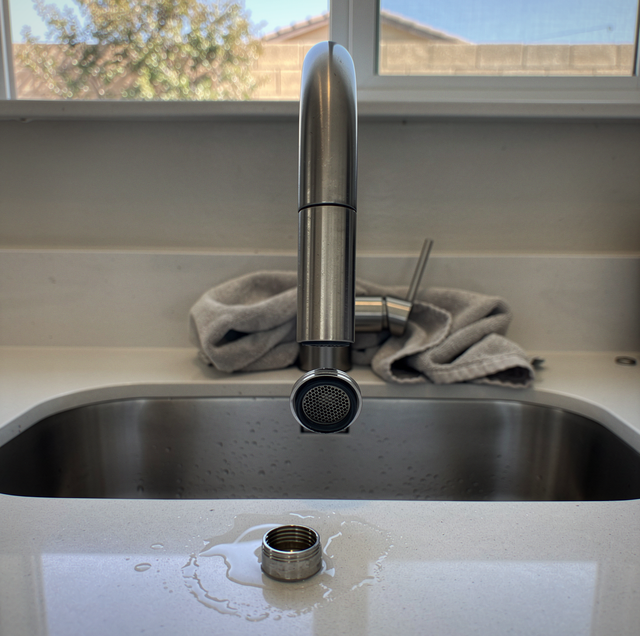
Quick Answer: If every other faucet in the home runs normally, whole-house water pressure is not the problem. Work backward from that one fixture instead: the aerator, the cartridge's inlet screens, the supply connector, and the angle stop feeding it.
You have already run the test without quite meaning to. Every other faucet in the house — the bathroom sink, the tub, the hose bib outside — delivers a normal stream. It is just the one fixture, usually the kitchen faucet, that comes out as a thin trickle no matter how far the handle is turned. That comparison already rules out more than it might seem to. A drop that shows up at every fixture points to something upstream serving the whole house, a separate problem with its own diagnosis. A drop confined to one fixture does not behave that way. It means the restriction sits somewhere inside a very short run of pipe and hardware, the few feet between the wall and the spout, and nothing beyond it.
That short run has only a handful of places a restriction can form. Working from the spout backward toward the wall covers them in order, from the part most likely to be the cause to the ones that are only occasionally.
Why the Aerator Is the Step You Have Probably Taken
The aerator is the small perforated fitting at the spout tip; it is the narrowest point in the whole fixture, and clearing it is an important step. Assume it has been done. What matters here is what it rules out: if flow is still weak with the aerator unscrewed and set aside, every remaining suspect sits behind the spout.
The Cartridge and Its Inlet Screens
With the aerator ruled out, the next stop is the cartridge inside the faucet body. Many faucets, single-handle or two-handle, move water through a cartridge that controls flow and temperature, and the cartridge has inlet ports where the supply enters. Those ports are narrower than the pipe feeding them, and on many cartridges they carry their own small screens meant to keep grit out of the moving parts inside. Sediment stirred loose by unrelated plumbing work elsewhere in the house settles wherever the passage narrows next, and the cartridge's inlet ports are usually the next narrow point after the aerator. This is a different failure than a worn cartridge that drips or feels gritty to turn; a cartridge with a blocked inlet screen can otherwise be in good working order and still starve the fixture of flow. Clearing it usually means pulling the cartridge and flushing or replacing the screen; it works best left to a plumber because the retaining clip that holds the cartridge at depth strips easily and the cartridge cannot be reseated without it.
Shut off the angle stop under the sink before disconnecting a supply connector or pulling a cartridge. Line pressure still in the fixture can send a sudden spray of water across the cabinet the moment a fitting breaks loose.
A Kinked or Restricted Supply Connector
Past the cartridge, the next segment is the flexible connector that runs from the angle stop to the faucet's tailpiece. These connectors are built to bend, but a cabinet with limited depth sometimes forces one into a sharper bend than it was designed for, and that bend point becomes the narrowest part of the entire path from wall to spout. A connector installed with a long loop of slack, coiled to take up leftover length in a tight space, is especially prone to this, since the coil folds back on itself rather than following a clean, gradual curve. The same debris that clogs an aerator or a cartridge inlet can also catch at the crimped fitting on either end of the connector, particularly right after other plumbing work has disturbed the line. A connector that is the source of restricted flow will often look completely ordinary from the outside; nothing about its appearance signals the problem, which is part of why it gets overlooked in favor of the aerator or the stop.
An Angle Stop That Is Not Fully Open or Has Scaled Internally
The angle stop under the sink is a valve, and, like any valve, it can restrict flow without leaking or failing to close. Two different conditions inside the stop produce the same symptom of weak flow at one fixture. The first is simple: the stop was not turned fully open. This happens most often after other work has been done under the sink, when a shutoff is closed to protect against a drip and then reopened only partway, or when a stop, installed slightly stiff, is never worked past its first resistance. The second is scale building up on the inside of the valve body over years, narrowing the passage the same way it narrows the inside of any older fitting exposed to hard water, without ever affecting how the handle turns or whether the valve seals. This is a separate condition from a stop that will not shut off completely, which is its own distinct problem with its own cause; a stop can turn fully off and still fail to pass a full stream of water once it is reopened. Confirming the stop is the source means opening it fully, counterclockwise on a multi-turn handle, lever in line with the pipe on a quarter-turn, and watching whether flow at the faucet improves. If the handle does not move under finger pressure, it stops there: a stop that has to be forced is a stop to be replaced, not tested.
When Only the Hot Side Is Weak
One case does not fit the pattern above. If the cold water at that same faucet runs at full strength and only the hot side is weak, the restriction is very likely not inside this fixture's short run at all. Hot and cold arrive at the faucet through separate lines that only meet at the cartridge, so a problem confined to the hot side points to something on the branch feeding hot water to this location specifically, upstream of the faucet's own hardware. That is a different diagnosis from anything covered above, and it is worth looking at on its own rather than treating it as another version of the same aerator-cartridge-connector-stop sequence.
Frequently Asked Questions
Running the faucet for a few seconds with the aerator removed entirely isolates that one part from everything behind it. If flow comes out strong and clear with the aerator off, the restriction was inside it and nothing else on the fixture needs attention. If flow is still weak with the aerator removed, the problem sits farther back, inside the faucet body or the connector, and cleaning or replacing the aerator alone will not fix it.
Yes, and it is the most useful thing the handle can tell you. Weak flow that appears at one end of a single-handle faucet's travel and clears at the other is not a blockage at all: a blocked inlet drags flow down across the whole sweep, evenly. Flow that changes as the handle moves points at how the cartridge's ports line up in the bore rather than at anything caught inside them.
A plumber can isolate the two by disconnecting the supply connector at the stop and running the stop briefly into a bucket. Strong flow at that point means the stop and everything ahead of it are clear, and the restriction is inside the connector, the cartridge, or the aerator. Weak flow directly at the stop means the restriction is inside the valve itself, whether from it not being fully open or from scale built up inside its body.
The braided or corrugated sheath on the outside of a flexible connector is only a cover; a separate liner inside actually carries the water. A tight bend forced during installation can crease that inner liner closed at one point while the outer sheath stays fully intact and shows no sign of damage, which is why a connector can pass a visual check and still be the cause of weak flow.
An older stop that has not been operated in a long time can turn stiffly or resist turning at all, particularly where mineral deposits have built up around the stem. A stop in that condition is not worked open with more force or with a tool: a wrench or pliers on a corroded body can shear the valve off a line that is still live and under pressure. A stop that will not move under finger pressure is a stop to have replaced, and the flow question at that fixture is answered after the new valve is in.
It is one of two places to look, and it is not the one to open first. A hot-side-only restriction can also sit at the stop: the hot stop and the cold stop under one sink are the same age but not the same duty, and the hot one has spent its life passing water that drops scale faster. Comparing the two stops at that fixture separates a local hot-side restriction from a heater-side one before anyone touches a tank.
Have the three suspects behind a clean aerator checked in one visit — the cartridge screens, the connector liner, and the stop itself. Ser Plumbing repairs water heaters across the area, from water heater repair in Downey to Long Beach. Call (310) 953-3566.
