
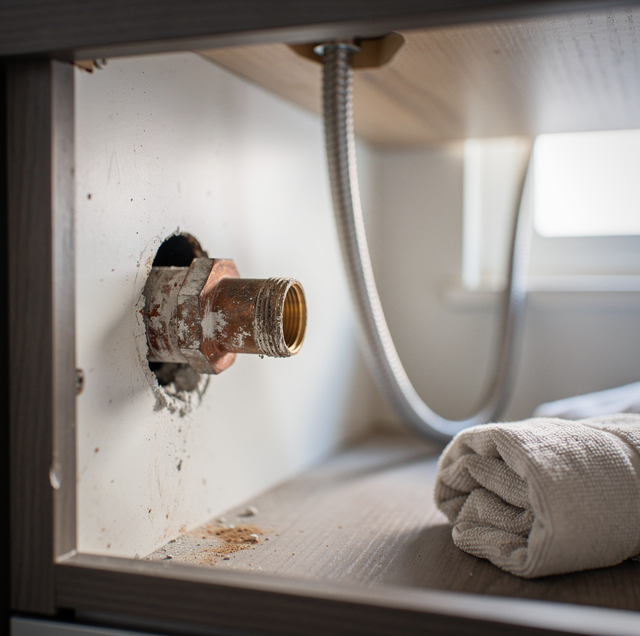
Quick Answer: A supply line gives little warning before it lets go, so the check on the stub-out, the stop and the connector feeding your faucet is visual, done in good light, with nothing handled, flexed or squeezed.
Cleaning supplies get pulled out from under the sink and put back without anyone looking past them. The trap gets wiped down the one time it drips. The two shutoff valves get a glance if a faucet is being swapped. None of that reaches the short run of pipe sitting behind the valves, where the wall meets the metal. That stretch is the oldest hardware in the cabinet, and it is also the one piece nobody has a reason to look at until something is already wrong with it.
The Supply Line Nobody Opens the Cabinet to Check
You call a plumber for a faucet, and the two valves under it get a look because they are in the way of the job. The pipe just past them, the stub coming out of the wall, is rarely part of anyone's mental picture of "the faucet." It should be. The supply line is one connected system: the stub-out set in the wall, the stop threaded onto it or drawn onto it by a compression nut, and the flexible connector running from that stop up to the faucet body. Every piece in that chain sits under full house pressure, all day and all night, whether or not your faucet has been touched in months.
A dripping faucet or a slow drain forces you to look, because it interrupts something you use every day. The supply line interrupts nothing. It works in silence until it does not, and the space it occupies, low, in the back corner, behind whatever gets stored on the cabinet floor, is not one your eyes pass over on the way to anything else under there.
What Corrosion Looks Like Before a Line Fails
Where corrosion does reach the outside of a stub-out or a stop, it is readable without touching anything. A reddish-brown stain creeping out from a threaded joint is iron corrosion product working its way to the surface. A chalky white crust where a nut meets a fitting is mineral left behind as water weeps out and evaporates. A pale green one is different: that is copper corrosion product coming out of the brass itself. Either one, sitting on metal that is otherwise dull gray or dark with age, marks a joint that is further along than the rest of the line around it.
None of that calls for handling the fitting to find out how bad it is. Corrosion thins metal from the inside as much as it marks the outside, and there is no way to judge how much wall thickness is left by feel. What your eyes can see on the surface is the only information available without opening the joint, and it is enough to act on.
A stub-out showing rust bloom or crusted deposits, or a flexible connector showing either of those or a swelling anywhere along it, is inspected by eye. Flexing, tapping, or squeezing a corroded fitting is how a line near failure lets go.
Replacing a Corroded Galvanized Stub-Out Behind a New Vanity
A vanity swap is one of the few jobs that puts this stretch of pipe in full view. The cabinet is gone, the wall behind the old valves is open, and the stub-out that has been sitting untouched inside that cavity for as long as the house has stood is finally something a plumber can see and reach rather than guess at through a cabinet back panel. Where that stub-out is galvanized steel and shows heavy corrosion, that visibility is what makes this the moment to deal with it rather than close a new cabinet back over it.
The water for the house is shut off at the main before any of that stub-out is cut. A dead stub-out behind an open wall is ordinary work; a live one is not, and the two valves that would normally isolate just this fixture are about to be removed from the pipe, so they cannot be relied on to hold anything back once the work starts.
Photograph the open wall before the patch goes over it, with the new fitting and the secured run in frame. That picture is the only record of where the pipe actually sits once drywall closes the cavity again.
With the water off, the corroded section gets cut back until what remains is sound metal rather than a thread-eaten thin from the inside. Threading a new stop onto pipe that has already lost that much material does not produce a joint anyone can trust, so the cut moves back until the pipe underneath is solid. A new coupling connects the sound pipe to fresh tubing routed to where the valve needs to sit, since your new vanity's stops may land in a slightly different spot than the old ones did. Where the new tubing is copper and the pipe behind it is still galvanized steel, the two are joined with a dielectric fitting rather than a plain coupling, so the wall is not closed over two dissimilar metals in direct contact.
That new run is secured to the framing behind the wall rather than left hanging on the fitting alone. A stub-out with nothing holding it in place flexes every time a valve is turned, and a joint under repeated flex fails faster than one that sits still. The wall stays open until the new connection has held with the water back on and nothing at the joint is wet. Only then does the vanity's back panel or a drywall patch go over what used to be visible.
Why the New Line Is Rarely Galvanized Steel Again
When a plumber has the wall open anyway, the material coming forward to the new valve is usually not another length of galvanized pipe. Copper or PEX tubing typically takes its place, run to match whatever the rest of your house is already plumbed with. The original galvanized run already showed how it performs behind that wall, so putting the same material back does not change anything about the conditions that caused the problem in the first place.
The choice also has a practical side. New threads have to be cut, or a new push-fit or sweat connection has to be made, and doing that on fresh copper or a length of new PEX gives a clean, known surface to work from. Building onto galvanized threads that are already compromised, further back in the same run, would only relocate the same weakness farther into the wall.
A Weeping Joint Is a Warning; a Burst Line Is Not
A joint that weeps gives you something rare from this part of the house: notice. A stain on the cabinet floor, a damp spot on the wall behind the pipe, and a drip that shows up after the water has been running all point to a specific fitting before it has failed outright, and all leave time to have it looked at on a normal schedule.
A line that lets go completely does not offer that same runway. Once corrosion has worked all the way through a pipe wall or a fitting, there is no thinning stage left to catch between sound and failed. The difference between a fitting that has been weeping for a while and one that is about to open fully is not something available from the outside, which is why a corroded joint gets replaced as soon as it is found rather than monitored for how it does.
One Corroded Fitting Rarely Stands Alone in the Wall
A stub-out behind a vanity or a kitchen sink is not plumbed in isolation. It shares an install date, a water supply, and the same years sitting behind a finished wall with every other galvanized fitting the original plumber ran through your house. Finding heavy corrosion at the one spot a vanity or faucet job happens to expose is information about the condition of pipe nobody is currently looking at, not just about the piece in hand.
That does not mean every other fitting in the house needs to come out on the same visit. It means the one that was reachable, and clearly failing, got dealt with, and the same water is still working on whatever is sealed up behind walls that have not been opened for anything else yet.
Frequently Asked Questions
Yes. The chrome on a stop is a thin plated finish over a brass casting, applied for appearance and wear rather than for strength. Plating stays bright over metal that has already lost material beneath it, so a stop that still looks new tells you about the finish, not about the brass carrying the pressure beneath it. That is why a visual read is done on the raw threaded metal at the joint, where the condition of the base metal is actually exposed, rather than on a polished valve body.
Where a steel pipe and a brass fitting meet in water, the two do not give up material evenly, and the size of each surface decides how uneven it gets. A large brass valve body paired with a narrow steel nipple concentrates the loss onto that small area of steel rather than spreading it out, so the little bit of pipe wears through long before the much larger fitting shows any comparable damage. A larger fitting paired with a larger fitting would not corrode nearly as quickly at that same joint.
No. The zinc layer is there specifically to corrode before the steel underneath does, giving up its own material to protect the pipe for as long as it lasts. Once that layer wears through at whichever point saw the most exposure, the steel underneath starts corroding directly, and it does so without anything left to give up material in its place, which is the point at which the pipe wall itself starts thinning.
Not by the same mechanism. Copper reacts with the oxygen and minerals in water to form a thin oxide layer on its surface, and that layer is stable enough to slow corrosion beneath it, rather than flaking off and exposing fresh metal the way rust does on steel. That is different chemical behavior from a coating being consumed, and it is why a copper stub-out does not repeat the failure pattern that put a hole in a galvanized one.
Yes, through a different failure entirely. Some brass alloys can lose the zinc mixed into them as an ingredient, not coated on top of them, when aggressive water works on the fitting, leaving behind a porous, weakened structure that is mostly copper and looks intact from the outside. Dezincification is a corrosion mechanism that works through the body of the alloy rather than eating away at the surface, which is why the fitting keeps its shape and dimensions while losing the strength that supports them, and it can leave a fitting brittle enough to crack under normal handling.
Some fittings are made from a dezincification-resistant brass, an alloy formulated so the zinc cannot leach out of it the way it can from ordinary brass. Where that alloy gets specified is a decision about the water the fitting will sit in and how reachable the joint will be afterward, not about what the fitting looks like.
One corroded fitting in an open wall says something about the ones still sealed behind drywall — a plumber can read the exposed joint before the patch goes on. Ser Plumbing repipes homes across the area, from repiping in Long Beach to Norwalk. Call (310) 953-3566.
