
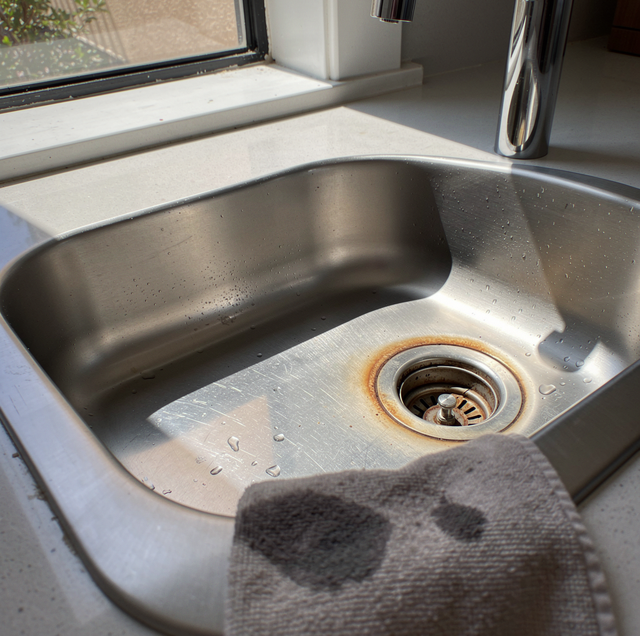
Quick Answer: Rust staining and a strainer that keeps weeping usually trace to the same place, the sealant bed under the flange. Fixing it means shutting off the water, freeing corroded mounting nuts, and rebuilding that bed underneath.
Lift the strainer basket out of a kitchen sink and the first thing you may find is a ring of rust-colored staining circling the drain opening, right where the strainer ring has been sitting for years. Or there is no staining at all, and instead the strainer rocks a little when you press on it, with a thin line of water tracking down the outside of the tailpiece every time the basin drains. Both point to the same place. Whatever is sealing your strainer to the sink has stopped doing its job, and the ring that looks solid from above is only half of what actually holds the assembly together.
What Sits Under a Sink Strainer
A basket strainer is not one part dropped into a hole. It is a short stack of pieces, each doing a separate job, and knowing what each layer does is the difference between resetting a strainer correctly and chasing the same leak twice. The strainer ring is the visible collar inside the drain opening, and everything below it hangs from it. Directly under the ring sits a bed of sealant, packed on before the ring is pressed into place, and that bed is what actually seals the gap between the ring and the top of the sink. Below the sink deck, a rubber sink seal and the mounting nuts thread onto the strainer's lower body, drawing the whole stack up tight against that bed, and the tailpiece hangs off the bottom of the assembly, running down toward the trap. Skip the sealant bed, and a new strainer will drip on the first fill, no matter how tight the mounting nuts are. Leave the sink seal out, and the nuts have nothing left to compress against.
Rust Forming Around a Sink Drain
Rust needs iron to work with, so where it shows up around a drain says something about what is actually rusting. A cast iron sink is iron under a thin, fired-on enamel coating, and that coating takes its hardest wear right at the drain opening, where a dropped pot or a scouring pad lands first. Once the enamel chips through to bare iron, water sitting in the drain keeps that exposed spot wet more often than any other part of the basin, and the iron oxidizes into the reddish-brown ring that spreads outward from the chip as more enamel lifts at its edge. In hard-water conditions, mineral deposits that collect at that same low point can hold moisture against the exposed metal even longer between uses, giving rust more time to work with each cycle.
A stainless-steel or vitreous china sink does not rust that way. Stainless steel is still an iron alloy, but the chromium in the mix forms a passive film on the surface that prevents the underlying iron from oxidizing, and a china basin has no metal in it at all. What looks like rust around the drain in those sinks is often the hardware instead. A strainer ring or mounting nut made from a lower-grade plated steel, rather than brass or stainless, rusts once its plating wears through or pits at a seam, and the rust runs down with whatever water passes it, staining the sink around the drain with streaks that look like the basin is rusting even though the metal directly under the streak is not.
Reading What a Rusted or Leaking Strainer Is Telling You
Not every rust streak or stain means the seal itself has failed. A rust streak from a corroding mounting nut can sit atop an otherwise sound seal for a long stretch, doing nothing worse than discoloring the surrounding metal. A strainer that rocks when pressed is a different signal: it means the mounting nuts have loosened enough that the stack is no longer clamped tight, and a stack that is not clamped tight cannot keep its sealant bed compressed the way it needs to be. Water that shows up on the cabinet floor under the sink, rather than just staining around the drain, means the seal has already opened enough to let water past it and down the outside of the tailpiece. The distinction is worth making before you decide what to do next. A stain can often be watched. A wobble or a wet cabinet floor indicates the seal is actively failing and worsening with continued use.
Putty or Silicone: Two Different Ways to Seal the Ring
The bed under the strainer ring comes in one of two materials, and they seal differently. Plumber's putty is a soft, oil-based compound, rolled into a rope, pressed into a ring under the flange, and, as the mounting nuts are drawn down, it squeezes into a thin, even layer that fills the gap between the ring and the sink. Silicone sealant goes on the same way, packed under the ring before it is set down, but it also bonds to both surfaces as it cures rather than sealing by compression alone. Which one your job calls for depends on the sink itself, and getting that choice wrong is a reason a newly set strainer starts weeping instead of holding.
Freeing a Seized Strainer Locknut
Replacing a strainer starts with getting the old one out. Before anything under the sink is touched, shut off the angle stop feeding that faucet and set a bucket under the trap — disconnecting the tailpiece lets out any water standing in it.
Only after the water is off do the mounting nuts come into play, and that is where the job stops being simple. Depending on the strainer, that is either one large locknut threaded onto the body or a set of small bolts drawing a ring up under the deck, and either one sits in a blind, cramped space against the underside of the sink, often rusted onto the strainer's threads by the same moisture that formed the rust ring above. Freeing them without damaging anything around them takes more patience than force.
A mounting nut that will not turn under firm hand pressure is not one to force. In that tight a space, extra force is more likely to crack a cast iron or fireclay sink than to break the corrosion loose.
A garbage disposal does not hang from a basket strainer; it mounts to its own flange in that bowl, so a bowl with a disposal under it is a different assembly than the one described here. Getting a seized strainer out cleanly, without cracking your sink or rounding off the hardware, is work worth handing to a plumber rather than a project you push through with more force.
Setting the New Strainer and Getting the Seal Right
Setting your replacement starts with the seat itself. The surface the new sealant bed will sit against has to be clean and dry before anything is packed onto it, or the new strainer inherits whatever was wrong with the old one. From there, the ring goes down over a fresh bed of sealant, pressed square into the drain opening, and the sink seal and mounting nuts go on from below and get drawn up in stages, alternating sides, rather than tightened all the way on one side first, so the ring settles down evenly instead of tilting. A strainer set square and even holds its seal. One drawn down unevenly, tight on one side and loose on the other, opens a gap on the loose side that the water finds first.
Frequently Asked Questions
Plumber's putty is an oil-based compound, and that oil can seep into porous or composite sink materials, such as cultured marble, natural stone, or some solid-surface basins, leaving a permanent dark ring around the drain opening that cleaning will not remove. Stainless steel, cast iron, and fireclay do not have that problem, since the oil has nothing to soak into. On porous and composite materials, silicone sealant goes under the ring instead of putty for exactly that reason.
It depends on which sealant went under the ring. Putty is serviceable the moment the mounting nuts are tight, because it never hardens at all. Silicone has to finish setting first: running water over a bead that's still curing can wash the bond out before it fully forms, so a silicone-sealed strainer sits untouched until the sink goes back into service.
No. The rubber sink seal under the deck goes on dry, against a clean surface. Smearing putty or silicone onto that gasket is a common reason a freshly set strainer weeps at the nut instead of holding, because the sealant sits between the rubber and the sink and stops the gasket bedding flat against it. Only the seat above the deck gets a sealant bed; everything below the deck seals by compression against bare surfaces.
Yes. The rope is laid as a continuous ring, and its ends are overlapped and pressed together, not butted end to end. A butt joint leaves a seam running straight through the bed, and once the ring is drawn down, that seam is the one line in the whole circle where the putty was never actually joined to itself, which is where the bed opens first.
A thin, even bead of sealant should squeeze out visibly around the outside edge of the ring once the mounting nuts are fully tight, and that squeeze-out is what shows the bed compressed all the way around rather than at just one or two points. A ring that seats down flush with no sealant showing at the edge usually means the bed was packed too thin somewhere, and that thin spot is where the seal tends to open first.
Yes. The underside of the ring is not flat; it has a shaped shoulder that the sealant bed must fill evenly on all sides before the mounting nuts are tightened. If the bed is packed thicker on one side than another, the thin side leaves a gap under that part of the shoulder even after the nuts read fully tight, and no amount of extra tightening pushes putty sideways into a shoulder the rope never reached.
Skip the fight with a seized strainer locknut — a plumber can free it, rebuild the seal underneath, and rule out a cracked sink before more force gets involved. Ser Plumbing repairs water heaters across the area, from water heater repair in Bellflower to Lakewood. Call (310) 953-3566.