
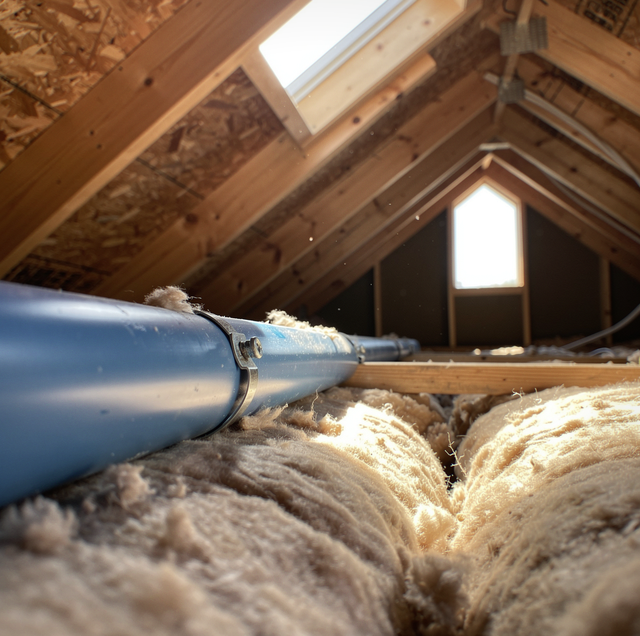
An attic on a hot afternoon is a different building from the house underneath it. The rooms below are being kept comfortable by an air conditioner and a shaded window. The space above them has none of that. It sits under a roof taking sun since mid-morning; it breathes outside air through its vents, and by mid-afternoon it is far hotter up there than in any room a person would choose to sit in. A blanket of insulation across the ceiling joists separates the two conditions, and nothing else does.
Now put a house's entire water supply into that space. That is what an overhead repipe on a slab foundation does: rather than break up the floor to reach lines buried in concrete, the new system goes up and over, trunks across the attic and drops down inside the walls. Every length of PEX spends its afternoons in the hottest part of the building and its nights in one of the coolest.
Which raises the question asked on nearly every overhead walk-through: what does that heat do to the pipe, and to the water in it?
Quick Answer: Heat overhead is a routine question rather than an emergency. Tubing sold for hot supply service is made for it, but a cold line above the ceiling warms all afternoon, so where the run sits determines what your tap gives you.
The Cold Line That Is Not Cold in the Afternoon
Whenever nobody is using water, every branch holds a still column of it, and on the cold side that column should be the coolest water in the building.
Overhead, it is not. A cold branch crossing an attic sits in warm air for hours with no airflow to carry heat away, and by late afternoon the water standing in it is at the temperature of the surrounding air. Open the tap, and that is what arrives first. It clears once moving water takes its place, though not always to what you would call cold, since incoming water picks up heat crossing the same attic, and the gentler the draw, the more it collects.
This is a comfort and habit problem, not a safety one, and not a sign of bad work. Households absorb it, filling the drinking glass from the refrigerator and running the tap a moment before putting a hand under. It is worth saying plainly, because a warm first draw gets reported as a fault and chased through the fixtures, when what produced it is tubing lying in hot air above the ceiling.
Heat is also one of the variables governing how PEX ages over decades, which is chemistry rather than comfort. The rest of this is the other half.
Why an Attic Is Not All One Temperature
From the hatch, an attic reads as one hot space. It is not. The air in it stratifies and pools, and the spread between its worst part and its mildest is wide enough to design around.
The hottest air collects high, against the underside of the roof deck and along the ridge, where sheathing that has absorbed sun all day radiates into the space. The mildest sits low, near the ceiling plane, above insulation holding the house's own temperature in the rooms below. Tubing run tight under the ridge lives in different air from identical tubing kept low against the framing, and a dead corner with no path to a vent holds heat while the rest of the attic sheds it.
So the route is a decision rather than a shortest-path exercise, and what a run crosses counts too: a trunk over a garage ceiling or a porch has no conditioned room beneath it at all.
The same spread is why a crew pulls the overhead portion of a repipe early and works inside the house later. A schedule built around the heat is a working condition, not a delay.
Below the Insulation, Not Above It
In most attics, the insulation lies across the ceiling framing, filling or covering the joist bays. That gives a run two very different options along one route: lie on top of the blanket in attic air, or lie down in the bay with insulation pulled back over the top of it.
Same path on a plan, opposite side of the thermal layer. Above it, the pipe's neighbor is the attic, and it follows the attic all day. Below it, the neighbor is the room underneath, so it stays much nearer the temperature the household is already paying to hold. A cold branch down in the bay still warms, but slowly and from a lower starting point, which is the whole of the first-draw difference.
The technique comes with conditions. It has to be settled before the tubing is pulled, because it dictates the path: a low run follows the bays and crosses them through drilled framing rather than sailing diagonally over everything. The insulation has to be deep enough to cover the tube, and loose fill displaced by the work has to be put back. Beams and ducts push a run back up into open air, and those crossings belong on the drawing too.
Ask which runs in the plan are below the insulation and which are above it. That one distinction changes what your cold tap does on a hot afternoon more than the brand of tubing named anywhere on the quote.
Where Pipe Insulation Earns Its Place
Insulation on PEX overhead does two jobs, depending on which side of the system it wraps.
On the hot lines, it holds the delivery temperature, so water reaching a distant fixture is closer to what left the heater, and the run loses less between draws.
On the cold lines: it slows the warming of that standing column, which is the direct answer to a lukewarm first draw, since the longer the column takes to reach attic temperature, the better the odds somebody opens the tap before it gets there.
Then the honest part, because this gets oversold. Insulation slows a temperature change; it does not prevent one. Given enough undisturbed hours in hot air, a wrapped line reaches the temperature of the surrounding air just as a bare one does, only later. Time is what you are buying.
Coverage decides how much of that time you get, because insulation performs at the rate of its weakest section: elbows and tees left bare where a sleeve will not turn, the gap at every hanger, the butt joint nobody sealed. Material and thickness belong on the quote as items, not as words.
The Damp Patch That Is Not a Leak
An overhead cold line does two opposite things, and which one depends entirely on whether water is moving through it.
Standing still for hours, the column inside warms until it matches the surrounding air. That is the lukewarm first draw. Nothing collects on the outside of a tube sitting at the ambient temperature. Draw water and the incoming supply arrives cool, so the surface of that tube is now colder than the attic air touching it, and where that air carries enough moisture, the difference shows up as water on the outside of the pipe.
So the two complaints belong to different halves of the same day. A warm first draw is what an unused branch does. Water on the outside is what a busy one does, and it gathers, runs to a low point, and falls in the same place every time, which is how it arrives downstairs as a stain with no leak anywhere near it.
A cold run crossing warm attic air collects water on the outside and drips onto the ceiling below, where it gets chased as a leak. Insulation on cold lines must be sealed at seams and fittings, not only wrapped.
Support, Spacing, and a Run That Moves All Day
Support intervals come from the tubing maker's instructions, and a hot attic puts a wrinkle in how they get applied. PEX is more flexible when warm than when cool, so a run hung to look right on a mild morning sags more at afternoon temperatures. Spacing is set for the conditions the run will live in, not those on the day of the pull, and that matters most across an open span.
Movement is the other half. All piping changes length as it heats and cools, PEX considerably more than metal, and no space in a house swings as far between night and afternoon as the attic, so an overhead run moves more, and more often, than the same tubing inside a wall. That is why the work goes in with a little slack rather than pulled drum tight, why the clips are the smooth kind, holding the run without gripping it, and why a long run gets an allowance where it changes direction. Movement with nowhere to go becomes ticking and wear wherever the tube rests.
What the Temperature and Pressure Ratings Actually Say
Ratings for PEX are published as pairs, never as a single figure, and confusion starts when you read half of a pair. A tube carries a pressure rating at a stated temperature, and the same tube carries a different, lower pressure rating at a higher stated temperature, because the warmer the material, the less internal force it is rated to hold.
Two things follow, and both belong to the route rather than to the product. The first is that the hot side is what the pairing is really about, since that is where the highest stated temperature and the house's own pressure meet within a single length of tube. The second is that an attic changes less about which pair applies than about how many hours a day a run spends near the warm end of it. A cold branch lying in hot air is not being asked to do anything the material is not made for. It is spending more of its life warm than the identical tube would inside a wall.
So the question worth putting to a quote is not whether the tubing is rated, since it will be. It is whether the tubing and fittings named there were chosen based on what your attic produces, and whether anyone read the pair rather than the first number in it. Those pairs are printed along the tubing, which is where a plumber reads them off a coil before any of it goes up.
Symptom, Cause, and What Helps
| What You Notice | What Is Behind It | What Helps |
|---|---|---|
| Cold tap runs warm on the first draw, worst late in the day | Water standing in an overhead cold branch has reached attic temperature | Routing it below the insulation, or insulating it where that is not possible |
| Cold water never gets properly cold, even after running | Incoming water picking up heat crossing a long, bare trunk | Insulation on the trunk, and a route kept low, away from the roof deck |
| Hot water arrives cooler than expected at a far fixture | Overnight standing loss on an uninsulated overhead hot run | Insulation carried through hangers and around fittings, not just on straight lengths |
| A damp patch on a ceiling below a cold run, no leak found | Condensation forming on a cold tube in warm attic air | Sealed insulation, seams and butt joints closed |
| Ticking overhead when hot water runs, or a run sagging visibly | The tube changing length as it heats, or spacing set for cooler conditions | Slack, sliding clips, support at the maker's intervals |
What the Route Drawing Should Show
A repipe plan for a slab house is, in practice, a drawing of your attic, whether anyone calls it that or not, and it is fair to ask to see one before the coils come off the truck.
A real one shows the path of each trunk across the framing and where that path sits relative to the roof above and the ceiling below. It marks which lengths lie in the joist bays under the insulation and which stay above it, with the beams and ducts forcing that difference drawn in rather than assumed. It names the lines to be insulated, hot side and cold side separately, with material and thickness written down rather than "insulate as required". And it lists the tubing and fittings as products, along with the temperature and pressure pairs each carries.
Then there are the questions to put to that drawing while it is on the table. Which run lives in the hottest air, and what protects it? Which branch feeds the kitchen tap, and how far does it travel above the ceiling before turning down? Where does the insulation stop, and why there? Who puts the ceiling insulation back over the runs laid into it?
A route someone can point to is one someone thought through, and it is the only part of this conversation that outlives the drywall.
Frequently Asked Questions
It depends which side of it the pipe is on, and it can work backwards. Insulation across the ceiling keeps the house comfortable, and doing that job better means less of the house's own cooling bleeds upward, which tends to make the attic harsher rather than milder. A run lying on the blanket gains nothing from a deeper blanket; a run buried in it gains a great deal. Ventilation and radiant barriers act on the attic air itself and belong to whoever handles the building envelope.
No, and the gap is wide. Once tubing turns down inside a wall, it is surrounded by cavity air far nearer room temperature, so only the length above the ceiling is doing the warming. That is why the first draw clears quickly at a fixture fed by a short crossing and slowly at one at the end of a long one, and why two taps in the same house behave nothing alike.
Some of it. Adding insulation to existing runs is ordinary work wherever a run can be reached, and it is the change that disturbs a finished house least. Lowering a run into the joist bays afterwards means unclipping, rerouting and re-supporting a system already tested and closed up, which is a different order of work and not something anybody undertakes casually. Where the complaint is really about drinking water rather than about the tap generally, an under-sink filtration unit with its own faucet answers that directly and leaves the overhead routing alone.
Yes, and it beats assuming. A small temperature logger left in the attic through a hot stretch records what the space does across a full day and night, and the swing between the two is as useful as the peak. Energy raters use them routinely. It turns the conversation from an argument about typical numbers into a reading from your own house.
Neither material escapes the heat; they respond differently. Copper changes length far less with temperature, so it asks less of its supports, but it conducts heat quickly, so water standing in a copper cold line reaches the surrounding temperature faster than in PEX. Both are made for hot supply service, and both need the routing and insulation questions answered the same way.
Have the attic route planned before any pipe is pulled — a licensed plumber will walk the space, name which runs sit below the insulation, and show you where each line is protected. Ser Plumbing repipes homes across the area, from repiping in Long Beach to Norwalk. Call (310) 953-3566.
