
Quick Answer: A stop that has sat open since installation is sealed as much by mineral scale and packing that has taken a set as by its working parts. Moving it for the faucet job breaks that set.
You booked one job and are being told about a second one. The faucet was the reason for the call. The two small valves feeding it were not, and now they are the subject: those should be changed as well, while the cabinet is open. You have never turned them. Until a minute ago, you did not know they had a name.
So the thought that arrives next is a fair one: is this an upsell, or is something actually wrong with a part that has never given you a moment of trouble?
That question deserves a mechanical answer rather than a reassurance. What follows is what happens inside a shutoff valve that has held one position since the house was plumbed, and why a faucet replacement is the moment that condition surfaces.
One boundary first. This is the proactive case only: a valve that has not failed, on a job you booked for something else. A stop failing at the moment you need it is a different situation with its own diagnosis. Nothing below is a troubleshooting walk-through. How long the visit itself takes, and the conditions that make one faucet swap simple and another complicated, are each covered separately.
A Shutoff Valve Spends Almost Its Entire Life Not Moving
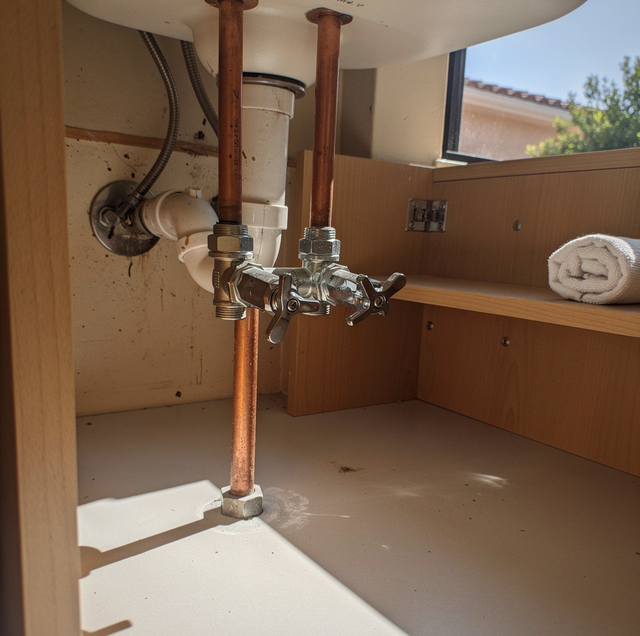
There are two of them under a sink, one on the hot line, one on the cold. Older ones are multi-turn: a handle you rotate several times, driving a stem down onto a seat, a soft washer on that stem doing the sealing, packing wrapped around it to keep water from climbing out past the handle. Newer ones are quarter-turn: a lever, a polished ball or ceramic discs inside, a quarter rotation between open and closed.
Both share an operating condition almost nothing else under your sink shares. A faucet cartridge moves every day. A shutoff valve holds a single position, wide open, with full household pressure against it and still water inside it, for the entire service life of the fixture it feeds. Disuse is not an exception for a stop. Disuse is its job.
And disuse is what changes it. A valve seals because a soft part presses against a hard part with some spring left in it. Remove all movement long enough, and that soft part loses its ability to recover. It conforms to what it is pressed against and stays there.
Scale Bridges the Stem and the Seat While the Valve Sits Open
In hard-water areas, the calcium and magnesium dissolved in the supply come out of solution wherever water is still, warm, or meeting an edge. Inside a stop held wide open, all three sit together in one small brass body. The water is not moving except when the faucet above is open, and even then it slides past the stem rather than through it. The stem threads and the seat shoulder are edges.
So scale forms in the one gap the valve depends on: the space the washer must cross to reach the seat, and the threads that carry it there.
What that produces is a valve that closes less than it used to and gives no sign of it. The handle turns, meets resistance, stops. It feels closed. What stopped the stem may be scale on the threads rather than the washer reaching the seat. Or the stem travels, and the washer lands on a seat with a crust on it, sealing against grit instead of brass. Either way, the closure is partial, and a partial closure stays invisible until something downstream is opened.
A stem that will not turn should never be forced with a longer wrench. The stem can shear inside the packing nut, or the packing nut itself can let go, and either one releases live household pressure into an open cabinet.
The thing downstream is your faucet, coming off. The plumber closes the stop, opens the faucet to drain the line, and instead of running dry, the spout keeps producing a thread of water.
The Packing Takes a Set Around a Stem That Has Not Turned
Packing is the seal that keeps water from following the stem out of the valve. On a multi-turn stop, it is a compressible ring squeezed around the stem by a nut, and the sealing force is that compression.
Compression only seals while the material still pushes back. Held motionless against one patch of stem, the ring conforms to exactly what it touches: that surface finish, that position, whatever mineral film has formed on it. It stops being a gasket under load and becomes a molded part fitted to one spot.
Then the stem finally turns, and on a multi-turn stop it does not merely rotate. It travels. It screws down toward the seat, dragging a length of stem that has sat elsewhere in a different condition, with packing shaped around a different section entirely. There is no give left to reconform with. Water finds the difference.
This is why a stop can be bone dry when the plumber arrives and show a bead of water on the packing nut by the time the new faucet is on, with a dark ring on the cabinet floor by morning. Nothing broke. The seal was held by shape rather than by compression, and shape does not survive movement.
A quarter-turn stop does not have that failure path. Its stem rotates in place rather than screwing down, so the seal is never dragged over a fresh section of the stem, and the handle stops hard at each end of its travel rather than threading into a seat. That difference is why the question gets asked with the cabinet already open rather than left for another day. The valve going back in is the one that has to still close the next time somebody needs the water off at this sink.
A Compression Stop That Survived the Shutoff Can Fail Days Later
A compression-style stop joins the pipe differently. The valve body slips over the copper stub-out coming through the wall, and a brass ferrule is squeezed between the nut and the tubing until it deforms into the copper and seals.
That ferrule is not a gasket you can snug up again. It is a metal ring that took a permanent shape against one spot of tubing under one load, and has sat that way ever since.
A faucet replacement puts hands and tools on that valve. The supply nut on top is loosened and retightened, and any wrench on that nut transmits torque to the valve body unless a second wrench holds it still. Even with a backup wrench, the body shifts a little, and the ferrule's grip breaks and is remade in a position it was not formed in.
A disturbed compression joint usually holds at first. Static pressure with the fixture shut is the gentlest condition that joint will ever see. What finds it is the pressure swing afterward: the faucet opening and closing, the surge when a quick-closing valve elsewhere in the house shuts, hot water moving the brass as it warms. The seep shows up days later, in a cabinet nobody has a reason to open.
That timing is why the subject comes up during the job rather than after it. The disturbance begins the moment the faucet comes off.
A Stop That Will Not Fully Close Changes What the Plumber Can Do
All of it lands at the supply lines, with the water either off or not. The test happens at the start of the job anyway. Close both stops, open the faucet, and watch. A stop that closes fully takes the faucet down to nothing, leaving a dead line. A stop that closes partly leaves water arriving as a slow trickle at the spout or a dribble from the connector once the nut is loosened.
You cannot make a dry connection with water moving through it. A new supply connector seals against a machined seat that wants a clean, dry, evenly loaded surface to bed into. Water crossing it while the nut is tightened produces a joint assembled wet, and that joint gets judged the same way the compression joint below it does: not that afternoon, but later.
Which leaves two ways forward. Shut the water off at the house main and work on a dead line, which puts the whole home without water for the length of the job. Or replace the valve, which gives a dry line and a working shutoff at once.
One consequence outlasts the visit. An angle stop exists to isolate one fixture so the rest of the house keeps running, and a partly closing stop has stopped doing that.
The Two Questions to Ask Before You Decide
You do not have to take the recommendation on faith. Two questions settle it, and both point at something the plumber has already done, because closing the stops is the first move of the job.
Ask whether the stop held fully closed with the faucet open. Not whether the handle turned. Whether the water stopped completely. If water kept arriving, the valve has already failed at its only function, and it failed in front of both of you.
Then ask whether the stem or the packing began to weep once it was turned. Dry before and wet after is the packing telling you it will not reseat.
A "no" to the first or a "yes" to the second is the valve's own verdict, not an opinion about it. If the stop closed hard and stayed dry through the whole turn, that is an answer too, and you are entitled to hear it in those words. The cabinet is open. Ask to see.
Frequently Asked Questions
They are fitted new with the faucet. The cone-shaped washer inside a flexible connector's nut has already conformed to the old faucet's shank and one seating position, so reusing it asks a washer that has taken a set to seal against a different shank at a different angle. Braided stainless connectors go back on.
Yes, and it is ordinary work on its own. The faucet stays where it is, the supply connectors come off at the stops, the old valves come off the stub-outs, and new ones go back on. What changes is the shutoff. With the fixture staying put, the water has to be controlled at the main for the length of the swap, because the valve being removed is the one that would otherwise isolate the sink.
It can. A dishwasher fed from under the sink takes its water off the hot side, through a stop with two outlets or a branch at the hot stub-out, which makes that valve a valve with two jobs. Mention the tie-in before work starts and ask whether the second outlet carries over.
You can, and it goes better with two people. The test runs from a standing position at the sink rather than from the cabinet floor. The plumber holds the stop closed below while the faucet above is opened, and somebody has to be watching the spout. Turning the faucet on and off at the counter while he works the valve underneath is part of the test, and it puts you in the position where the answer shows up.
The name is geometry. When the supply comes out horizontally from the wall, the valve directs the flow upward toward the faucet, so its inlet and outlet are at a right angle. Where the supply comes up through the cabinet floor instead, nothing needs to be turned, and a straight stop is used. Same valve, same job, different body shape.
Access is. Pedestal stops sit behind the column with barely enough room to swing a wrench, and there is no cabinet floor underneath to catch a drip, so a weeping packing nut shows on the finished floor instead of inside a box nobody opens.
Ask to have both stops closed and watched before your faucet comes off — you will know the true condition of each valve before a single supply line is opened. Ser Plumbing repipes homes across the area, from repiping in Bellflower to Lakewood. Call (310) 953-3566.
