
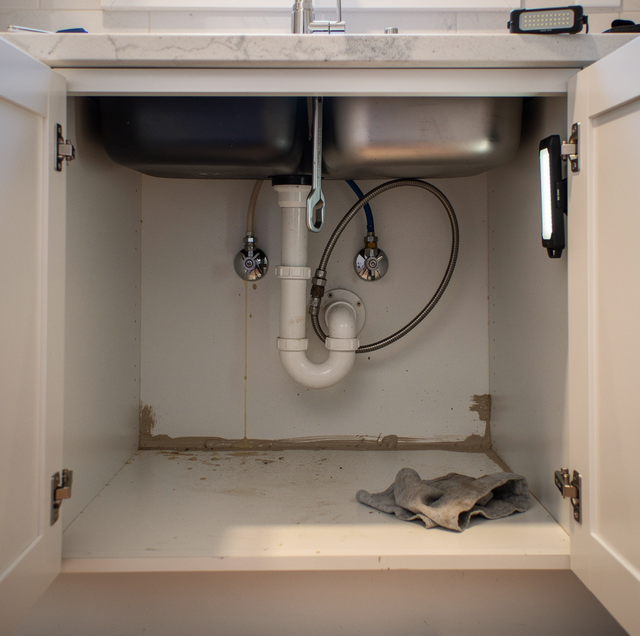
Quick Answer: The fixture rarely sets the scope of a faucet replacement. Hole count and what covers them, mount style, whether the shutoffs hold, the supply lines and stub-outs, cabinet depth, sink material, and whatever else is bolted under the deck do.
Two houses on the same block order the identical faucet. In the first kitchen, the sink has three holes across the deck, the cabinet under it is shallow and empty, and both shutoff valves turn shut and stay shut. In the second, a stainless plate hides however many holes are drilled in that deck, a filter housing is bolted to the cabinet floor, and one shutoff turns freely without ever stopping the water. Same fixture. Two jobs that look nothing alike.
What separates those two kitchens is the sink, the deck it rests on, and the short run of pipe behind the cabinet wall. None of it shows from standing at the counter. This article names the physical conditions that change the scope of a faucet replacement and what each one requires. Scope is assessed on site, with the cabinet doors open, because that is the only place these conditions can be read.
Two questions sit outside this one. Whether the fixture needs replacing at all is separate, and a faucet that only drips may be settled by a cartridge or a valve seat instead. A fixture you buy yourself carries its own set of checks before it is hung.
How Many Holes the Deck Has, and What Is Covering Them
A sink deck is drilled with a fixed number of holes, and that number was set by whoever installed the sink. Nobody reads it from the counter. A deck plate already sitting on the sink hides it completely, because from above a plate looks the same whether it spans one hole or three.
The count is confirmed from underneath by reading which shanks pass through the deck and which holes remain empty behind the plate. That reading is about reach before it is about anything else. Every occupied hole is a shank with its own nut to get a wrench onto from below, and every empty one is a place where the deck still has to be closed. A plate bedded in sealant for years comes off in its own step, and what it has been hiding- sealant residue, mineral crust, a ring worn into the finish- has to be cleaned back to bare deck before anything is set on it.
Single-Hole, Three-Hole and Wall-Mount Put the Connections in Different Places
What is already mounted on the deck decides where a pair of hands has to go. A single-hole faucet puts one shank through one hole, and everything happens at that point: the mounting nut, the supply connections, and any sprayer hose the body carries. A three-hole spread separates the spout from two handles, each with its own shank and nut, so the connections get made at three points along the back of the deck. Reaching the outer two means working at an angle past the bowl on each side.
A wall-mount faucet is not attached to the sink at all. It hangs off unions inside the wall, above the sink and behind the finished surface, which puts the connection points where nobody can see them from the cabinet. Getting to those unions means opening the wall. The wall stays open until the connections have been run and watched dry, because a joint behind a finished surface is a joint nobody can check.
What Happens When the Shutoff Is Asked to Close
Under the sink, two angle stops feed the faucet. A stop untouched for years does one of three things when it is finally closed. It holds. It keeps passing water. Or it holds and then weeps around the packing nut once it has been moved. Why an unused valve ends up in one of those three states is taken up in the article on why a plumber recommends new angle stops during a faucet replacement.
Do not force a seized angle stop with a wrench to test it. A corroded stop can snap at the stem or shear off the stub-out behind it, and the line feeding that stop is live and under pressure.
Only the first outcome lets the work stay at the fixture. A stop that will not hold means the water has to be controlled at the main instead, and no connection can be made against a live line. The stop is then replaced within the same work because the faucet above it cannot be joined until the line below it is dead.
The Supply Lines and the Stub-Outs Behind Them
The flexible connector running from the stop up to the faucet inlet is the part everyone sees. The part that sets the scope sits behind it. Each stop meets a stub-out, the short piece of pipe coming out of the cabinet wall, either threaded onto it or slipped over it and sealed with a ferrule. Either way, taking the stop off puts load on that stub-out.
Where the stub-out is galvanized, the inside is scaled down, and the threads at the end have been corroding for as long as the pipe has been in the wall. Backing a stop off a galvanized stub-out can take the threads with it or break the nipple flush with the wall surface. The work is then no longer about the faucet: it is about reaching sound pipe inside the wall. A flexible connector that has gone stiff cracks where it gets bent.
Cabinet Depth and Whether a Basin Wrench Can Reach the Mounting Nut
The mounting nut holding a faucet down sits on the shank, directly above the back edge of the sink bowl, in the gap between the underside of the deck and the back wall of the cabinet. A basin wrench is built for that spot, with a long handle and a jaw on a pivot that reaches up where no hand fits. What it needs is room to swing.
Reach into the cabinet and put a hand flat in the gap between the back of the sink bowl and the cabinet's back wall. That gap is where a basin wrench has to swing.
A deep bowl set close to the back of the cabinet leaves a narrow gap, and a narrow gap limits how far the handle travels per pull. A nut sitting under scale in a hard-water cabinet needs steady torque, and steady torque is what a cramped angle takes away. When the nut will not break loose from below, the sink itself has to be freed from the counter so it can be reached from above.
Sink Material and Deck Thickness Change How the Faucet Seats
A faucet seats on a gasket against the top of the deck and gets pulled down against it from below. Whether that seat is solid depends on what the deck is made of and how thick it is. A thin stainless deck flexes, and if the surface around the hole is not flat, the base can rock, and the gasket will not compress evenly. An enameled cast iron sink is rigid and thick, and the shank has to pass through that full thickness while still leaving threads for the nut to grab.
Undermount sinks move the question off the sink entirely. The holes go through the countertop instead, in stone or solid surface, which is thicker than any sink deck and unforgiving of a hole placed wrong. Cutting a new hole in stone is done wet, with a bit made for the material.
What Else Is Mounted Under the Sink and Blocking the Approach
Several fittings can live in a kitchen cabinet besides the trap. A garbage disposal hangs under one bowl and fills the area directly beneath that side of the deck, so the approach to the mounting nut on that side has to come around it. An under-sink filter housing gets bolted to the cabinet with its own inlet and outlet lines crossing the working space, and those lines block a wrench even where the housing does not. A soap pump takes one of the deck holes and drops its shank and reservoir into the same area.
None of these stop a faucet replacement. What they do is set the angle available to work at, and sometimes decide that a fitting has to come out and go back so the angle exists at all.
Whether the Sprayer or Diverter Carries Over to the New Fixture
A side sprayer sits in its own hole in the deck, fed by a hose running from a diverter inside the faucet body. The diverter directs water to the sprayer when the trigger is pressed, rather than out through the spout. It belongs to the old faucet and leaves with it.
That cuts two ways. If the new fixture is a pull-down design with the sprayer built into the spout, the old side-sprayer hole becomes empty, and the deck plate question returns. If the new fixture is also a side-sprayer design, the hose has to be routed through the deck and joined to the diverter port on the new body, a connection the pull-down version never has. Keeping an existing sprayer head on a new body is not a given either, because the hose end and the port have to match.
None of these conditions announces itself from the counter. A deck plate hides its own hole count, two stops look identical whether they close or not, and the stub-out behind each of them is inside the wall. No two sinks carry the same set of them either, which is why the scope of a faucet replacement gets read with the cabinet doors open, before a fixture is ordered.
Frequently Asked Questions
Most of them, plus one that a kitchen lacks. On a bathroom sink, the drain is part of the faucet set, so the swap extends down to the pop-up assembly, the lift rod behind the spout, and the clevis strap linking them under the basin.
Very little of it. A photograph of the deck shows the visible holes and nothing about what sits behind a plate. The stops, the stub-outs, the gap behind the bowl and whatever is bolted to the cabinet floor are all below the counter. The one that matters most, whether a stop still closes, is not a condition anyone can see at all. It is a thing the valve does when it is asked to.
It changes the odds rather than the answer. Older cabinets are where galvanized stub-outs, multi-turn stops, and rigid supply tubing turn up, and where a fixture has sat long enough for a mounting nut to seize onto its shank. A newer kitchen can still hold a shallow cabinet, a filter housing bolted to the floor, or a stop nobody has ever turned. The conditions get read at the sink either way.
That order of assembly shows up on undermount sinks and stone tops, where a shank can end up behind a rail or a bracket fitted after the faucet was already in place. Nothing about the fixture has changed. What changed is the route to its fasteners, and a nut that can be reached from only one angle has to come loose at that angle.
Because it decides where the only connection under the sink gets made. Some faucets arrive at the factory with the supply tubes already attached to the body, so nothing is joined at the top and everything happens down at the stop. Those tubes have a fixed length and must reach the stop without being pulled taut or coiled tightly against the cabinet floor.
Yes, with their own additions. A laundry-room basin faucet shares a wall with the washing machine valves and hoses, so a seized or dripping laundry valve and an original rubber hose that should be a braided stainless steel one are visible from the same position. A bar faucet is a single-hole fixture in a small deck, where cabinet depth decides the working angle.
Start with the cabinet doors open rather than with the fixture — the deck, the stops, the stub-outs and the room to swing a wrench are what set the work, and every one of them is read on site. Ser Plumbing installs sewer cleanouts across the area, from sewer cleanout installation in Bellflower to Lakewood. Call (310) 953-3566.
