
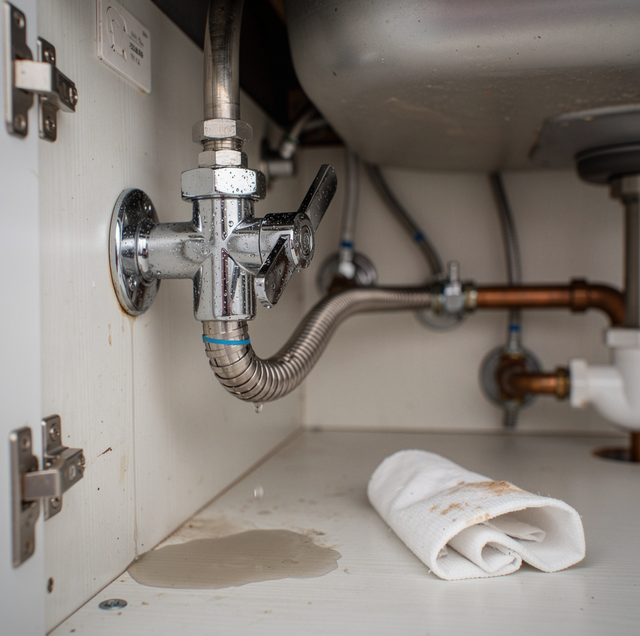
Quick Answer: A stop that will not shut off is not something to force. Forcing a seized valve is how a slow drip becomes a flood. Close the main instead, then have the valve replaced: the seat inside has taken a permanent set.
The handle turns. And turns. There is no click, no resistance, no point where the water stops, just the same loose bit of play every time you bring it back around, while the drip under the sink keeps its own rhythm. Or the opposite happens: the handle stops dead, seized against the valve body, and leaning on it harder does nothing but load a valve that has already lost some of its strength. Either way, you are on your knees with a flashlight and wet knuckles, and the water underneath the fixture is still running.
This article is about the valve under the sink failing right now, under your hand. It is not about the faucet on the counter, and it is not about replacing stops that have not failed yet — both are covered separately.
Which of Four Failures You Have, and Why It Matters Right Now
A stop that will not shut off fails in one of four ways, and the four are not equally urgent. The handle spins and never bites. The handle closes hard, and water keeps arriving anyway. The handle turns, and water starts seeping out around the stem. Or the handle will not move at all.
Sort yours first, because what separates them is how much time you have. A spinning handle and a seized handle mean the same thing at this sink: the valve will not close, and the water has to be controlled further up the line now. A stop that closes but keeps passing water has cut the volume without stopping it, buying minutes rather than hours and still putting water on a cabinet floor overnight. A packing nut that has begun to weep is live water leaving the valve at a rate that only moves one way.
None of the four is fixable at the handle, and none of them is something you caused. Why a valve that sat open for years arrives in this condition is the mechanical subject of a separate article on replacing angle stops during a faucet job. The useful question at this moment is which of the four is in front of you.
The Stem Spins but Never Seats
On an older multi-turn angle stop, the handle drives a threaded stem down through several full rotations until a washer at its tip presses against the seat, blocking the flow. When that stem fails, the handle keeps spinning with no resistance at all, turn after turn, and the water never slows. That loose, endless spin usually means the threads inside the valve body have corroded enough that the stem no longer grips them, or the washer has separated from the end of the stem entirely, so turning the handle moves nothing but the handle.
A spinning handle can feel like progress because it is moving, but it is doing no work. Treat a stop like this exactly the way you would treat one that will not turn at all: it is not going to shut off, no matter how many more turns you give it.
The Stop Closes but Keeps Passing Water
A different failure shows up after the handle has fully closed and stopped, with real resistance at the end of the turn. It feels shut off. But water still reaches the fixture, sometimes as a strong trickle, sometimes as a bead that shows up only under the sink and quietly finds the cabinet floor. This means the washer and seat made contact but never sealed: the sealing surface is pitted or etched by mineral scale, or the washer itself has hardened and cracked with age, so it can no longer flex into the small imperfections in the seat the way a fresh, supple washer would.
This is one of the more deceptive failures because the handle gives every physical signal of a normal shutoff. The only way to know for certain is to watch the fixture itself, or the line beyond the stop, for continued flow after the valve is closed.
The Packing Nut Weeps Once You Touch the Handle
What identifies this one is where the water shows up. Not downstream at the fixture, and not at the connection below. It appears at the base of the handle, seeping out around the stem where the stem passes through the valve body, and it starts within moments of the handle being moved for the first time in years.
That placement is the whole diagnosis. Water at the base of the handle is the stem seal, not the shutoff, which is why the valve can weep at the top and still pass water below. It is easy to mistake for damage you caused by touching the handle. The valve was already at the end of that seal, and moving it showed you where.
The Handle Will Not Turn at All
The most familiar failure is also the easiest to make worse: the handle will not move in either direction, and the instinct is to lean on it harder. That instinct is the problem. The stem and the valve body have bonded together, and what feels like a stuck handle is corrosion product filling the clearance between two parts that are no longer separate.
Do not tap the valve body with a hammer, spray lubricant and keep forcing the handle, or clamp the stem with pliers. A stripped stem or cracked body under line pressure can flood a cabinet fast.
A seized stop is not a puzzle to solve with more force. Every added bit of pressure on a valve body that has already lost some of its integrity due to corrosion raises the odds that something breaks open rather than turns, and a break can occur with the water still fully pressurized behind it.
What to Do When None of Them Close
When the stop under the sink will not shut off in any of these ways, the fixture-level valve is no longer an option, and the fix is to go one step further up the line: the home's main shutoff. This is the valve that controls water entering the entire house, and closing it will stop water everywhere, not just at the sink in question, until a plumber can replace the failed stop and turn the main back on.
Once the main is off, fully open the affected faucet. That drains standing pressure trapped in the line and confirms the shutoff actually caught, rather than just slowing the flow to a trickle you might miss.
Finding the main ahead of time, before water gets on the floor, is worth it. It is typically located where the supply line first enters the house, often near the foundation, a utility area, or an exterior wall near the water meter. Knowing that location before an angle stop fails is the difference between a controlled shutoff and a scramble through a wet kitchen looking for a valve you have never had to find under pressure.
Why the Fix Is a New Valve, Not a Repair
Once mineral scale has etched a seat, a washer has hardened into a fixed shape, or packing material has lost its own compression, none of those parts return to new-condition performance. There is no adjustment, no extra turn, no tightening sequence that restores a seat pitted by scale or a washer that has taken a permanent set. The materials themselves have changed, not just their position.
That is why a plumber's response to a failed angle stop is a new valve and new supply lines rather than an attempt to rebuild the one that is there. The replacement removes the specific parts that failed instead of coaxing more life out of materials that have already reached the end of what they can do.
Frequently Asked Questions
Watch the spout, not the handle. Open the faucet above the stop you have just closed and leave it open. A valve that has truly closed takes the flow down to nothing within a few seconds, and the spout then stays dry. Anything that keeps arriving after that, a thin run or a bead that rebuilds itself at the tip, means water is still passing the valve no matter how firm the handle felt at the end of its travel.
The parts that failed are the parts that cannot be reached. What seals a stop is a sealing face inside a closed brass body, and on most stops, that face is either machined into the body or carried on a ball or disc that is not sold separately. Nothing about the failure is at the handle end, where the only accessible fasteners are. So a stop that has stopped sealing gets exchanged rather than opened, and the exchange happens with the line dead.
That lower nut connects the supply line to the stop's body, and it is a separate joint from the packing nut around the stem higher up. A drip there points at the connection rather than at the valve's sealing surfaces. It is not a joint to tighten by hand while the line is live: a compression ferrule has already taken its permanent shape against the tubing, and torquing the nut against a live line is as likely to move the ferrule as to reseat it. A plumber checks that connection before assuming the valve itself has failed.
When both stops are original to the house and the same age, a plumber will often replace both during the same visit even though only one has failed. The one that is still working has sat through the exact same years of mineral exposure and the exact same stillness as the one that just gave out, so it is typically already close behind it.
Partly. A fixture's cold supply branches off the main line well before the water heater, so the heater's inlet valve does nothing for a cold-side stop that will not close. A hot-side stop is different: everything on the hot side is fed through the heater, so closing the heater's cold inlet valve isolates it once the hot line above has been drained at a faucet. For a cold-side failure, the home's main shutoff, or an interior valve upstream of it, is the only control.
Many homes have an interior shutoff valve somewhere between the main line's entry into the building and the water heater, and that valve is usually easier to reach in an emergency than a meter-side or street-side valve buried underground. It is worth locating and testing that interior valve before an angle stop failure forces you to find it for the first time under pressure.
Stop turning a valve that already failed — a plumber can secure the main and swap it before a weep becomes a flood. Ser Plumbing repipes homes across the area, from repiping in Lakewood to Bellflower. Call (310) 953-3566.
