
Quick Answer: The same drip can end in a cartridge swap or a new faucet. Three things settle it: whether the part is still made, how long the repair will hold, and whether that fixture has already come back once.
Three questions decide whether a faucet gets a new cartridge or gets carried out to the truck. Are the parts that fixture needs still made? Will a repair hold once the body is closed up and back under pressure? And has this same faucet already come back for this same complaint? Nothing else settles it.
Age does not. A fixture installed decades ago on a heavy cast body can take a cartridge and go quiet again, and a much newer faucet built around a valve nobody else makes can be past repair the first time it fails. The drip does not settle it either. A heavy drip and a slow seep come from the same missed contact between a seal and a seat.
Two of the three are answered inside the body; at the surfaces, a cartridge presses against them every time the handle closes. What follows is one of those conditions at a time.
A Drip That a Fresh Cartridge Ends for Good
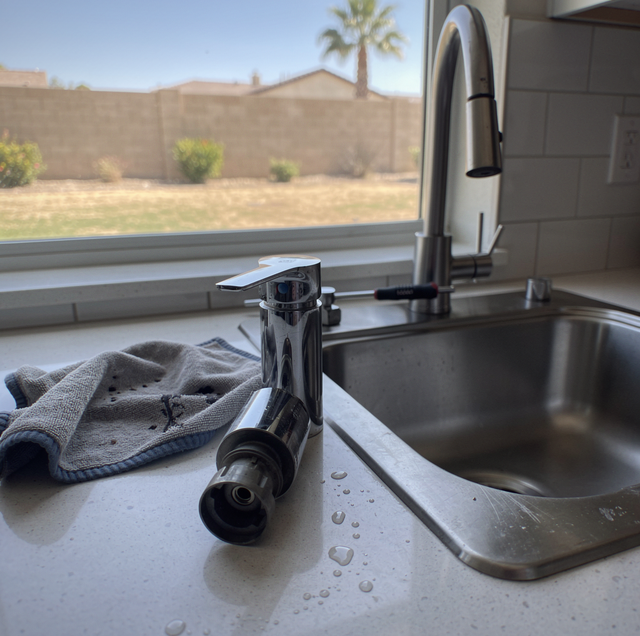
Inside the body, the cartridge carries the moving seal and the casting carries the fixed one. When the moving seal wears out, the two no longer meet cleanly, and water passes to the spout with the handle closed. If the fixed surface is still smooth, a new cartridge lands on clean metal, and the faucet shuts as it did when it was new.
The evidence is in what comes out. A cartridge that slides free of its bore without a fight, showing wear on its seals and none on its shell, sitting in a bore that is bright and even, is a repair. Nothing else in the sealing path took damage, so the new part does the whole job by itself. That repair holds.
Seat and O-Ring Wear on a Body That Is Still Sound
Not every faucet puts its sealing surfaces on the cartridge. On two-handle designs, the seal closes against a valve seat. Where that seat is a separate insert threaded into the casting rather than machined into it, the sealing surface is a part rather than a piece of the fixture. O-rings sit in grooves around the stem and around the spout collar and do the same consumable work.
Wear confined to those parts, in a body whose grooves are square and whose seat threads are clean, is a repair. The insert comes out, a new one goes in, fresh O-rings drop into undamaged grooves, and every sealing surface is new again. It holds for the same reason as the first case. Nothing that stays in the house is damaged.
What has to be true is the casting. The groove walls have to hold an O-ring against pressure, and the seat threads have to draw a new insert down flat. Both are visible the moment the faucet is apart.
A Worn Spout Collar Is Part of the Body, Not a Part You Can Buy
The spout that swings over the bowl is not part of the casting. It rides on a collar that is turned into the body and sealed to it by O-rings seated in a machined groove. Those O-rings are a consumable. The collar under them is not.
Fresh O-rings settle a weep there only if the collar and its groove are still round and unscored. A spout swung back and forth for years wears the collar out of round, and grit carried in the water cuts fine lines into the surface the seal has to grip. A new O-ring on an oval collar seals for a while and weeps again. That repair does not hold, and the fixture returns.
So base leaks are judged by the collar, not the O-ring. If the collar is worn, the answer is a new faucet, because that surface is part of the body.
Seats That Are Pitted or Scored Inside a Cast Body
If the seat is a removable insert, that damage leaves with the part. If the seat is machined into the casting, it stays, and that is the whole of the decision. A new cartridge closing on a scored land holds back most of the flow and weeps the rest, which reads as a drip that got better and never stopped. A lightly marked seat can be dressed flat again, and dressing gives up a little of the surface the seal closes on, so the next drip arrives sooner.
Pitting inside a casting is the clearest case for replacement on this list. The damaged surface is the fixture.
A Cartridge the Maker No Longer Sells
Parts availability is not a footnote at the end of the decision. Whenever the answer is no, it is the entire decision.
A faucet whose internals are still in production can be rebuilt as many times as the body allows. A faucet built around a cartridge proprietary to a discontinued line cannot, no matter how good the inside looks. The seat can be perfect, and the casting heavy, and none of it matters if the one moving part is not made.
Moen, Delta, American Standard and Pfister build around serviceable cartridges, and their internals are the kind a supply house carries. A fixture sold under a name with no parts channel behind it may have nothing available at all. If the cartridge carries a searchable marking with a current listing, repair is on the table. If it does not, the body can be sound and the faucet still gets replaced, because there is nothing left to put into it.
Availability is also not the same as fit. Cartridges from one maker can share an outward shape while differing in stem length or port position, so a part that looks right and is in stock can still fail to seat. The model marking closes that gap, not the resemblance.
A Spout That Was Rebuilt Once and Came Back
The third question you can answer without opening anything. Has this faucet already been repaired for this exact complaint?
A faucet that had been rebuilt and remained quiet was read correctly. A faucet that was rebuilt and is dripping again is telling you the wear is not in the parts that were changed. New seals went onto a surface that cannot hold them, or the cartridge is seating in a bore that has lost its shape, or the water carries enough grit to cut a fresh seal faster than the last one.
Keep the old cartridge in the cabinet after a repair. If the drip returns, the wear on that part next to the new one shows whether the seal simply aged or the body is cutting seals, which settles the second decision.
Running the same repair on the same fixture produces the same result. When the second failure follows the first at the same faucet with the same complaint, the answer moves to replacement on durability alone. The replacement visit follows a known sequence, and seized or weeping angle stops under the sink get changed along with the faucet.
Mineral Damage Inside the Faucet Body
In hard-water areas, the water leaves scale on every wetted surface inside the fixture, including the cartridge bore and the sealing land. Scale is not soft. It fills the clearance the cartridge needs to slide, and it roughens the flat the seal has to close against.
The first sign is a handle that has stiffened or moves in steps instead of sweeping. By the time it is stiff, the cartridge is bonded into its bore. Pulling it then takes real force, and force against a scaled bore takes some of the bore with it. That is the point where a repair attempt becomes a replacement anyway, so a faucet scaled to that degree gets called before anyone starts pulling.
A shutoff that has not been turned in years can break at the stem when it is forced, and a dripping faucet becomes open water inside the cabinet. Locate the main shutoff for the house before turning anything under the sink.
Scale reaches the rest of the assembly too. Mounting nuts under the deck seize onto their studs, and the stops feeding the faucet stiffen on the same water, which is most of what separates a simple replacement from an involved one.
Put the three questions in order, and the answer usually arrives before the faucet is fully apart. A cartridge is a real repair when the surfaces around it are sound, and the part still exists. It is a delay when either one of those is not true.
Frequently Asked Questions
Customer-supplied fixtures are welcome, and one gets fitted like a stocked model. What to check before you buy is whether the brand publishes replacement cartridges and sells them through a normal parts channel, because that determines whether the faucet you install today can be repaired later rather than replaced again.
That is a stripped stem. The splines that let the handle turn the valve have rounded off, so the handle rotates and the valve stays put. In designs where the stem is a separate part, it is replaceable. On designs where the stem is part of the cartridge, the cartridge goes, and if that cartridge is no longer sold, the faucet gets replaced instead.
As many times as the surfaces those parts close against stay sound. A body with a smooth bore and an unmarked seat takes a new cartridge and goes quiet again each time, and what ends the run is parts going out of production rather than a count of repairs. The other thing that ends it is the first rebuild that does not hold, because that is the body saying the wear has moved off the parts you can buy.
It applies, but the parts sit differently. A hose bibb seals with a washer at the far end of a long stem, and on a frost-free style that stem runs back through the wall. A washer at the end of a stem is replaceable on its own. A bibb whose seat has been cut by grit, or whose stem will not draw out, gets swapped as a whole unit.
Not to the faucet. The wear that produced it is already done. What the drip does is hold the sealing surfaces in constant contact with moving water, and that water carries whatever grit the supply holds, which is the mechanism that cut the seat in the first place. A fixture left dripping is in slightly worse shape than it was on the day you noticed.
It depends on how the maker supplies the part. Some lines list the hose, the wand, and the internal sprayer valve as separate order numbers, and a sprayer on one of those gets sorted out without opening the rest of the faucet. Other lines sell the hose and wand only as one matched assembly, so the smallest available repair is larger than the part that failed. Where nothing is listed at all, the sprayer sits in the same position as any other part no longer made.
Book the faucet that keeps dripping for a look inside — the seats, the spout collar and the parts supply hold the answer, and a licensed plumber reads all three in the one visit. Ser Plumbing repairs water heaters across the area, from water heater repair in Bellflower to Lakewood. Call (310) 953-3566.
