
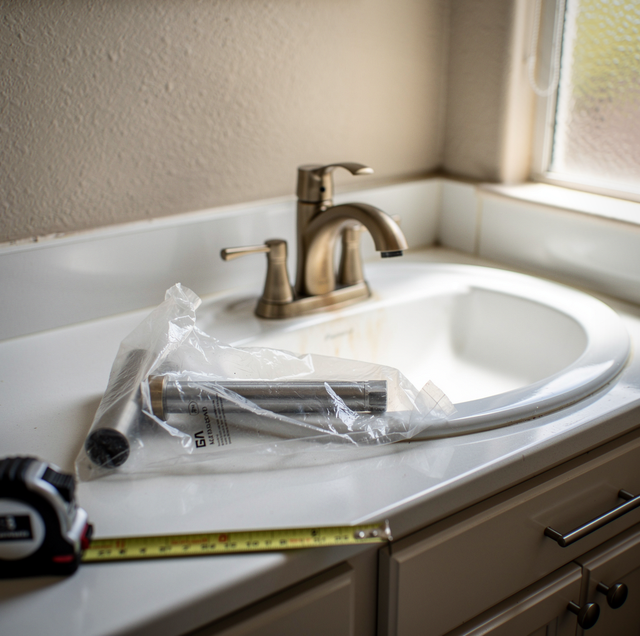
Quick Answer: Before installing a customer-supplied faucet, a plumber checks hole count and spacing against the deck, whether the included supply lines reach the stops, whether the sprayer setup matches the holes available, and what the box left out.
The faucet is out of its shipping box and sitting on the counter before anyone touches a wrench. Checking a customer-supplied faucet before installation is not about second-guessing the purchase. It is about laying out what arrived next to what the sink already has, so any mismatch turns up while the old faucet is still on the sink and the water is still on, rather than after everything is apart. Four things get checked in the same order every time: what the deck underneath will accept, whether the supply lines in the box will reach, whether the sprayer arrangement lines up with the holes available, and what the box left out that the job still needs. That comparison happens with the faucet still in its packaging where possible, since finding a mismatch after everything is unwrapped means repackaging a fixture that may not seal back up the way it shipped.
The faucet itself has already been chosen. This is a different question from picking one out. It is whether the one that showed up on the counter will go onto this specific sink with what came in the box.
None of these checks take long, and each is easier to answer with the old faucet still on the sink than with it off.
What the Deck Underneath Has to Match
The check turns on two numbers: how many holes this deck already has, and how many the faucet in the box is built to use. Both come off the physical objects, the counter and the faucet body, read on the same trip rather than carried in from memory.
Fewer holes needed than the deck has is the case a deck plate answers, and what gets verified there is whether the plate that came in this box is wide enough for the spacing this particular deck was drilled to. More holes needed than the deck has cut is the case that stops a swap where it stands, and it is the first thing flagged before the old fixture comes off, not discovered after.
That comparison is made against the actual counter and faucet body, not against the online listing's photos or diagram, since a listing photo can't show how a particular counter was drilled when the kitchen or bathroom was built.
Replacing a Wall-Mounted Kitchen Faucet: The Unions Inside the Wall
A wall-mounted kitchen or bar faucet flips the whole check. There is no deck to measure, because the faucet does not sit on the counter at all. It bolts to a pair of supply unions set into the wall, with the spout aimed down at a sink positioned underneath it. What has to line up is the on-center spacing between those two unions and the spread built into the new faucet's body, the same job deck holes do for a countertop unit, just moved off the counter and onto the wall.
Getting eyes on that spacing means reaching the unions wherever they sit, and how that access is achieved is part of the survey rather than this check. What this check produces is a number: the on-center distance between the two unions, measured at the wall and set against the spread the new faucet was built to. Those two either agree or they do not, which is why the measurement happens before the new faucet ever comes out of its box.
Whether the Supply Lines in the Box Will Reach
The measurement runs from the point where the faucet's shanks will sit, down through the deck, to the fitting on each stop. It gets taken with a tape against the cabinet in front of you rather than by eye, and it gets taken on both sides, since the hot stop and the cold stop are not always set at the same height or the same distance back from the front of the cabinet.
Then the lines themselves come out of the packaging and get held up against that distance, before anything is disconnected, to see whether there is slack to spare or a shortfall. A shortfall is answered with an extension or a different connector, not by stretching a line to reach something it was not built to reach.
Matching the Sprayer or Side-Spray to the Holes You Have
A pull-down or pull-out kitchen faucet keeps its sprayer built into the faucet head, so it only ever needs the one hole the deck plate already accounts for. A side-spray setup works differently: a separate handheld unit on its own hose that needs a hole of its own next to the faucet body, not folded into it.
The check runs both directions. A faucet with a built-in pull-down head arriving for a sink that used to have a side spray leaves an extra hole that has to go somewhere, capped, plated, or put to some other use. A faucet that expects a side-spray hole that was never cut into that particular deck needs one added before the spray hose has anywhere to sit. Either way, it is confirmed against the deck itself before the old faucet comes off, not assumed from a box photo. Settling that question early matters because it decides what accessories or plates need to be on hand before the old fixture is disconnected, not after.
What Is Missing from the Box That the Job Still Needs
A faucet box rarely contains everything a specific installation calls for, even when the faucet itself is the right one for the sink. Mounting hardware sized for one deck will not always fit another. Extension lines or different-length connectors may be needed if the ones included do not reach. If the stops under the sink are old enough to be seized or weeping, that is a separate repair the faucet box was never going to solve, and it gets named the same visit rather than found halfway through the job with the water already off.
Before the old faucet comes off, lay out every part still bagged inside the box, from mounting hardware to supply lines to any deck plate, against what the sink needs, so nothing gets improvised partway through with the water already off.
None of that means the wrong faucet got bought. It means the gap between a box built for a generic install and the sink underneath it gets closed before the old faucet comes off the counter, rather than being discovered with half the job already apart. Even a faucet that is exactly right for the sink can still need one more part before it is ready to go on, and naming that part while the old faucet is still connected is the whole reason the checks happen first.
Frequently Asked Questions
Most pull-down and pull-out kitchen faucets ship with a small weight already meant to clip onto the hose partway down its length. That weight is what pulls the sprayer head back into the spout after use, so if it is missing from the box or never gets clipped on, the hose stays loose and will not retract on its own.
A laundry or utility-sink faucet is usually built to connect to garden-hose-style threaded fittings rather than the compression fittings used under a kitchen or bathroom sink. A kitchen or bath faucet ordered for a utility sink by mistake will not thread onto those connections without an adapter, even if the hole spacing lines up.
On the maker's spec sheet rather than on the carton. The carton sells the finish and the spray pattern; the spec sheet lists the mounting shank and the deck thickness the faucet is rated to pass through. Setting that one number against the counter it has to clear is a pre-purchase check, and it is the one people skip.
Not as exactly as a one-piece faucet needs its holes to match. A widespread bathroom faucet connects each handle to the spout with its own flexible hose, so it can bridge a range of hole spacings rather than requiring the fixed spread built into a single-piece centerset faucet.
The shutoff on a frost-free hose bibb sits well back inside the wall, on the heated side, reached through a long stem running from the exterior handle to that valve. A standard hose bibb's shutoff sits right at the wall face, which is why the two are not interchangeable just because the spout on the outside looks similar.
It comes with one, threaded into the spout tip at the factory. Worth knowing where it is: the first minute of water through a new install pushes debris out of the lines, and that debris lands in the new aerator screen. Unscrewing it, rinsing it and putting it back is a normal day-one step, not a fault in the faucet.
Book the install for the faucet already sitting on your counter — the deck, the stops and the box get checked against your sink first. Ser Plumbing repairs drain lines across the area, from drain line repair in Downey to Long Beach. Call (310) 953-3566.
