
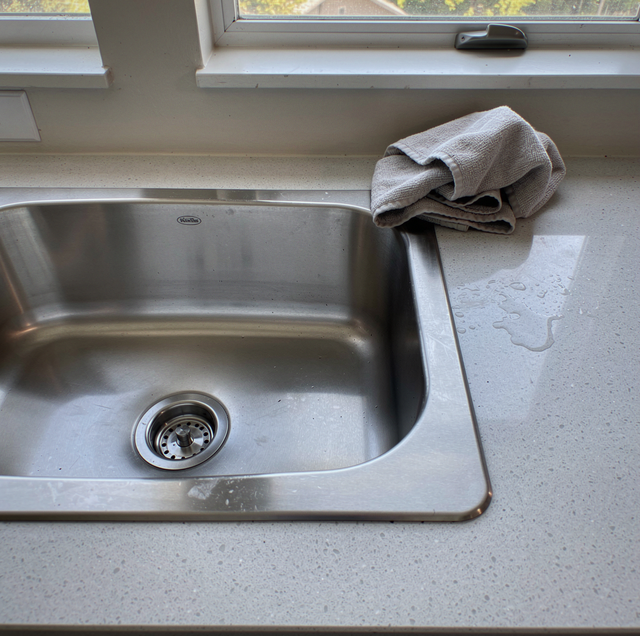
Quick Answer: A same-size sink swap can skip the countertop entirely when the new bowl's outside dimensions, rim, and faucet-hole pattern match what is already cut into the counter. Everything else, including a change in size or mount style, means the opening has to be recut.
Standing over a stained or chipped kitchen sink, most people ask the same question first: can the sink just be replaced, or does the whole counter have to come out with it? The real answer splits into two completely different jobs, and which one applies depends on a single detail decided before any tool touches the counter: whether the new bowl fits the opening already there.
If it does, the swap is a same-size replacement: old sink out, new sink in, with the existing cutout doing exactly the job it always did. If it does not, because of a different footprint, a different mount style, or a sink that is not made in the size already cut into the counter, the opening itself has to change, and that becomes a different job with a different order of work. Both are common. Neither is automatically the harder path. What decides it is dimensions, not preference.
The Swap Path: Matching a Drop-In to the Opening That Is Already There
A drop-in sink, also called a self-rimming sink, has a flat rim that rests on top of the counter and covers the cut edge underneath it. As long as a new sink's rim matches the shape and size of the opening the counter already has, that new bowl can go into an old cutout without the countertop being touched at all. That is what makes a like-for-like swap a straight exchange: the counter was cut years ago, and the new sink is built to sit where the old one sat.
An undermount sink meets the counter somewhere else entirely: it sits below the surface, with no rim showing above it, so the counter's cut edge is exposed and finished rather than covered. Those two sinks are not interchangeable in one opening because of the edge, which is what makes a mount-style change a recut rather than a swap.
What Has to Match for a Same-Size Swap to Work
Three things decide whether a swap stays a swap. The first is the outside footprint, meaning the rim's overall length and width, not the basin size printed on the box. The cutout is a fixed size once it exists, so a rim that is even slightly smaller than the old one leaves the counter's raw cut edge exposed to water, and a larger rim will not sit flat against the surface.
The second is the rim profile itself: how far the flange extends past the cut edge and how it is shaped at the corners. A rim designed for one cutout style does not always cover another cleanly, even when the overall dimensions are the same.
The third is the faucet deck. On a drop-in sink, the faucet holes are punched in the sink's own deck, so they leave with the old bowl and arrive with the new one, which means a new sink can change the hole count without anything happening to the counter. On an undermount, the holes go through the countertop itself, and those were fixed the day the counter was drilled. A new faucet that needs fewer holes than a counter already has is usually solved with a deck plate covering the unused opening rather than cutting anything new.
The Fabrication Path: When the Countertop Opening Has to Change
Two situations push the job past a swap. The first is a different bowl footprint: wider, narrower, deeper front-to-back, or shaped differently at the corners than the existing cutout. The second is a change in mount style, from drop-in to undermount or the reverse. Both require the opening itself to be cut, and the reason comes back to how each sink type meets the counter.
A drop-in relies on its rim to cover the cut edge from above, so the cutout can be a little rough at the margins without showing. An undermount has no rim to hide behind: the counter's edge at the opening is finished and exposed, because that edge is what a person sees looking down into the sink. Converting between the two is not a hardware change; it is a different opening shape paired with a different finished edge, and neither can be faked with the wrong mount style's sink.
That difference also flips the order of work. On a same-size swap, the old sink comes out, and the new one goes in during the same visit, since the opening never changes. On the fabrication path, the old sink comes out first, the opening gets cut to the new bowl's exact template, and only once that cutting is finished does the new sink get set and connected. It is a sequence with an extra step in the middle that a same-size swap never needs.
Once a stone or engineered-quartz countertop is cut for a wider opening, the freshly cut edge is more likely to crack under stray weight or a dropped tool until the new sink is set and secured beneath it.
The Plumbing Side of a Sink Swap During a Countertop Change
A different situation entirely is a full countertop replacement, where the whole slab is coming out as part of a kitchen update, and the sink is simply going along with it. The plumbing tasks are the same as any other sink swap, but the order they occur in is reversed.
Instead of the sink being disconnected, removed, and replaced with the counter staying put the whole time, the new sink, and often the new faucet, gets mounted to the new countertop before that countertop is ever set on the cabinets. Fastening a sink to a slab is easy work while the slab is flat on a bench; it is far harder once that same slab is installed and the cabinet space underneath is cramped. Meanwhile, the plumbing work at that stage is disconnection: shutting off the water, disconnecting the supply lines, and removing the old sink, faucet, and trap so the old counter can come out clean. Once the new countertop is set in place, with the sink already mounted to it, the reconnection happens: supply lines, trap connections, the disposal, and the dishwasher tie-in all go back together on the new setup.
The two halves of that job belong to two different trades. Templating the old counter's footprint, fabricating the new slab, and mounting the sink to it before delivery are the countertop side of the work. Disconnecting the old fixture before that counter comes out, and reconnecting everything once the new counter is set, are the plumbing side. Neither half substitutes for the other, and the sequence only works because each one happens at the right point in that order.
What Comes Off and Goes Back on Either Path
Underneath the sink, the same set of connections gets disconnected and remade no matter which path got the job there. The basket strainer seats in the sink's drain opening and does not transfer from an old bowl to a new one; a new strainer goes in every time a sink changes, matched to that bowl's drain hole. The tailpiece hanging below it and the trap connections underneath come apart at their joints and get remade once the new sink is set and level.
If a garbage disposal is mounted under the sink, it has to come down before the old sink is removed, since it hangs directly off the drain opening and is otherwise in the way, and it gets reconnected to the new bowl's drain outlet afterward. Where a dishwasher drains through that same area, its tie-in gets remade at the same time. None of that underside work changes based on whether the sink above it arrived by a same-size swap or by a full recut; the only thing the path changes is what happens at the counter, not what happens underneath it.
How easy it is to reach and work on that under-sink reconnection depends mostly on how much room there is to maneuver, which varies from one cabinet to the next.
Where the Plumbing Work Ends, and the Countertop Work Begins
Cutting a counter for a new sink is part of the plumbing scope when no same-size opening is available, and a footprint or mount style change makes cutting necessary. That work happens on the existing counter, in place, sized to the new sink's own template, and it is limited to producing the opening the new sink needs.
Fabricating a new countertop is a different trade altogether: choosing the slab material, cutting it to the kitchen's full dimensions, finishing the edges, and setting the new top on the cabinets are jobs that belong to a countertop fabricator, not to plumbing work. So is general remodeling or coordinating other trades on a larger job. On a project where the whole counter is being replaced, the fabricator supplies, templates, and sets that counter; the plumbing side is the disconnection before it comes out, the cutting of an opening only when an existing counter is not already being replaced, and the reconnection once the new surface, with its sink in place, is set.
Frequently Asked Questions
Maybe, even if the box says "standard size." Two sinks can share the same length and width on the label and still have different bowl depths. A deeper bowl reduces the clearance underneath for the trap and, for a disposal, if there is one, even though the cutout itself fits without any cutting. Depth also sets the tailpiece, since it decides where the bowl's drain lines up over the trap arm, so a deeper bowl can need a new tailpiece even when the trap arm below it stays exactly where it was.
Not always the same steps. Many vanity sinks come as a single integrated top, with the bowl and the counter surface molded as one piece rather than a separate sink set into a cut opening. In that case, there is no rim-to-cutout matching at all, because the whole top comes out and a new one goes in as a single unit.
Usually not. A laundry-room basin is typically a freestanding utility tub set on its own legs or a cabinet base rather than a bowl dropped into a cut counter opening, so the swap-versus-recut question this article covers does not really apply to it. There is no rim or cutout to match in the first place.
Usually not, even when the overall length looks close on paper. A double-bowl sink divides that same width across two basins instead of one, which changes the footprint's proportions enough that an existing single-bowl opening rarely lines up cleanly, so a bowl-configuration change like this typically falls into the recut path rather than the drop-in swap.
It changes the method, not whether it can be done. Stone and engineered quartz are cut wet, in place, with a bit made for the material, which means the water and slurry from that cut have to be contained inside the kitchen while it happens. That containment is scoped against the material before it is scoped against the sink.
From the sink, not the hole. With the bowl still mounted, the cutout is hidden under the rim, so the usable numbers come off the old sink itself: its overall rim length and width, and the shape of its corners. A candidate that matches those in the same mount style is a swap, and anything else gets measured again from below once the old bowl is out.
Bring the new sink's dimensions to the conversation and find out which job you have — a clean swap and a recut are two different pieces of work with two different orders of operation. Ser Plumbing flushes water heaters across the area, from water heater flush in Downey to Long Beach. Call (310) 953-3566.
