
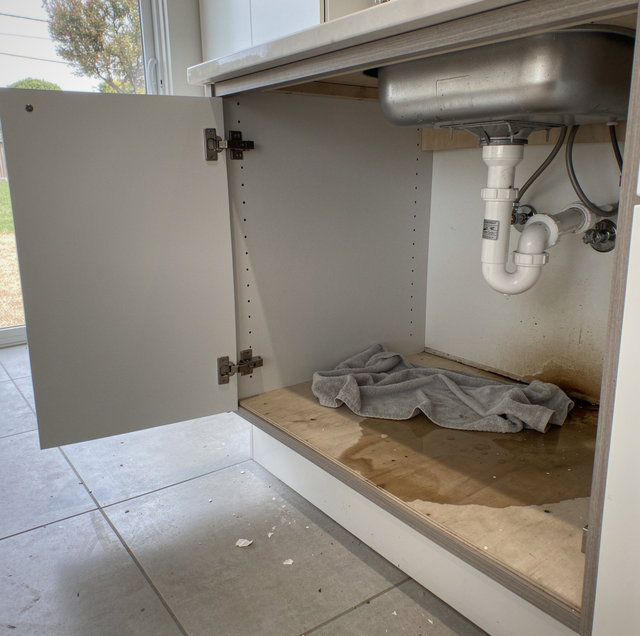
Quick Answer: Check for power at any appliance outlet in the cabinet, then close the shutoffs under the sink, empty the cabinet, and dry the base completely. Then watch when the water returns: the timing tells you which system is feeding the leak.
Water is spreading across the cabinet floor under your sink, and you are standing over it with a phone in your hand. Work in this order, before anything else.
- Check the cabinet for power before you reach in: If a dishwasher or disposal is served from inside that cabinet and water has reached its outlet, cord, or switch, keep your hands out and shut that circuit off at the breaker first.
- Shut the water off at the fixture: Close both small valves on the wall behind the drain, the ones the faucet's supply lines run up from. Turn each one clockwise until it stops.
- Empty the cabinet and dry the base: Everything out, doors open, towels down until the base is dry to the touch. Nobody can see where water starts while it is pooled across everything.
- Read the pattern: Watch for when the water comes back. What you are timing is not the leak itself; it is the system feeding it, and each system runs on a different schedule.
This is first response to water that is still arriving, not a drain-leak teardown. If the water proves to be coming from the trap or the joints beneath the bowl, that diagnosis is its own subject, and it begins after the water has stopped. If a garbage disposal shares the cabinet, treat it as a separate source and exclude it from this sequence.
Shutting the Water Off Comes Before Anything Else
Supply piping is under pressure every second of the day, whether or not a tap is open. A failure on that side does not wait for anyone to use the sink, so the volume on the floor depends on how long the line stays open. Closing the two stops pulls the fixture out of the pressurized system and turns an ongoing event into a puzzle you can solve at a normal pace. Close both, hot and cold, even when you are certain which side is wet.
Which handles to turn, what to do about one that will not move, and where the house main is when neither will close. Nothing after this point depends on knowing why a stop failed. It depends on the water having stopped.
An Empty, Dry Cabinet Makes the Source Visible
A cabinet base is almost never level. It sits on a sloping floor, on shims, or on a frame that has settled, and water landing anywhere on it runs to the lowest corner and collects there. The wet spot you notice first is downhill of the origin. Stored bottles and cardboard make that worse, since board and paper wick water sideways and hold it against the base long after the drip that put it there stopped.
So the cabinet comes out. All of it. Then towels, until the base is dry to the touch and the pipes are dry too, undersides included, since that is where a drip hangs before falling.
A breaker panel is not the place to guess. If you cannot identify which breaker serves that cabinet, shut off the main breaker rather than flipping switches one at a time with water on the floor below.
What that buys you is a test surface. The next water to arrive has a visible starting point and a direction of travel, so you can follow it upward instead of guessing. A base that is dark, swollen, or soft under a thumb has been taking water long before today, which points at a slow weep rather than something that let go this morning.
Water That Sprays or Rises Fast Is a Supply-Side Leak
Speed is the giveaway. Line pressure has no off switch, so a supply-side failure produces water continuously, at a rate that does not care whether anyone is home. Spraying, a visible stream, or a puddle that returns within a minute of being wiped with nothing running: that is the pressurized side.
Three locations feed water in at that speed, and on a dry base you can usually see which one is wet. The stop on the wall is one. The flexible connector running from that stop up to the faucet is the second. The third is the faucet shank, the threaded tube that drops through the sink deck and the connector screws onto; it sits high in the cabinet and directs water down the outside of the connector, so the connector takes the blame for something above it. Temperature narrows it further: warm water at the base means the hot side is involved, and one stop and one connector have just come off the list.
Do not put a hand or a wrench on a live connection. A weeping fitting is holding pressure with whatever grip it has left, and pressure on it can turn a drip into a spray faster than anyone can react.
Water That Appears Only While the Tap Runs Is on the Drain Side
The drain carries water only when you send it, and it carries that water at atmospheric pressure rather than line pressure. A leak on that side is use-triggered by definition: it starts seconds after the tap opens, runs while the tap runs, and quits when the flow quits. Volume tracks minutes at the faucet, not hours on the clock.
Reading it means leaving the sink alone. If the base stays dry through an hour of no use and then wets within seconds of the tap opening, the pressurized side is not your problem, and the connections below the bowl are. That is where a joint-by-joint diagnosis begins, and it is separate work. What matters now is that the water is not under pressure, so the sink can wait for a scheduled visit as long as nobody uses it. One wrinkle: water showing up a few minutes after the tap is off is still drain-side, because that side does not empty the instant flow stops.
Water That Appears Only When the Dishwasher Drains
A dishwasher does not drain by gravity. It pumps, and the discharge hose from that pump runs into the sink cabinet and ties into the sink's drain plumbing inside it. During the pump-out portion of a cycle, that hose carries a surge with real force behind it, nothing like the gentle flow a sink drain sees. That surge arrives on the machine's schedule rather than yours, which is what makes the timing readable from outside the cabinet.
The pattern is hard to mistake once you watch for it. Water arrives in bursts, minutes apart, with a cabinet that dries between them, and it stays dry when nobody runs the machine. The hose, the clamp, and the tie-in are plumbing. The machine itself is an appliance, so where the water shows up sorts out who to call: inside the cabinet is plumbing, seeping from under the dishwasher door is not.
Water with No Obvious Source at All
Sometimes the base is dry, every pipe is dry, and there is water anyway. Three things produce that.
Condensation: Cold supply lines and a cold drain pull moisture out of humid air onto their outer surfaces, and a closed cabinet with no air movement holds that humidity against them. It happens in any month the air is damp and eases in dry stretches, whatever the season. It also reads differently from a leak: an even film along the entire pipe, including the top surface, instead of a trail running to one low point.
Water arriving from elsewhere: A cabinet base is often the lowest accessible point in a run of floor, so water from a neighboring fixture, an appliance, or a wall travels to it and pools, with nothing above it to leak into. The tell is position: wet at the back edge or along one side, dry at every pipe, no change after the base is dried.
Piping nobody can see: Water that returns hours after every stop, with every visible surface dry, is coming from upstream of the cabinet. That is leak detection rather than fixture repair, and the search moves into the wall or the floor. Slab-on-grade construction raises the stakes because a supply line under a slab has no path to daylight and announces itself as damp flooring or a warm patch rather than a drip anyone can point at.
What Makes It a Same-Day Call, and What Can Sit Under a Bucket
The dividing line is control, not drama. If you can stop the water and keep it stopped, you have time. If you cannot, you do not.
Same-day, no waiting: water that keeps arriving with both stops closed and nothing running; a stop that will not close, leaving the main shutoff as the only thing between the house and an open line; water that has already reached past the cabinet into flooring, a wall cavity, or a ceiling below; and water near the electrical serving an appliance in that cabinet. Each of those means the water is unstoppable or already somewhere it will not dry.
A bucket answers exactly one situation: a leak that appears only while the tap runs, arrives in drops rather than volume, leaves a dry base between uses, and sits above a container that catches all of it. That sink is out of service until someone looks at it, because running it is what feeds the leak.
Then there is the middle case. The water stopped when you closed the stops, and nothing is arriving now. That is not an emergency, and it is also not fixed. The fixture is off, the cabinet is empty, and you know which system is involved. That is the moment to book, with the pattern in hand.
Frequently Asked Questions
Long enough to cover the slowest source on the list. A supply-side failure shows within a minute with nothing running. A drain-side leak requires the tap to actually be run. A dishwasher leak needs a full cycle to reach its pump-out. A base that stays dry through all three and then wets overnight with everything shut is pointing past the fixture, into the wall or the floor.
Position over pipe. The stops and the stub-outs behind them are the only fittings back there, so water along the back edge with every connection in the middle of the cabinet dry usually means water arriving along the wall rather than from the fixture. Wet at the back and dry at every joint is a different search from wet under the bowl.
It can. A deck plate is the escutcheon covering unused faucet holes on the sink deck, and it is a cover rather than a seal. Water pooling around the faucet base runs beneath it, through the holes it hides, and into the cabinet. The signature is dry connections plus a puddle that only follows a splash.
Easily. An under-sink filtration or reverse-osmosis unit brings its own feed connection, tubing, and storage tank into that cabinet, tied to the cold line. It holds water independently of the faucet and the drain, so it can be the wet thing while both pass every test.
Not until the base has been tested against each system. A source tied to something that runs on a cycle can skip a day without meaning anything, and a slow weep can take that long to reappear on a dried base. Run the tap hard, run a full dishwasher cycle, and leave the base bare and dry through both before anything goes back under there.
Look at what it leaves behind. A tipped bottle of dish soap, detergent, or cleaner gives liquid that is tinted, cloudy, or scented, feels slick between the fingers, and dries tacky with a ring at the edge. Water dries clean. Two seconds of checking rules out a knocked-over container.
Close the stops first, then let a licensed plumber name the source before the cabinet goes back together — same-day response for water you cannot stop. Ser Plumbing handles burst pipes across the area, from burst pipe repair in Downey to Lakewood. Call (310) 953-3566.
