
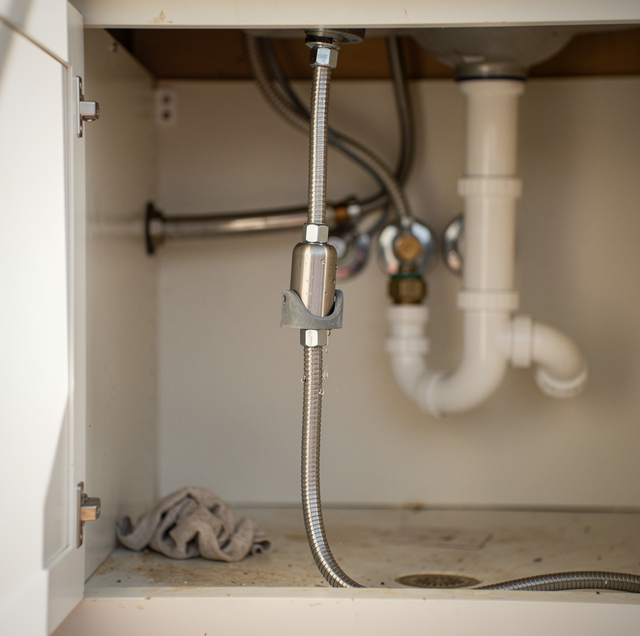
Reach into the cabinet under a kitchen sink with a pull-down faucet, and there is a hose disappearing up through the spout, with a plastic or metal weight clipped onto it partway down. That hose travels every single time the wand comes out over the sink and goes back in, and the weight is what draws the hose back down whenever the wand is not being held. The hose goes unnoticed until it stops doing its job, until the wand refuses to sink back into its dock, or the stream loses force while water sprays from the head, or the spray pattern stays fixed and will not switch back to a stream.
Those three complaints get lumped together as one broken sprayer, but they trace to three separate systems sharing a single faucet. A small control on the wand itself switches between stream and spray. A diverter inside the wand's spray head decides whether water goes to the single aerated outlet or the ring of spray holes around it. And the hose-and-weight assembly under the sink is a purely mechanical system that has nothing to do with either valve. Sorting out which one has actually failed is most of the diagnostic work; the fix, once the right part is identified, is usually simple.
| Symptom | Part Most Likely at Fault |
|---|---|
| Wand sprays no matter what the button says | The toggle valve inside the wand |
| Stream loses force and water leaks from the spray holes at the same time | The diverter inside the spray head |
| Wand will not pull back into the dock | The counterweight, the hose path, or the docking catch |
A Kitchen Faucet Stuck in Spray Mode
The control that switches a pull-down wand between a single stream and a fan spray sits right on the wand itself, usually a button on top near the trigger or a collar at the nose. Pressing it shifts a small valve inside the wand's own housing between two internal channels, one open and one split into narrow spray outlets, and that valve is sealed off from the rest of the faucet. It has nothing to do with the diverter behind the spray face, which only comes into play when it sticks part way instead of moving fully from one position to the other.
Spray mode routes water through channels far narrower than stream mode, so any mineral scale in the water reaches those channels first and builds there fastest. In hard-water areas, that scale can be enough to jam the small internal slide in one position, and once it holds in spray mode, pressing the button no longer moves it back. Nothing else about the faucet's flow is affected either way, because this valve only ever changes the pattern inside the wand. A wand that sprays evenly in either mode but will not switch back to a stream is not a problem with the diverter behind the spray face, just a stuck internal toggle.
When Water Escapes the Spray Face in Stream Mode
On a pull-down faucet, the wand is the only outlet. The hose runs up through the spout, and everything the faucet delivers passes through the head at its end. The part that decides where water goes inside that head is a small diverter seated behind the spray face, shifting flow between the single aerated outlet and the ring of spray holes around it.
When sediment or scale holds that diverter part way, both paths open at once. The stream loses force while water weeps or sprays from the outer holes at the same time, which reads as a faucet that cannot pick a mode. Because the part sits inside the head rather than in the faucet body, the correction is a new spray head assembly, not work inside the faucet.
Why the Wand Will Not Pull Back Down
Retraction has nothing to do with either valve. The counterweight clipped onto the pull-down hose beneath the sink is designed to overcome the wand's own weight and the friction of the hose sliding through the guide tube inside the spout, pulling the hose back down and the wand back up into its dock whenever the wand is let go. If that weight has slid down toward the hose's lower connection, or come loose from its grip point on the hose entirely, there is not enough downward pull left to draw the wand back up into its dock. The wand will simply hang wherever it was left.
Checking the weight's position on the hose is the first step, and it usually means opening the cabinet doors and following the hose down by hand until the weight is found. A weight sitting low, near where the hose meets the supply connections, is doing far less work than one riding higher on the hose's midsection.
A hose caught on a supply line, a trap, or a disposal body resists retraction the same way a low counterweight does. Never force it by pulling harder; the strain can crack the quick-connect fitting or the spout's guide tube instead.
Not every pull-down faucet uses a counterweight at all. Some models replace it with a spring built into the hose assembly, which stores tension as the wand is drawn out and releases it to draw the hose back, doing by spring force what a weight does by gravity. A spring that has lost its tension produces the same symptom as a slipped weight, but there is no clip to reposition; the fix is a new hose assembly with the spring already built in. Either system can also fail due to added resistance within the spout's guide tube, where the hose rubs against a rough or slightly misaligned passage and drags with every pull, regardless of how well the weight or spring is doing its job.
A Hose Caught on Something in the Cabinet
A caught hose produces the identical symptom as a weak counterweight — the wand will not come back — but the cause and the fix are different. If something in the cabinet has shifted, a new filtration housing, a filtration housing or a stored bucket, or even a new shutoff bracket sitting slightly closer to the hose's path than it used to, the hose can snag against it on the way down. The counterweight may be doing its job perfectly and still lose the fight against an obstruction it cannot pull past.
Freeing the path means opening the cabinet, following the hose by hand from the spout down to the weight, and moving whatever the hose rests against rather than applying force at the wand. Once the path is clear, a properly weighted hose should retract fully on its own.
A Worn Docking Catch at the Spout
Even with a working counterweight and a clear hose path, the wand needs help for the final stretch of its trip. Many spouts use a magnet set into the base of the spout and a matching plate in the nose of the wand, which pull the two together and hold the wand snug once it is seated. Other models use a friction ring instead of a magnet, gripping the wand's nose the same way.
Magnets weaken, and friction rings wear smooth with years of use, and when that happens, the wand's final approach into the dock loses its pull even though the counterweight brought it most of the way home. The wand seats loosely, sits with a visible wobble, or drifts back out of the dock on its own after being pushed in. This differs from a low counterweight or a caught hose in one clear way: the wand travels the full distance without a fight; it simply will not stay locked in once it gets there.
Working Around the Quick-Connect
The pull-down hose is not one continuous piece. At the trigger end, it plugs into the wand's own short hose through a squeeze-clip coupling, and that coupling is the point most retraction work runs into, because freeing a snagged hose or repositioning a weight means handling the hose right where it joins. It sits on the pressurized side of the line.
Close the angle stops under the sink before anything at that joint is opened or separated. Leak diagnosis at that fitting is its own subject and is covered separately.
Closing both angle stops and briefly running the wand's trigger afterward relieves the remaining pressure in the hose before the quick-connect is opened, which prevents the disconnect from spraying water into the cabinet on the way apart.
That one extra step turns a routine wand swap into a dry one.
Frequently Asked Questions
It is usually a rubber-coated slide clip, sometimes called a roller ball, clamped around the hose rather than tied or glued to it. Because it grips by clamping rather than fastening permanently, it can usually be slid back up the hose by hand to a better position without removing the faucet.
No. The top-mounted button is the common form, but some models place the same control in a rotating collar built into the wand's nose, twisted rather than pressed. The valve underneath works the same way regardless of which shape the control takes.
The extra length is what lets the wand reach past the far edge of the sink, and the surplus hangs as a loop in the cabinet so the weight has room to travel its full stroke. Coiling or zip-tying that loop tight leaves the weight bottomed out, with nothing left to pull.
Because the weight will not pass through the spout's guide tube. The hose has to be threaded down from the top with nothing attached, and the clip goes on afterward from inside the cabinet, which is also why a replacement weight can be fitted without pulling the faucet.
Yes. The magnet face in the spout and the steel plate in the wand nose both collect fine metal debris and dried mineral film, and either one holds the two surfaces slightly apart. Wiping both faces restores the grip on a dock that has not actually weakened at all.
It can. With the water shut off at the angle stops under the sink first, the wand's nose piece can be unthreaded and soaked in vinegar, which loosens mineral scale packed into the narrow spray channels and often brings the spray pattern back to normal without replacing the wand. It will not help a toggle that has jammed mechanically rather than scaled shut, which needs the internal valve replaced instead.
Pin down which part in the pull-down system is failing — then get it repaired without guessing. Ser Plumbing repairs sewer lines across the area, from sewer line repair in Downey to Long Beach. Call (310) 953-3566.
