
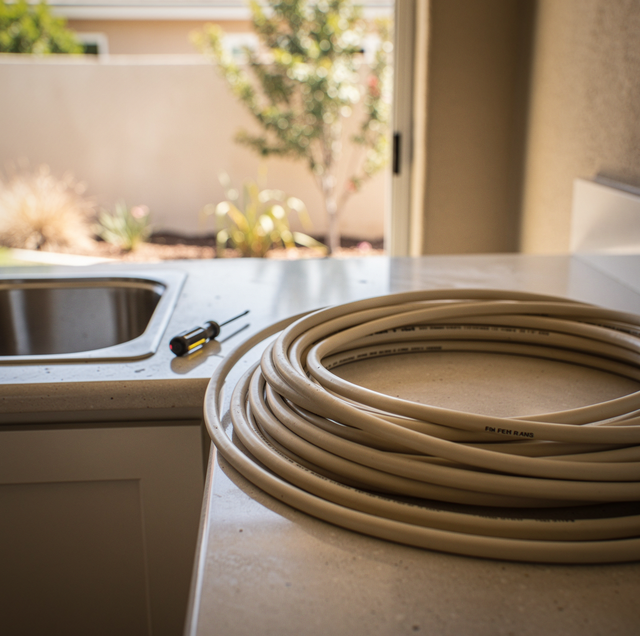
Quick Answer: NSF/ANSI 61 is the standard for materials in contact with drinking water. NSF/ANSI 372 defines lead content in plumbing products. A code listing mark is a third statement. All appear on the print line, on fittings, and on the carton.
Somewhere on the water line under your kitchen sink, printed lengthwise along the tube in type about an eighth of an inch tall, is a line of text. It repeats every foot or two, the same string over and over, so wherever a plumber cuts that tube, both cut ends still carry the whole of it.
Read it, and you get a manufacturer, a material and its type, a size, ratings, the standards the tube was made and tested to, and usually a code identifying the production run.
That printing is the only place your house writes down what it is made of. No plate on a wall says it, and nothing filed with the address says it. A building's account of its own water piping is written on the piping in type the size of a footnote, then covered with drywall for several decades.
Two marks in that string get asked about most and explain themselves least. Both name standards can be checked against a certifier's published listing rather than against anybody's word.
What the Print Line Actually Tells You
A print line is not one fact. It is a short record with several fields, and each answers a different question.
Manufacturer and brand: who made the tube and which product family it belongs to. This field finds everything else for you, because certifier listings are organized by company first.
Material and type: what the tube is. On a plastic supply line, this names the polymer and, for PEX, the type letter, which indicates the process by which the tubing was made rather than a quality score.
Nominal size and ratings: the size the trade calls it, which is not the measured outside diameter, then rated pressures at stated temperatures. How long a tube lasts in your water is a question about heat, pressure, and water chemistry together, and no mark on the tube can answer it.
Manufacturing standards: commonly ASTM designations covering dimensions, materials and test methods. These are separate from the certification marks further along the same line.
Certification and listing marks: the certifier's mark, the standards it certified the product against, and often a code listing mark. This is the part of the string this page is about.
A production code: letters and digits identifying when and where that length was extruded, useful only when a manufacturer needs to know which run a piece of pipe came from.
What NSF/ANSI 61 Covers
NSF/ANSI 61 is the standard for materials and products that come into contact with drinking water on its way to a tap. Its reach is wider than pipe: fittings, valves, gaskets, solders and fluxes, tank linings, coatings and meters all fall inside it, because all of them sit in the wetted path.
What the standard contains is a procedure. It sets out how a sample is prepared, what water it is exposed to and for how long, how it is analyzed afterward, and how the result is compared against the standard's own criteria. It is a long document maintained through a consensus process and revised as methods change.
Certification occurs when someone else runs that procedure. An accredited body, independent of the manufacturer, evaluates the product against the published standard and, where it concludes the product conforms, adds it to a listing it publishes and grants the right to carry its mark. The certifier is not the maker, and the listing is public.
It is maintained rather than granted once, through periodic retesting, plant audits and annual renewal, so a listing describes a product's current standing rather than a moment in its history. That is why the listing, and not the mark alone, is worth checking.
What NSF/ANSI 372 Defines
NSF/ANSI 372 is the lead-content standard for plumbing products, and it reads more like a definition than a performance test.
The phrase "lead free" used to be a description people applied loosely to plumbing parts. It now points to a calculation, and NSF/ANSI 372 sets out how that calculation is performed: which surfaces count as wetted surfaces, how the area of each is weighted, how the lead content of each material is established, and how all of it resolves into a single figure. The figure the definition is built around is a weighted average lead content of 0.25 percent across those wetted surfaces.
That is a definitional matter rather than something a page like this one settles for your household. The useful part is narrower: the phrase points to a measurement someone else performed, against a written procedure, recorded in a list you can look up.
Which products that lands on is worth making concrete, because on a repipe it is mostly not the tubing. A weighted average across wetted surfaces is a calculation about metal sitting in the water path, so the parts it describes are the ones made of alloy: the angle stops under your sinks, the valve at the main, the adapters where plastic tube meets a threaded fitting, the inserts inside crimp joints, and a manifold body where the house has one. Those are also the parts a supplier can offer in more than one alloy, which is why a listing search on a repipe usually starts at the fittings rather than at the coil. Which fitting system those inserts belong to is decided by how the joints go together, not by what they are made of.
The two standards usually travel together, and small parts often carry one combined designation rather than two lines, because there is no room on a half-inch body for two of anything.
A print line repeats along the tube, so a short exposed section still carries the entire string. If part of it faces the framing, rotate a loose end or read the same fields again a foot further along the run.
A Code Listing Mark Is a Different Statement
A third kind of mark answers a question neither of the standards above touches. A code listing mark says a body evaluated the product against the criteria a model plumbing code points to, and listed it for use under that code. It appears as the listing organization's own mark, on the print line and again on the carton.
A code listing and a drinking-water-contact certification are separate evaluations against separate documents, and neither substitutes for the other. Which code applies at your address and what your building department accepts at inspection are questions for that department. The mark says that a product was evaluated and listed, not what your jurisdiction requires.
Where the Marks Physically Appear
Three surfaces carry this information, each carrying different amounts.
On the tube: printed, repeating and complete. It survives cutting, which is why a plumber can pull an offcut out of a bucket and tell you what went into the wall.
On fittings and valves: stamped or cast into the body and heavily abbreviated, often just a certifier symbol and two or three characters, read with a light.
On the carton or spec sheet: the full statement in plain language, with the product family name a certifier listing uses. Worth photographing, since it matches the wording in a searchable listing and then goes in the recycling.
Then the walls close, and the order of that list inverts. The carton went out with the recycling, the fittings are buried, and the tube carrying the complete string is now the least reachable of the three.
A print line does not fade so much as become unreachable. Once the drywall is up, the only record of what is in your walls is whatever someone wrote down or photographed before that morning, so do it while the runs are open.
What Each Mark Covers and Where You See It
| Mark on the product | What it covers | Where you see it |
|---|---|---|
| NSF/ANSI 61 | Materials in contact with drinking water, evaluated against the published standard by an accredited certifier | Print line, fittings, valves, carton |
| NSF/ANSI 372 | Lead content of wetted surfaces, as a weighted average calculated by the standard's procedure | Beside the 61 mark, often combined into one designation |
| Code listing mark | That a listing body evaluated the product against the criteria a model plumbing code points to | Print line and carton, as that body's mark |
| ASTM designations | Dimensions, materials and test methods the tube was made and tested to | Print line, as a short list |
How to Check a Listing Instead of Taking Anyone's Word
Every one of these marks belongs to an organization that publishes what it has listed.
Start from the mark, not the product: The mark names the certifier. Go to that organization's own listings search, rather than to a distributor page that repeats the claim.
Search the manufacturer first: Listings are organized by company, then by product family. A model number or a store SKU usually returns nothing, and that nothing is misleading.
Find the family, then read the scope: A listing entry names the standard the product was certified against, the category, and often which sizes are covered. The scope line is the part people skip and the part that answers the question.
Treat a miss as a question: Companies rename families and sell the same tube under a distributor's brand, so a product you cannot find is a reason to ask who holds the listing.
What to Keep for Your Own Record
The materials record is one page long, and it exists so that nobody has to open a wall to answer a question about the pipe.
The tubing: manufacturer and product family, material and type, and sizes used.
The fitting system: which one is in the walls, and who makes the fittings where that differs from who makes the tube.
The standards and certification designations: copied off the print line word for word rather than summarized, because the exact string is what a listings search matches on.
Each certifier by name, with the date you checked it. A listing is a live record, so the date indicates to a future reader how much the entry is worth.
One photograph of an exposed run, close enough that the printing is legible, plus one of the carton if a carton is still around.
The rest of the closeout packet is its own step at the end of the job.
What Reading the Marks Puts in Your Hands
You can stand at a rack of tubing and read what is in front of you: the maker, the material, the standards, and which certifier stands behind which mark. You can look at two products a supplier calls equivalent and see where they differ. You can take a stamped fitting to a window, read three abbreviated characters off the body, and know which organization to ask about them.
The same reading works years out on a two-inch offcut in a drawer, on a photograph taken the week before the drywall went up, and on a line of type in a garage where a run was left exposed. A buyer's inspector asking what the supply lines are made of gets an answer off a page rather than a shrug.
None of it depends on anyone volunteering anything. The information was always printed on your pipe. Reading it is the part you keep.
Frequently Asked Questions
No, and the distinction is worth holding onto. Certification and listing describe a product as it left the factory: this tube, this fitting, this valve, evaluated against a written document. Nothing on a print line has an opinion about how the part was joined, supported, or tested once it was in your walls. That half is workmanship, and where a job is permitted, it is what an inspector is looking at. A house can be built entirely out of listed products and still be assembled badly, and the marks read exactly the same either way.
They do, and finding them is a different exercise from reading a tube. Nothing is printed because printing wears off a part when a wrench is put on it, so the information is cast or stamped in and abbreviated hard. Where it sits has no convention at all: a hex flat, the barrel, a shoulder that only shows when the part is rotated, sometimes the underside of a flange. Take the part to a window rather than reading it in a cabinet, and expect to find a mold identifier in among it that means something to the manufacturer and nothing to you.
No. NSF International writes and maintains the standards, but several accredited certification bodies run programs against them, each with its own mark and its own published listing. A product certified by one of the others is certified against the identical document, so read which organization the mark belongs to before searching.
Treat the absence as unproven rather than settled, because several ordinary things erase a string that is still there. Paint covers it. Pipe insulation covers it. Years in a hot space, or sunlight through a garage window, can take it off the surface entirely. Older metallic systems frequently carry no such marking to begin with, and marks rolled into old copper wear smooth. Where the run gives you nothing, the next places to look are an offcut left behind in a garage, the carton if anyone kept one, and the invoice from whoever installed it.
Treat it as a live record rather than a certificate on a wall. Entries are added as new sizes are certified and removed when a company stops renewing, discontinues a family, or restructures after an acquisition. What that means in practice is that a brochure, a saved spec sheet, and a distributor page can each describe a listing accurately as of the day it was written and inaccurately today, without anyone having said anything untrue. Read the certifier's own listing on the day you need the answer, and write down the date you read it.
An inspector identifies the supply piping material and notes it in the report, and where a run is exposed, the print line settles it quickly. A materials record answers the same question without anyone climbing into an attic, and answers the follow-ups a photograph does not: which fitting system is in the walls, and which certifier listed the tube.
Ask a licensed plumber to read your existing pipe and write down what is in your walls — print line read aloud, materials record handed over, no upsell. Ser Plumbing repipes homes across the area, from repiping in Norwalk to Long Beach. Call (310) 953-3566.
