
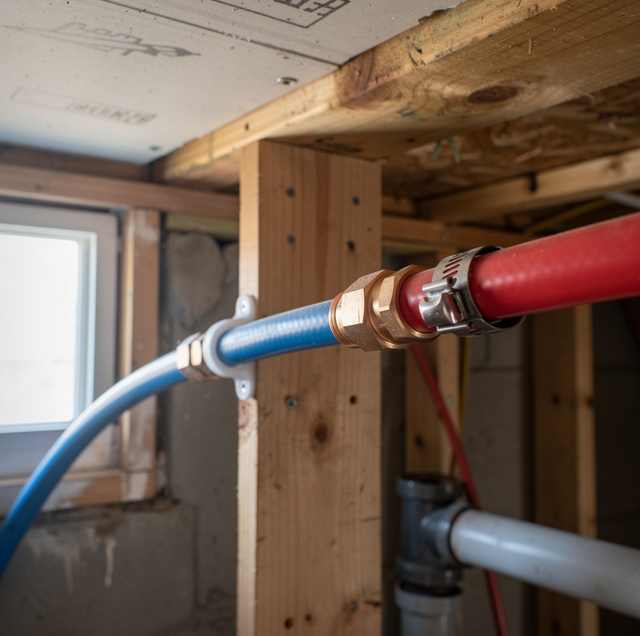
Quick Answer: PEX is joined in three ways: cold expansion, which requires PEX-A and a dedicated tool; crimp or clamp rings, which work with any PEX and depend on a calibrated tool and a gauge check; and push-to-connect fittings, which require no tool at all.
Ask plumbers what they argue about and the list runs long. Ask where a water system actually fails, and the answers converge almost word for word: not in the middle of a length of pipe, but at a joint. That agreement points straight at the line on a repipe quote most people read past.
The reason sits in how the two are made. Tubing is a factory product, extruded to size and tested in batches, shipped to spend its life holding still. Every connection on it is made once, on-site, by hand, in a few seconds, within whatever headroom the framing allows. Then it gets covered over.
So the fitting system is the part of a bid worth slowing down for. It names the tool a crew owns, the tube they are tied to, the metal or plastic sitting in your water at every turn, and the check an installer can run before a joint disappears. Three families are commonly used for PEX, and they are not interchangeable.
What a Joint Has to Do After the Walls Close
A supply line is under pressure every second of the day, and on the hot side it cycles, warming and cooling and moving a little each time against whatever holds it. Add the shock of a valve slamming somewhere in the house and the working life of a connection is constant load, daily movement, no maintenance, and nothing to look at.
The tube handles that by lying still. A joint is the one place it is asked to do something else, and polyethylene has a habit every fitting system must answer: under a sustained squeeze it slowly relaxes. A grip that depends on the tube staying as tight as it was on day one will fade. The three families answer that differently, which is the honest way to tell them apart.
Cold Expansion, Where the Tube Does the Gripping
Cold expansion is the method designated ASTM F1960. A ring of the same material as the tubing slides over the tube end, a tool opens the tube and ring together, and the fitting goes in while the opening is wide. The tube then draws back down onto it. Nothing metal squeezes anything: the grip is the tubing's own contraction, so it does not rely on a band staying tight for decades.
That works only with PEX-A, because only that grade carries the shape memory it depends on. A crew tooled for expansion has thus chosen both a tube type and a fitting.
One thing follows that matters to anyone looking at the joint afterward. The finished connection carries no metal ring at all, so there is nothing on it to hide behind, and a ring sitting at the wrong distance from the end declares itself instead of disappearing inside the joint. How much any fitting narrows the waterway, and where a long run makes that felt, is a tube-sizing and layout question rather than a fitting-line question, and it belongs to whoever is drawing your routes.
What it asks for is tooling: an expander, heads in every size, and matched fittings and rings, bought once and then worked inside of.
Crimp and Clamp, the Two Insert Methods
Both insert a barbed insert into the tube and hold it in place with an outer ring. They differ in the ring and the tool.
Copper crimp: a copper band slides over the tube, the fitting is pushed in, and a jaw sized to that tube compresses the band evenly all the way around. Each size needs its own jaw.
Stainless clamp: a stainless band with a raised ear is closed by a pincer that squeezes the ear shut. One tool covers every size, and it reaches into bays too tight for a crimp jaw.
Both work with any PEX, which is why they are the common ground of the trade. Their answer to the tube's habit of relaxing is mechanical rather than material. The ring keeps a little spring in it after it is closed, and the barbs on the insert body give the tube ridges to hold against, rather than a smooth wall it could creep off. The ring does not have to stay as tight as it was on the day it was made. It has to stay tighter than the barb underneath it needs.
Execution is where the variation lives. The tube has to be cut square, the fitting seated to its shoulder, the ring set the right distance from the end, the tool closed completely, and the finished ring passed across a gauge. A tool drifting out of calibration keeps producing connections that look correct in a photograph.
That is not a strike against the method; it is where the quality comes from. With expansion, the material does the work and the tool only has to open far enough. With crimp and clamp, the tool and the hand do the work, which puts the burden on things you can actually ask about: whether the jaw matches the tube, whether the gauge comes out of the pouch on every joint or only when somebody is watching, and how often the tool goes away to be checked.
Ask how often the crimp tool is calibrated and whether every ring gets checked with a go/no-go gauge. A tool that has drifted keeps producing joints that look right in a photograph and are not.
Push-to-Connect, and the Job It Is Best At
A push fitting works differently again. A ring of stainless teeth inside it bites the outside of the tube and prevents it from pulling out, while an O-ring forms a seal against the tube wall. A release collar lets the joint come apart later.
The advantages are real. No tool, seconds to make, and it joins PEX to copper or CPVC without heat. For a repair, a temporary cap, or a connection in a cavity too tight to swing a crimp jaw, it is often the right call, and a plumber who reaches for one there is not cutting a corner.
The useful test is not whether a push fitting is good hardware. It is whether the joint it makes will ever be looked at again. Behind an access panel, under a sink, in a garage, at a hose bib: those are places a hand can reach, and a fitting designed to come apart is at home in them. The same fitting above a finished ceiling has been put somewhere nothing will report on it until the ceiling below does.
The seal is an elastomer rather than tube gripping metal or metal gripping tube, and the fitting is designed from the start to come apart again. Its result depends on preparation nobody can see afterward: a square cut, a deburred end, no scratch across the sealing surface, full insertion. That does not make an installer careless. It makes the fitting a different kind of component, and a house whose concealed joints are all of that kind is a different proposition from one repair behind a door.
A push fitting requires the tube end to be cut square, deburred, and pushed fully to its depth mark. Short of that mark, the teeth and the O-ring are working on the wrong part of the tube, and nothing shows from outside.
The Three Families Side by Side
| Method | What Holds the Joint | Tube It Works With | What the Result Depends On | Where It Earns Its Place |
|---|---|---|---|---|
| Cold expansion (ASTM F1960) | The stretched tube contracting onto the fitting | PEX-A only | Full insertion, ring position, letting the tube draw back | One matched system through a whole house |
| Copper crimp ring | A copper band compressed over a barbed insert fitting | Any PEX | A calibrated jaw, a seated fitting, a gauge check | Repipes by a crew working across every tube |
| Stainless clamp ring | A stainless band tightened by closing a raised ear | Any PEX | The same prep, plus room to square the pincer | Tight bays and retrofits, one tool across sizes |
| Push-to-connect | Stainless teeth gripping the tube against an O-ring | Any PEX, copper, CPVC | A square, deburred, unscored end pushed to depth | Repairs, caps, transitions, no room to work |
Ratings would belong on that table too, and they are the column no bid fills in: they are published for the fitting rather than inherited from the tubing, and they differ by family and by maker.
Brass or Polymer, and Why Your Water Belongs in That Choice
Fittings are made in two materials, and bids rarely say which.
Brass is the familiar one. It is rigid, it tolerates rough handling in a bag of parts, and it is what threads are cut into at valves and transitions. Its vulnerability is chemical. Brass is an alloy of copper and zinc, and in some water chemistries, the zinc is the part that goes, migrating out of the metal over the years and leaving a fitting that is still the right shape but no longer sounds. The trade calls it dezincification, and the alloys made to withstand it are marked for it. Whether the question is live in your house depends on what your supply carries and whether a softener sits ahead of the piping.
Polymer fittings remove metal from that equation. They add no second metal to the joint and are unbothered by the chemistry that works on brass. Makers publish handling limits a good crew follows anyway: keep them out of sunlight, do not overtighten a threaded one, do not install one that hit a hard floor. Less forgiving of abuse, more forgiving of the water.
Neither is the wrong answer. The wrong answer is a bid where nobody asked, and if the answer is brass, whether the alloy is rated against that loss is a fair thing to have written down. Water that is hard, heavily treated, or softened makes that a real question rather than a formality.
What the Method Says About the Crew That Chose It
So the method written on a sheet is a fact about the crew before it is a fact about your pipe, and it can be read as one.
A crew tooled for cold expansion has tied itself to one tube type and one maker's hardware, and decided the extra tool is worth carrying for the way that joint behaves once it is buried. A crew that crimps kept its options open across every tube on the market and took on a check to run instead: the gauge, the calibration schedule, the seated fitting. When the person quoting brings up that gauge before you ask, you have learned how their joints get made on the days nobody is watching.
A bid that says PEX and stops has told you the least, though not nothing. It was written to be produced quickly rather than checked afterward. All of it was true of the crew before you called them. The fitting line is only where it shows up in writing.
Frequently Asked Questions
It happens for real reasons. A bay too tight to swing a crimp jaw, a tie-in against existing copper, a connection in a spot nobody could reach twice. The question to settle before the walls close is whether that is a decision your plumber makes and tells you about, or one you discover years later with a wall open. Ask for any departure from the named method to be written on the invoice and photographed where it lands, and ask the bidder where their own line falls between a legitimate exception and a shortcut.
Clamp rings come off with a small cutter, which is part of why service vans carry that tool. A copper crimp ring is cut or split off. An expansion joint is cut out with a section of tube and remade, so the expander has to come back to the house, which makes that system easiest for a shop already carrying one. That is why plenty of shops repipe with one system and service with another.
It is a small stamped metal plate with slots cut to size. After a crimp, the ring is checked against the matching slot: the go side must pass over it, and the no-go side must not. That one check catches an under-compressed ring, an over-compressed one, and a tool drifting out of calibration while still producing joints that look right. Crimp tools also go out for recalibration, and asking how often is an ordinary question.
Insert fittings are built to common dimensional standards, and that one fact is the part worth having. It is why a repair van that has never seen your house can open a wall and carry a ring that fits, and why a crimp system does not tie the building to one supplier for the rest of its life. Cold expansion trades that away on purpose in return for the joint it makes, which is a reasonable trade as long as somebody wrote down whose system went in, because that does not show on the finished connection.
Those points are transition fittings, and they deserve their own question, because they are the connections most likely to belong to a different family than the rest of the house. A transition carries PEX on one side and a thread, a sweat end or a compression end on the other, and where a threaded brass adapter meets a different metal, that pairing is its own consideration. At the heater, the last connections are usually flexible connectors rated for the heat at that spot rather than tube pulled tight into fittings.
Not automatically, and assuming so is where people get caught. Two products that both say hot and cold potable water can sit behind different numbers, and the lower of the two governs the whole assembly, which is the part that surprises people: a good tube does not lift a fitting. The hot side is where a gap shows up, because that piping stays warm and swings between warm and cool every day, while the cold side mostly sits. Ask for the fitting ratings in writing next to the tubing's.
Have the fitting system named on the quote before anyone opens a wall — a licensed plumber will walk your house, name the method, the material, and where every concealed joint lands. Ser Plumbing repipes homes across the area, from repiping in Downey to Lakewood. Call (310) 953-3566.
