
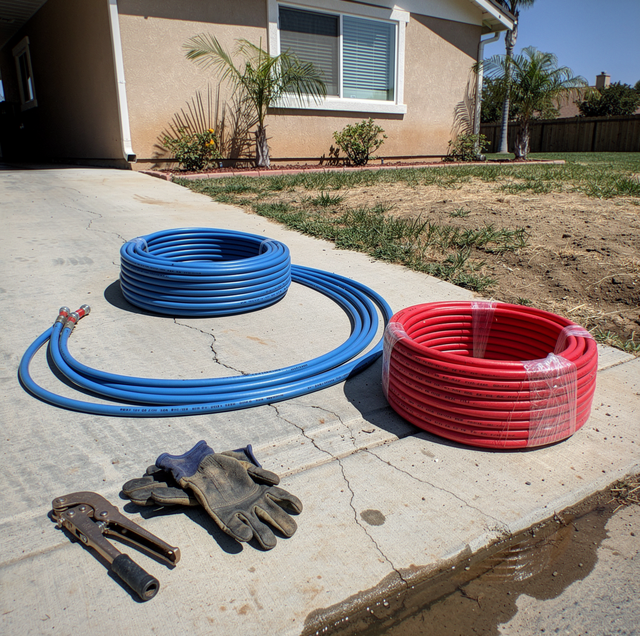
Quick Answer: PEX-A and PEX-B are the same material cross-linked by different processes. PEX-A is more flexible and accepts expansion fittings; PEX-B is stiffer and accepts only insert fittings. On a repipe, it decides how many joints end up hidden.
A coil of PEX comes off the truck bound in a tight roll, and before any of it goes into a wall, somebody walks it out along the driveway to pull the coil memory out of the tube. Watch two crews do that with two different products, and the difference shows up before a hole is drilled. One tube pays out and keeps whatever gentle curve it is laid in. The other springs back toward straight and has to be argued with at every turn.
Both coils are labeled PEX. Neither quote said which one, and from the paper alone there is no way to tell whether two crews are proposing the same product, joined the same way, in the same number of places. Those two tubes are about to disappear into the same attic and the same walls.
What the Letters After PEX Actually Name
PEX is cross-linked polyethylene: polyethylene whose molecular chains have been chemically cross-linked so the tubing holds its shape and pressure rating at temperature rather than softening. The letter is not a grade, and it is not a quality score. It names the process a manufacturer used to create those links.
PEX-A is made by the Engel method. A peroxide is blended into the polyethylene, and cross-linking occurs in the melt while the material is still hot and moving through the extruder. Because the links form before the tubing has cooled into its final shape, they are evenly distributed throughout the pipe wall, and PEX-A has the highest degree of cross-linking among the PEX types. That even, high degree of linking is what gives the finished tube its two useful habits: it bends easily, and it remembers the shape it started in.
PEX-B is made by the silane method, also called moisture cure. A silane compound is grafted onto the polymer during extrusion, and cross-linking occurs afterward, once the finished tubing is exposed to heat and moisture in a steam or hot water cure. The links form after the pipe has already taken shape. That sequence is why PEX-B comes off the line stiffer than PEX-A, with a larger minimum bend radius and no meaningful shape memory.
Both are made to the same tubing standards, sold in the same nominal sizes, and listed for the same potable water service. A repipe in either is a repipe in PEX, and a house plumbed in PEX-B is not plumbed in something lesser. The differences that matter are narrower and more practical than the marketing around them.
The Differences That Change a Repipe, Side by Side
| What Differs | PEX-A | PEX-B | Why It Matters on a Repipe |
|---|---|---|---|
| How it is cross-linked | Peroxide, in the melt (Engel) | Silane, cured after extrusion | Sets everything below; not a quality ranking |
| Flexibility and bend radius | More flexible, turns tighter without a fitting | Stiffer, larger minimum bend radius | Decides how many corners need an elbow fitting instead of a bend |
| Fittings it accepts | Cold expansion (ASTM F1960), plus crimp, clamp and push-to-connect | Crimp, clamp and push-to-connect | Expansion is a PEX-A only method and drives the tooling a shop carries |
| Waterway through the fitting | Expansion fittings leave a wider opening | Insert fittings narrow the opening more | Small on one joint, noticeable at the end of a long run with several |
| Behavior when kinked | Shape memory allows a heat repair per the maker's instructions | Kink is permanent; the section is cut out | A cut and coupled kink adds a joint exactly where the tube was stressed |
| Habit in a stud bay | Wants restraint; sags more between supports | Holds a line; sags less | Both are fine when hung correctly, but they are hung differently |
Flexibility Decides How Many Joints End Up Inside Your Walls
Every change of direction in a water line is settled one of two ways. Either the tube bends around the corner and is held there by a bend support, or it stops at a fitting, and an elbow turns the flow for it. The first is a continuous piece of pipe. The second is a joint. A more flexible tube can sweep turns that a stiffer tube has to make with a fitting, and that one fact is most of the argument between the two materials.
Now put that into a real house. On a slab foundation, where the new system is routed overhead, every fixture group is fed by a drop from the attic, and each of those drops is a directional change. The fixture groups multiply them. The kitchen sink and dishwasher, each bathroom's lavatory, tub and toilet, the laundry valves, the water heater connections. At each of those points the layout either sweeps the tube or fits it, and the larger the tube's minimum bend radius, the more often the answer is a fitting.
None of those fittings is fragile. A properly made crimp or expansion joint is permanent and is expected to outlast the house. What changes the arithmetic is where those joints sit. In a raised house with a crawl space under it, most connections are reachable with a flashlight and a creeper. In a slab house, the same connections are above a finished ceiling, and the first notice you get of one letting go is a stain spreading across drywall in a room that has nothing to do with plumbing. Fewer concealed joints is the reason a shop that works mostly in overhead repipes tends to standardize on the more flexible tube.
Which Fitting System Each Type Accepts
Cold expansion works only with PEX-A because of the tube's shape memory, not because of anything written into the standard. An expander tool stretches the tube end, and a ring is slid over it; the fitting is pushed in while the opening is wide, and the tube shrinks back down onto the fitting and grips it. PEX-B cannot be joined that way. Stretch a PEX-B end, and it stays stretched.
PEX-B is joined with insert fittings held in place by a copper crimp ring or a stainless steel clamp, and PEX-A accepts those same fittings. Push-to-connect fittings work on both. So the question is not symmetrical: PEX-A supports expansion as well as the insert methods, whereas PEX-B supports only the insert methods. Which one a shop uses is a tooling decision as much as a material one, because the expander tool, the rings, and the fittings are a set a crew commits to and carries.
Ask each bidder to specify the pipe type and the fitting system on the quote itself, not just the word "PEX". Two bids naming different fitting systems are not the same job quoted twice.
What the Fitting Does to Flow at the Far End of a Run
Both crimp and expansion connections put the fitting inside the tube, so both narrow the waterway at the joint. They do not narrow it equally. Because the tube is stretched to receive an expansion fitting, that fitting can be made with a wider opening through it than a crimp insert fitting of the same nominal size, where the barbed body has to fit inside the tube at its normal diameter.
On one joint at a laundry valve, that difference is nothing you would feel. It shows up at the end of the longest run: the shower in the far bathroom, fed by tubing that crossed the attic, turned several times and dropped down a wall, with a restriction at each turn. Pressure lost to friction along a run is not recovered further down it. Each narrowing takes a little more, and the fixture farthest from the water heater is where the difference is most noticeable, as a shower that never quite matches the one in the bathroom nearer the heater, even with nothing else running. Sizing the tube correctly matters more than the choice of fittings, but with an equal layout, fewer, wider joints leave more pressure at the last fixture.
Shape Memory, and What Happens When a Line Gets Kinked
Pulling tubing through an attic is not gentle work. It gets dragged over truss chords, fed through drilled holes and worked around ductwork in limited headroom, and tubing occasionally kinks.
On PEX-A, a kink is usually recoverable. Controlled heat, applied per the manufacturer's instructions, allows the tube to relax back toward the round shape it was extruded in, and the run continues as one unbroken piece. On PEX-B, there is nothing to recover. The damaged length is cut out, and the two ends are rejoined with a coupling, which means a new joint, added under field conditions, at the exact point where the tube was already stressed, in a location that is about to be covered by insulation and drywall.
That is the half of the joint count argument nobody puts on a quote, because nobody plans to kink a line. Those repairs land wherever they land.
A kinked PEX-A line is brought back using the heat source and temperature specified by the tubing maker, not with a heat gun and judgment. Overheat the spot, and the tube is scrap, and the damage does not always show from outside.
PEX-B Is Not the Wrong Pipe
Be blunt about this, because the internet is not. PEX-B is a legitimate potable water material, made to the same standards, and plenty of plumbers install it well on repipes that will still be sound long after everyone involved has forgotten the job. Its stiffness is real and useful in places: it holds a line in a stud bay, it sags less between supports on a long horizontal run, and some experienced installers prefer working with it for exactly that reason.
A shop that standardizes on PEX-A is not doing it out of loyalty to a label. It does so because the material allows one crew to make fewer connections within the finished construction and provides a way to fix a kinked run without adding one. If the crew in front of you works in PEX-B, the question to ask is not whether the material is acceptable, because it is. The question is how many concealed fittings their layout puts above your ceilings, and where.
What to Ask a Bidder Who Wrote Only PEX
The word on its own does not describe a system. Six questions turn it into one, and any competent bidder can answer them standing in your driveway:
- Which type are you installing, A or B, and which fitting system goes with it?
- Roughly how many fittings does your layout put inside walls or above the ceiling, and at which fixture groups?
- Does the run to the farthest fixture use swept bends or elbow fittings at its direction changes?
- How do you handle a line that kinks during the pull?
- Where do the shutoffs land, and is any part of the system left accessible after the drywall goes back?
- What size trunk feeds the far end of the house?
Ask all six of both bidders. Answers that differ tell you what the two sheets of paper never could: these crews are not proposing the same system.
So the letter after PEX settles three practical things: how many direction changes in your house get made with a fitting instead of a bend, which fitting system the crew is tooled for, and what happens to a run that kinks during the pull. All three are decided before the walls close, and all three fit on one line of an estimate. A quote that will not write that line has not finished describing the job it is quoting.
Frequently Asked Questions
An expander tool, expansion rings and matching fittings are one purchase. A crimp tool, copper rings and insert fittings are another, and a crew buys one set and then lives inside it, which is why the choice usually follows the truck rather than the homeowner. Asking a shop to work outside its own system puts borrowed tools and unfamiliar hardware on your house, which is worse than either system installed properly. Choose the crew whose standard method you understand rather than dictating a material to a crew tooled for the other one.
Yes. PEX-C is cross-linked by electron beam irradiation after extrusion, a dry physical process rather than a chemical one, which makes it the odd one out. It is generally the stiffest; it is sold mostly in shorter coils and repair lengths rather than the long rolls a whole-house job pulls from, and it joins with the same insert fittings PEX-B uses. You will run into it in a repair kit far more often than in a repipe bid.
The problem is not the joint; it is the repair years later. Whoever opens that wall has to identify which tube was cut before choosing a fitting, and a house running both types keeps two sets of spare rings in the van and one more thing to get wrong under a sink at nine at night. Insert fittings are rated for both, so the connection itself is ordinary. A single transition where new work ties into existing tubing is normal. Types scattered at random through a new system are not.
The print line running along the tubing identifies the type, among other things about the coil. Where the tubing is buried, and only the connections at the water heater are visible, the hardware tells you instead: a copper crimp ring or a stainless clamp band means an insert fitting, while an expansion connection shows a plain sleeve of the same tubing material shrunk flush over the fitting body with no metal ring at all.
Neither letter decides that. Chlorine resistance comes from the antioxidant and stabilizer package blended into the resin, and the rating a product carries reflects a laboratory test on that product rather than a property of the cross-linking method. Two coils wearing the same letter can carry different ratings, and a PEX-A coil and a PEX-B coil can carry the same one. So the question to put to a bidder is which product is going in and what its print line says, not which letter is on it.
It needs support at the intervals the manufacturer's instructions set, along horizontal runs and at the drops. The more flexible PEX-A sags more between hangers and is generally supported more often. Both types also move as they heat and cool, more than metal pipe does, so runs go in with a little slack rather than pulled tight, and the hangers are smooth plastic clips that let the tube slide instead of pinching it. A line pulled drum tight across a truss ticks and rubs every time hot water runs through it.
Get the pipe type and the joint count named before the walls open — a licensed plumber will walk the attic route with you and say where every fitting lands. Ser Plumbing repipes homes across the area, from repiping in Compton to Bellflower. Call (310) 953-3566.
