
Polybutylene Replacement: What the Job Actually Involves
Quick Answer: Replacing polybutylene means running a complete new supply system to every fixture, hot and cold, then removing or capping the old tubing. The part specific to this material is finding every point where someone has already spliced another pipe onto it.
Polybutylene was sold as the better idea. It was flexible where copper was rigid, quick to run through framing, and it joined with fittings that went together without a torch.
For a stretch of years, it went into houses as a supply pipe, and for a while it looked like where residential plumbing was headed.
What it turned out to be is a material that ages from the inside out, beginning at the joints, and gives almost nothing away on the outside while it does it.
So if your house has it, the question is not whether one particular length is bad. It is what replacing the whole system involves, and what a crew will find in your walls once they start looking.
How Polybutylene Shows Itself in a House
The tubing is flexible plastic, most often a medium gray, though white, cream, silver, and black were all made. It runs about the same diameter as the copper it replaced, and, like any supply tube, it carries a print line down one side. You can move a run of it with your hand in a way you cannot move copper.
The fittings are the part that matters more. Original systems were joined with insert fittings pushed into the tube and squeezed by a metal crimp ring, and those inserts were made of plastic and metal. Wherever the tube turns, branches, or lands at a valve, there is one of those joints. A plumber looks at the joint before the tube, because it is the more distinctive part and the part that fails first.
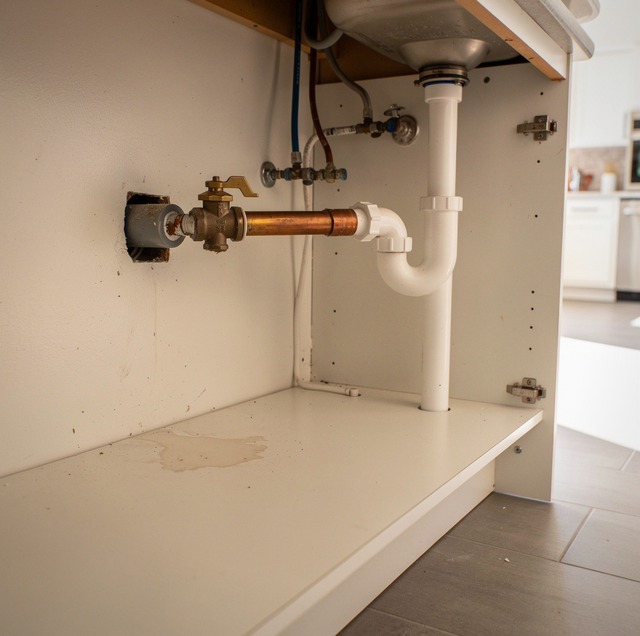
Where owners find it is not in a wall. It is at the few places the supply system is visible without cutting anything: the stub-out under a sink, just behind the angle stop; the laundry valves; a run crossing an open garage ceiling; and the connections at the water heater. That last one is the least trustworthy of the four, because a heater is the easiest point in a house to reach, which makes it the first thing anybody ever changed. Copper, there proves nothing about the rest. The other three are where a house is usually identified, from a cabinet floor rather than from the walls, where most of the pipe lives.
Color is a hint and not a verdict. Other gray plastic has been used in houses for other purposes, and a run in poor light has fooled people who do this for a living. What settles it is the fitting style at each end, how the tube behaves in the hand, and, following the run, seeing what it actually feeds, done at the house rather than against photographs on the internet.
Why the Failure Begins Where Nobody Can See It
Two things are happening at once, and both of them happen on surfaces you cannot inspect.
At the fittings, the insert sits inside the tube, and the ring clamps the tube onto it. The tube is held under steady stress in a narrow band, permanently, at every joint in the house. Anything that weakens the plastic there weakens it in the one place carrying the load.
Inside the tube, oxidants in treated water work on the bore. Fine cracking starts on the inner surface and works outward through the wall, so the pipe loses strength from the water side while the outside stays smooth, gray and entirely ordinary to look at.
The fittings have a failure of their own, and it is the one these systems are known for. Where the inserts were made in plastic, that plastic grows brittle with age and with what passes through it, and a brittle insert clamped permanently inside a tube cracks. It can crack while the tube on either side of it is still sound, which is why a system showing no trouble anywhere proves far less in this material than the same silence would in copper.
Do not assume a dry, clean-looking system is healthy. Polybutylene degrades from inside the tube and inside the fittings, so there is no drip, no stain, and no rust to warn you before a joint lets go.
That is what makes this material different from what people are used to. Galvanized steel announces itself with rust and falling pressure. Copper weeps at a pinhole and leaves a green stain. Those two taught owners to trust their eyes. With this material, the eyes get nothing until water is already moving through a ceiling.
Why a Repair and a Replacement Are Different Propositions
When one joint fails in a copper system, it is an event with a cause: a nail, poor solder, or a spot where something corroded. Fix that spot and the rest of the system is what it always was.
A material problem does not work like that. If the joints throughout the house share a design, an age, and the same water passing through them, then the one that failed was not unlucky. It was first. Cutting it out and fitting a new section leaves every other joint exactly as it was, and the piece you just had repaired becomes the newest and strongest thing in the building.
None of which argues against the repair. Water running through a wall on a Sunday night gets stopped. What matters is knowing what it is: a stop to the water and time to plan, not a step toward a finished system. It also leaves behind a joint between two materials that somebody later has to find.
What the Replacement Work Itself Involves
Physically, it is an ordinary whole-house repipe, scoped the way any repipe is scoped, and the clearing you do beforehand is the same as for any repipe.
What this material changes is not the method but the order. A walk-through and a written plan come first, and they matter more on this material than on any other, because the first day or two goes on tracing rather than installing, after decades in which every failure was handled one at a time by whoever was available. The house keeps working through most of the project, and the stretch with the water off is the changeover, planned for a known window.
The Transitions Are the Part Specific to This Material
Very few houses that still have polybutylene have only polybutylene. Somebody spliced a length of copper into a bathroom wall after a leak. A later owner had a plumber run a section of PEX across the garage. A stub-out was swapped under the kitchen sink and the branch behind it left alone. Each is a place where old pipe and newer pipe meet, joined with whatever transition fitting was on the truck that day.
Those joints matter for three reasons. Nobody has a record of them; they were made under time pressure, sometimes inside a wall closed the same afternoon, and they sit where nobody would open a wall to check. They are also where a partial job goes wrong: replace what you can see, miss a transition, and the original material is still live in the house while the owner believes it is gone.
Ask for the location of every transition the walk-through turns up, written down room by room. Those splices are where an old system and a new one meet, and a list of them lets you check that none were missed.
So a good walk-through traces rather than samples. Every accessible connection gets looked at; each fixture is traced back to what feeds it, and where a run vanishes into a chase or a closed ceiling, the plan says in advance what happens there. That answer can be to open the line and deal with it, or to route the new system around it and cut that branch dead where it can be reached. What it should not be is silence.
What Happens to the Old Tubing
Anything reachable comes out. Runs in an attic, across a garage ceiling, in an open crawl space, or exposed through the access holes cut anyway are pulled and carried off, fittings and all. Taking it out is a matter of hands and time, and it removes the chance that a plumber years from now looks up, sees gray tube and has to work out whether it is live.
Anything whose removal would mean dismantling finished construction stays where it is. It gets cut back and sealed at whichever ends can be reached, which for a run inside a chase or under concrete may be one end rather than two. A dead length is not a risk once nothing is feeding it, and chasing it out would mean opening finished work for no plumbing gain, the same reasoning that leaves abandoned lines under a slab while the new system runs overhead.
Leaving a dead line in place asks one thing of you, which is a record, because a dead line and a live one look identical from the outside.
What Gets Found, and What Happens to It
| What turns up | What it usually means | What happens during replacement |
|---|---|---|
| Gray flexible tube at a stub-out under a sink | Original supply piping, probably throughout | Replaced back to the branch it comes off |
| An insert fitting squeezed by a metal crimp ring | An original joint, and the first thing to fail | Removed with the run it belongs to |
| A short length of copper spliced mid-run | An earlier failure was repaired at that spot | Cut out with both sides, so the transition disappears |
| PEX crossing a garage or attic | Part of the house was redone at some point | Traced to find where it meets the original material |
| Tube in a sealed chase or under concrete | Not reachable without demolition | Cut dead where it can be reached, new line routed elsewhere |
What the House Is Like Afterward
The gray tube is off the garage ceiling and out of the attic, gone on the truck with the fittings still on it. In two or three places behind closed walls, short lengths of it remain, cut dead and dry. Overhead there is new pipe on new supports, running clean lines above the ceiling in place of the route that was patched and re-patched over the years.
Under every sink there is a new stop that turns with one hand and a new connector above it. The walls carry the openings that were made: high on a hallway wall, a square in a bedroom ceiling, a strip beside a vanity. How far each of those is taken, and who takes it the rest of the way, varies more between one quote and the next than almost any other line on the sheet, which is why it is settled in writing beforehand rather than discovered on the last afternoon. There is an inspection record, and photographs of the runs taken before those openings closed.
What the house has now is one supply system where it used to have several grown together: one material, one age, one set of joints, all of it put in during the same week by the same hands. And there is a written account of where that pipe goes, which is something the house never had.
Frequently Asked Questions
No. Both are flexible plastic supply tubing, and they look alike enough to a non-plumber that the two get mixed up constantly. They are different polymers using different fitting systems, and PEX arrived after polybutylene as its own product rather than a renamed version of it. A plumber separates them by the feel of the material and, above all, by the fitting style at each end.
Start with what the run does, not its color. This was supply pipe, so it goes to fixtures, and it is under pressure whenever the water is on. Gray plastic that turns out to be something else is usually rigid and thick-walled, whereas this is not. Then, two physical tests: you can flex a length of it with one hand, and it ends in an insert that's fitted and squeezed by a metal crimp ring rather than in a soldered or glued joint. One of those on its own is a maybe. Both, at more than one point in the house, is not.
Yes. It was also used for the buried service line between the meter and the building, usually in a blue tube rather than a gray one. That length sits entirely outside the building, reached by digging along its path or by pulling a new line through, rather than by opening a wall, and it is quoted and scheduled as work in its own right rather than folded into the interior job. If the inside of the house has the material, ask whether anyone has looked at that line.
Not on that evidence, and the same caution covers a laundry valve. A short copper run at either point can sit at the front of a house that is entirely original everywhere behind the drywall. What it does tell you is worth having on its own: somebody worked on this system at some stage, which means there is at least one transition in the building, and locating it is a large part of what the walk-through is for.
Some of it may. Discolored first-draw water and dark specks in an aerator screen often come from the inside of an aging tube and its fittings and leave with it. What new pipe cannot change is anything arriving from the street: hardness, chlorine taste, and the pressure your house is served at are all set upstream of the piping you replaced. Expect the grit at the fixtures to stop and the water to taste much as it did.
No, and that is part of what makes this material awkward to plan around. Nothing you can read off a gauge grades a run of tube sitting in a wall. A failed section, cut out and examined, tells a plumber something about how that house's water has treated the material, but it grades only the piece in hand. The rest of the system remains exactly what it was the week before the failure, and the one thing the examination proves is that the material behaved as it does.
Book a walk-through before anything is scheduled — have a licensed plumber identify the material at every accessible point, trace what feeds what, and put the transitions and the capped runs in writing. Ser Plumbing repairs sewer lines across the area, from sewer line repair in Bellflower to Lakewood. Call (310) 953-3566.
