
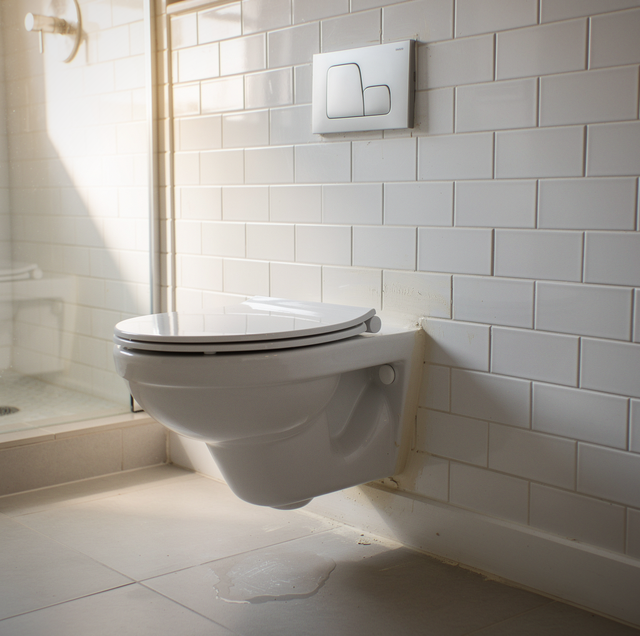
The bowl floats off the floor, the tile runs unbroken beneath it, and there is no tank lid to lift in the room. So when the flush weakens, or something hisses behind the wall long after the last flush, the first thing most owners picture is a demolition estimate and a bathroom out of service for a week. That is not how these systems are serviced.
Your wall-hung toilet keeps its tank, its valves, and its steel frame inside a stud bay, and it keeps a way in for you. Knowing where that opening sits, what a plumber can reach through it, and what your household should stop doing while you wait will turn a noise you cannot quite place into an ordinary service call.
Inside a Wall-Hung Toilet
Nothing you can see is holding the fixture up. Behind the finished wall stands a steel frame bolted to the floor, and the bowl hangs from two threaded studs projecting out of it. Carrier frames are built adjustable for bowl rim heights from 15" to 19" (381 to 483 mm). The tile carries the finish and nothing else.
These wall-hung systems have been installed in modern bathrooms for over 50 years. The wall-integrated frame and the toilet have a load-bearing capacity of up to 880 lbs (400 kg). That rating applies to the steel frame, not to your tile or grout line, which is why a properly set carrier does not care how heavy the person using it is.
The Flush Plate Is the Service Door on a Concealed Tank
The rectangular plate on the wall above the bowl is not trim, and it is not fixed. It is the lid, the button, and the access hatch at once, and on most systems it lifts or unclips off the wall by hand. Everything you assume is sealed inside the wall- the fill valve, the flush valve, the float, and the connections between them- sits directly behind it. That single fact separates a concealed tank from the demolition job most people imagine.
The flush plate is the only visible element of the in-wall toilet tank and carrier system, sometimes called a concealed cistern, and it provides tool-free access to all the working parts of the system, including the fill and flush valves, for simple maintenance. Tool-free is the operative phrase. A plumber arriving for a weak flush or a tank that will not stop filling expects to work through that opening, with the finished wall untouched and your bathroom back in use the same afternoon, rather than a week later behind a sheet of plastic.
Not every system behind a wall is the same, and the plate is where the differences show. Some plates hinge, some lift straight off, and the button faces themselves come away on some ranges. So the first thing a plumber does on one of these calls is identify the plate on your wall and the system behind it, because the fill valve, the flush valve, and the linkage that fits are the ones built for that specific system.
Where Water Shows Up First When a Concealed Tank Leaks?
A concealed tank does not announce a fault the way an open tank does. There is no lid to lift and no water level to check, so the earliest signals arrive at the two joints you can see: the line where the plate meets the tile, and the line where the bowl meets the wall. Damp at either is worth a photograph and a call.
The sound matters as much as the water. A hiss that continues after the bowl has stopped refilling points at a fill valve that never closes. Water arriving at the floor while nothing is running points somewhere different, at a supply connection or a tank seal inside the chase, and that one runs at supply pressure around the clock whether anyone is home.
Neither one is a reason to cut tile. Both are reasons to stop using the fixture and have a plumber remove the plate, since that is the first move on any of these calls, and the parts and joints behind the plate account for most failures. If everything behind the plate is dry, the search moves outward from there. In practice it rarely has to.
Parts, Warranties, and Why Identifying the Plate Comes First
The reason servicing beats replacing on these systems is that the parts remain in place. Spare parts remain available for 50 years for all replaceable parts of the concealed tank and flush actuator plate, aside from specific electronic functions, on many of these in-wall systems. A tank sealed into a wall in 2004 still has its fill valve.
Warranty is a separate question from availability, and it is not one term across the whole assembly. One wall-hung installation system carries three of them together: a limited lifetime warranty on tank and carrier, a 10-year warranty on fill valve and flush valve, and a one-year warranty on actuator flush plates. So the frame in your wall carries the longest cover and the plate you touch every day carries the shortest, which is worth knowing before you choose a finish.
When a Wall-Hung Bowl Begins to Move
Movement is the symptom on this list that threatens a person rather than a floor. The bowl hangs on two threaded studs coming out of the carrier frame, with a gasket between it and the frame's connections. Those bolts, hidden under caps at the base of the bowl, are the first thing many owners reach for when it starts to rock. They are also the last thing anyone should touch without seeing the frame they thread into.
A wall-hung bowl that has begun to shift can drop whoever sits on it onto broken porcelain, so leave it unused and have a plumber check the carrier fixings.
Tightening a bolt you cannot trace is a guess, and the guess has a floor and a body underneath it. A carrier bolt can be backing out of a nut that has loosened in the frame, or the gasket behind the bowl can have compressed, leaving the bowl bearing on the wall instead of the studs. The two look identical from the bathroom, and only one is visible with the plate off.
What a Plumber Actually Does on a Wall-Hung Service Call
A service call on a concealed system runs in a set order, and almost none of it involves the wall. First the plate comes off. The make and model behind it are identified from the tank shell and valve bodies. The water is shut off at the shutoff serving that fixture, and the tank drains through the bowl.
From there, the work is ordinary toilet work done through a smaller opening. A fill valve lifts out, and a new one drops in. A flush valve and its seal come forward through the same hole. The button faces and the linkage behind them are adjusted at the plate, instead of over an open tank.
The exceptions are real: a cracked tank body, a failed connection outside the frame, a carrier that was never fixed properly when the wall went up. Those are the calls that open drywall, and they are the minority. Everything else is a plate off, a part swapped, and a plate back on before your next visit in the spring.
Frequently Asked Questions
The plate carries it. With the plate off, a plumber reads the maker's name from the tank shell and the valve bodies behind your wall. Guessing the system from the button shape is how the wrong valve reaches your house and costs you a second visit.
It adds a pre-check nobody thinks about. A heated seat requires power at the fixture, so the visit starts with determining whether an outlet is within reach of your bowl and where it sits behind the carrier. That is asked before a seat is ordered for your bathroom, not after you own it.
The parts are the same parts. A fill valve, a flush valve, and a seal fail on a concealed tank for the reasons they fail on any tank in your house. What differs is access, which is why a plumber wants the plate off before ordering parts for your bathroom, so you get one visit.
It comes off two studs on a frame nobody can see from the bathroom, and it goes back onto a gasket that has to seat evenly against the carrier. A bowl rehung out of square carries your whole weight on a bad joint. Keep your household off it entirely and have a plumber refit it for you.
Many of these wall-hung systems come with a guarantee of replacement parts for the concealed tank and the actuator plate for fifty years, so a fill valve for a tank sealed two decades ago is a catalog item. That changes the arithmetic your plumber will walk you through: the frame stays, the wall stays, and only the failed part leaves in the van.
Not automatically. One installation system puts a floor under it: the system needs to fit within a minimum 5 1/2" (140 mm) framing wall or plumbing chase, with wood construction or steel framing members placed 19 3/4" (500 mm) apart, and those framing members need to support an 880-pound (400 kg) load without damage to the wall. So the question about your bathroom concerns the studs behind your tile, how far apart they sit, and how deep the cavity runs. A plumber answers that for you before anyone orders a fixture.
Book service on a wall-hung toilet that hisses, drips at the plate line, or shifts — this is a service call and not a demolition project, and the plate comes off first. Ser Plumbing serves Paramount, Bellflower, and Lakewood. Call (310) 953-3566.
