
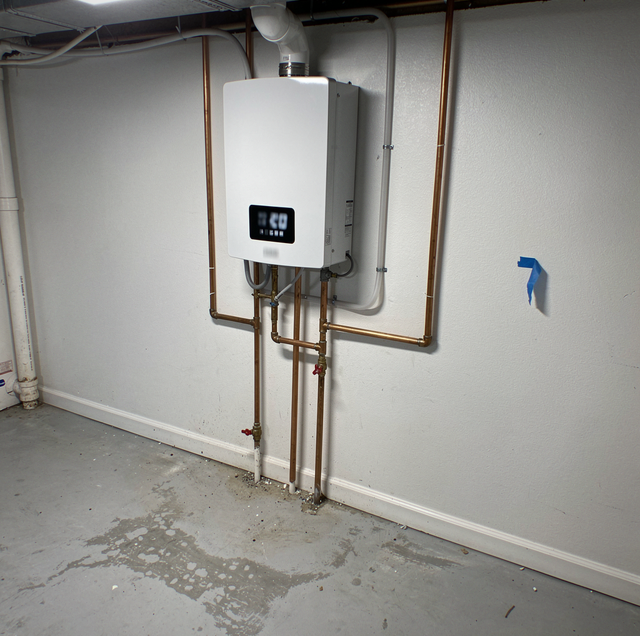
The water turns cold at a different point almost every time, and where in the shower it happens is not random. A brief chill a few seconds into the draw is a different problem than a fade that starts a few minutes in, and both are different again from the shower that goes cold the moment someone else starts the dishwasher. Five separate failures produce the same word, cold, and the moment it arrives is the evidence you already have.
Sorting them starts with a single question: how many seconds or minutes into the draw did the cold show up, and what else was happening in the house at the time?
| When the Cold Arrives | Likely Cause | What's Actually Happening |
|---|---|---|
| Hot, then a cool stretch, then hot again, on a draw restarted soon after the last one | Cold-water sandwich | Water that cooled inside the exchanger while the burner was off |
| The instant a second fixture opens | Flow ceiling | The unit is out of heating capacity, not water |
| A few minutes into a steady draw | Scale on the exchanger | Mineral is narrowing and insulating the passage |
| With an audible cycling sound or a code on the display | Combustion, gas, or venting | A different system than the water side entirely |
| At a barely opened tap that never warms at all | Flow below the firing threshold | The draw is too small for the flow sensor to call for ignition |
Hot, Then Cold, Then Hot Again
A tankless unit heats water only as it passes through the exchanger, so the instant a tap closes, the burner shuts off, and the water standing inside the exchanger starts losing heat. Reopen the tap a minute or two later, and three temperatures arrive in order. First comes the hot water still sitting in the pipe between the unit and the fixture, left over from the just-ended draw. Behind it comes the slug that sat cooling in the exchanger while the burner was off. Then the burner senses the flow, ignites, climbs back to the outlet temperature the thermostat is requesting, and hot water returns. That hot, cool, hot sequence is what the name describes: a cool layer between two hot ones. How pronounced it feels tracks the distance and pipe diameter between the heater and the fixture, since a longer or larger run holds more leftover hot water ahead of the cool slug and takes longer to push it through. The first shower of the morning produces no sandwich at all. After several idle hours, the whole run has cooled, so nothing hot arrives ahead of the cool water, and the tap simply runs cool until the burner fires and the heated water travels the distance, which is an ordinary delivery wait with no sandwich in it.
A Flow Ceiling the Burner Cannot Exceed
A tankless heater has a rated flow ceiling: past whatever gallons per minute the exchanger can bring to full temperature at once, the unit runs short of heating capacity rather than water. Add a second draw, a dishwasher cycle, a washing machine fill, another shower, and the total flow moving through the unit at that moment climbs, so the same burner is now spreading its output across more water than it was heating a minute earlier. Depending on the model, the unit either lowers its outlet temperature to stay within capacity or begins favoring one fixture over another, and either behavior can be read in the shower as the water going cold or tepid the instant the second fixture opens, rather than fading gradually.
This is the one case here where the unit may be working exactly as built: the household is drawing more hot water at once than it was sized to deliver, common in a house that has added a bathroom, a second shower, or simply more people since the heater went in. Sizing a bigger unit, or adding a second one, for a household that has outgrown its heater belongs to whoever is comparing replacement units, and it starts from current fixture count and how often several run at once.
Scale Insulates the Heat Exchanger
Hard water carries dissolved calcium and magnesium that heat pulls out of solution wherever the water gets hottest, and inside a tankless unit that means the narrow passage of the heat exchanger itself. The deposit does two things at once: it narrows the channel the water has to move through, and it sits between the burner's heat and the water that heat is meant to reach, so less of it actually gets there. A unit compensating for a thin layer can usually maintain its outlet temperature during a short draw, which is why the first minute or two of a shower can feel completely normal even with scale already present.
The mismatch grows as the draw continues and the exchanger keeps working against the deposit, and once it crosses whatever threshold the unit's own sensors are set to protect, the burner backs off or drops out rather than push the exchanger hotter than the metal is built to run. That is the signature that separates this failure from the other four: normal heat for a while, then a fade or a full drop after several continuous minutes, on the same fixture, every time the shower runs that long. In a house on hard water, this is the deposit a plumbing technician checks first once that pattern shows up.
Cold That Arrives With a Sound or a Code
A unit that goes cold while making noise, or that stops and shows a code on its display, behaves differently from the three failures above. Restricted combustion air, a gas supply that can't sustain the burner's full firing rate, or a partially blocked vent all show up the same way from inside the unit: the flame sensor loses its signal, the control board shuts the burner down as a protective response, and the unit tries to relight, sometimes more than once inside a single shower. Each attempt is audible as a distinct click and a brief flare before the burner either holds or drops out again.
Manufacturers assign specific fault codes to these conditions because the control board is reading real values- air pressure, flame current, and exhaust temperature- that fall outside the range the burner needs to run. A single relight during a long shower is common enough and often clears on its own. A pattern of it, or any code that returns after the unit is reset, points at the gas connection, the combustion air path, or the vent run rather than anything on the water side of the unit.
Repeated flame failure with a venting fault can put combustion products, carbon monoxide included, into the house. Working CO alarms matter. Shut it off at the gas valve, ventilate the room, and call a licensed plumber rather than shower through it.
This is also where the complaint stops being about comfort. A cold shower is an inconvenience; a burner that won't hold a clean flame is a sign that something upstream of the water side needs a licensed set of hands on it before the next shower.
Why a Trickle Never Turns Warm
Every tankless unit requires a minimum amount of moving water before it will fire, because the flow sensor must register a draw before the control board ignites the burner. A tap opened just enough to trickle can sit below that floor indefinitely. The result reads as a fixture that simply refuses to get warm, no matter how long it runs, when in fact the unit has never once turned on. Opening the same tap a quarter-turn further, past the threshold, brings the flow sensor's reading up to where the burner ignites within a couple of seconds, and hot water follows on the same schedule it would anywhere else in the house. A tap that never warms up despite running for a while often traces to this floor, the unit doing exactly what it was built to do at a flow rate below what it needs to fire at all. A single low-flow fixture, a partially closed valve upstream, or a showerhead restrictor can all push an otherwise adequate tap below that line.
A tankless unit requires a minimum flow before its sensor calls for ignition, and that figure is printed on the unit's data plate, typically around half a gallon per minute. A faucet barely cracked open sits below it indefinitely.
What a Descaling Visit Changes
A descaling service reaches exactly one of the five: the mineral deposit narrowing and insulating the heat exchanger. Clearing that deposit brings the channel back to the dimension the unit's flow and temperature sensors were calibrated against, which is why a unit that had been fading a few minutes into a shower typically holds its full draw again afterward. A flush does not shorten a pipe run, raise a rated flow ceiling, lift a minimum firing threshold, or touch a flame sensor.
Frequently Asked Questions
Only when a draw restarts soon after the last one ended, while the pipe run still holds hot water from that draw and the exchanger has had just enough idle time for the water inside it to cool. A second shower right after the first, or a tap reopened after a short pause, is the case most likely to show the full hot, cool, hot sequence. A shower first thing in the morning, or the first draw after several idle hours, skips the sandwich entirely because no hot water remains in the line to arrive before the cool stretch.
A unit's flow rating is measured at a specific temperature rise, the difference between the incoming water's temperature and the target outlet temperature, and that number changes with the season and the source water. The same unit, rated at an impressive flow for a mild rise, delivers less usable flow when the incoming water is colder, because more of its fixed heating capacity goes into raising the temperature rather than moving more water through.
Yes. Many units only display a code once a fault repeats past an internal threshold, so an isolated relight or two during a shower can come and go with no code ever appearing on the panel. A pattern is still worth reporting even without a code: how many times it happened and roughly when in the draw, since that timing is often more useful to a technician than the code itself.
Yes, when the valve blends in enough cold water to hit a moderate setting. A shower valve mixes hot and cold before the water reaches the showerhead, so the hot side alone, the side actually running through the tankless unit, can sit below the minimum firing flow even while the total water leaving the showerhead looks completely normal. Turning the mix hotter, drawing more hot and less cold, is often what crosses the threshold.
It shortens the wait, though it does not remove it. Insulation slows how quickly the standing water in that pipe run loses heat between draws, so a run that used to cool completely overnight might only drop partway, which shortens the cold stretch the next time the tap opens. It does nothing about the water that has to physically travel that distance, so a long run still clears more slowly than a short one no matter how well it is wrapped.
Because that one answer sorts a unit-side fault from a fixture-side one before anybody opens a panel. Cold at every hot tap in the house points back at the heater itself, its flow ceiling, its exchanger, or its burner. Cold at a single shower while the kitchen sink still runs hot usually points to that shower's own mixing valve, which blends hot and cold behind the wall and can drift or wear out, so it keeps feeding cold into the outlet whatever the heater is doing. Running a second fixture before the call is worth the thirty seconds it takes.
Tell a plumber when in the shower the cold arrives — that timing narrows a cold-water sandwich, a flow ceiling, scale, or a combustion issue before anyone opens the unit. Ser Plumbing serves Paramount, Bellflower, and Lakewood. Call (310) 953-3566.
