
Plunger vs Drain Cleaner in a Sink with a Garbage Disposal
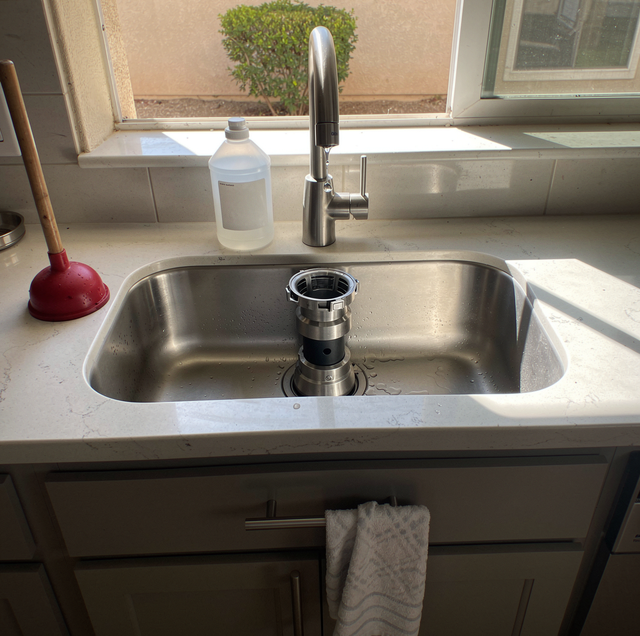
A kitchen sink that stops draining brings out two objects within a minute of each other. One is the plunger that lives in a closet or under a bathroom vanity. The other is a bottle that has sat under the sink since somebody bought it for a different drain, in a different room, in a different year.
Both of those objects were designed around a plain sink: one opening, one strainer, one trap hanging below. A garbage disposal completely changes that layout. It puts a sealed metal chamber between the bowl and the trap, stretches a rubber baffle across the opening, and usually brings a dishwasher hose into the same casting. Each of those changes what a plunger can push against. Each of them also changes where a chemical goes and how long it stays there.
What a Plunger Actually Does in a Kitchen Sink
A plunger is not blowing air at a blockage. Water barely compresses, so the cup is working the column of water already standing in the tailpiece, the trap, and the trap arm, shoving it toward the blockage on the downstroke and dragging it back on the upstroke. The backstroke does at least as much work as the push, because a soft blockage of grease and food fiber breaks apart when it is pulled both ways rather than packed tighter in one direction.
All of that depends on the system being closed. The cup has to seal to the sink bottom, and every other opening on the same pipe has to be closed as well. If one is open, the water takes that route instead, and you feel a plunger that moves easily and accomplishes nothing. That reads like a stubborn clog, but it's actually a leaking system. A plunger also nudges anything loose along the pipe, including a dropped object, farther from reach.
Where the Pressure Goes in a Double Bowl
In most double-bowl kitchens, the bowls do not have separate drains all the way down. Each has its own tailpiece, and those tailpieces meet at a tee under the cabinet before a single trap and trap arm carry everything to the wall.
That makes the second bowl the shortest, easiest opening in the system. Its basket strainer is a loose cup sitting in a flange, not a seal. Push on one bowl, and the water column takes the low-resistance path back up the other tailpiece, lifting that strainer aside. You get a surge of dark water in the clean bowl and nothing reaching the blockage.
Sealing that second opening is the difference between a plunger that works and one that relocates the mess. It has to be held down hard enough to stay put against a pressure spike, not simply set in place.
How the Dishwasher Connection Changes the Picture
Look at the shoulder of the disposal body, and you will see a molded dishwasher inlet. When the unit was installed, the knockout plug cast inside that inlet was driven out so the dishwasher could drain into the grind chamber, and a hose was clamped on. Below the unit, a discharge tube carries everything from the chamber to that same tee.
The consequence is a third opening on the closed system you are trying to pressurize, and it runs uphill into a machine you cannot see into. Pressure follows it. Food debris sitting in the disposal gets pushed backward through that hose into the dishwasher tub, filter, and sump. People work a plunger on a kitchen sink, walk away satisfied, and open the dishwasher two days later to standing gray water and a smell.
Both of those openings have to be accounted for, not just the second bowl.
Why Drain Cleaner Is Worse in a Sink That Has a Disposal
This is what changes most with a disposal in the bowl, and it is why plumbers get uneasy about that bottle in a kitchen specifically.
The chamber holds the product: In a plain sink, whatever you pour runs through the strainer, down the tailpiece, and into the trap. In a disposal, the discharge port sits in the side wall of the grind chamber, above the chamber floor, so liquid poured in never fully drains out. Some stays in the chamber by design. If the line below is already blocked, nothing goes anywhere, and the product sits in a metal cup surrounded by the parts that make the unit work.
What it is sitting against: The metals and coatings inside a disposal vary by model, and the labels on both sides make claims that do not align. Read either one as a marketing position rather than a settled fact. What every unit has in common is the soft parts: a rubber splash guard across the opening, and gaskets and washers at the mount and the discharge flange. Those are the pieces a caustic or acidic product sits against for as long as the line below stays blocked.
Rubber fails quietly: The splash guard and the gaskets do not tear while you are standing at the sink. They stiffen, swell, or lose their set, and it shows up later as a weep at the discharge connection or a baffle that no longer springs closed. By then nobody connects it to the bottle from three weeks ago.
A second bottle is a reaction, not a stronger dose: Do not pour a second product on top of a first, and do not follow a commercial product with a home mixture. A second product poured onto a first can react, and it can do so inside a closed metal chamber with no easy way to vent. This is not a matter of dose or technique. Two products go in, something neither label describes comes back out.
The hazard transfers to whoever opens the line: When the sink still is not draining, the product has not gone anywhere. It is in the bowl and in the chamber, and the first person to loosen a slip nut on that trap takes it on their hands and forearms, sometimes at face level from below. Say plainly what went in, how many times, and whether anything followed it. A straight answer changes how the line gets opened.
Standing water that has had drain cleaner in it remains chemically active. It does not weaken or neutralize while it sits. Leave the bottle on the counter so the label can be read, and say if more than one product went in.
Heat, Boiling Water, and What It Moves
Very hot water is recommended constantly for kitchen drains, and it does one real thing: it softens the fat and grease film coating the inside of the branch line. The trouble is where that softened material ends up. It moves a short distance, hits a cooler pipe, and sets again at the next bend or fitting along the run. The sink drains that evening, then slows again, and the interval between rescues shortens each time, because the restriction is being rebuilt farther along and thicker.
There is a second cost under the cabinet. Most kitchen drain assemblies are plastic tubing with slip-joint washers, and the disposal adds gaskets at the mount and the discharge. Repeated blasts of near-boiling water work on those seals, and a joint that was dry for years starts weeping.
The rule that matters most: never add hot water to a bowl that already contains a chemical product. Heat drives the reaction and drives the vapor, in a bowl you are leaning over.
What the Reset Button and the Grind Path Cannot Do
The red button on the underside of the disposal is a thermal overload reset. It restores power after the motor's own protection has tripped, and that is its entire job. It has no relationship to a restriction in the pipe past the discharge port, and pressing it repeatedly on a sink full of water only cycles a motor into a load it cannot clear.
A disposal is also not a pump. It shreds what is in the chamber and relies on gravity and drain water to carry the pieces out. Run it into a bowl of standing water and the flywheel spins in liquid, which can push water and debris back up past the splash guard rather than down. If the drain below is blocked, grinding only makes finer material to pack into the blockage.
Two hard limits go with that. Never reach into a grind chamber, and never ask anyone else to, powered or not. And if a bowl is holding water that has had chemicals in it, leave the unit off entirely until somebody knows what is in that water.
Before anyone works under that sink, cut power to the disposal at the wall switch and at the breaker. A countertop air switch is easy to lean on, and a wall switch is easy to flip by habit.
What a Drain Professional Does Instead
The approach is mechanical rather than chemical, and it starts with access rather than with the bowl. A cable is driven through the trap arm or a cleanout, sized to the diameter of the kitchen branch, and it cuts and drags material back instead of trying to dissolve it in place. That is why a cabled line comes back with something on the head: the blockage leaves the pipe rather than moving along it.
For a branch lined with hardened grease, hydrojetting scours the pipe back toward its full diameter rather than punching a channel through the middle of the deposit, which is the usual reason a kitchen sink clogs again on a schedule. When a line keeps closing after it has been cleared, a camera inspection shows whether the branch has a low spot holding water, scale narrowing the bore, or a fitting catching fiber every time.
Sometimes the restriction is the appliance itself. A worn grinding surface, a seized flywheel, or a corroded chamber turns the disposal into the narrow point, and repairing or replacing the unit is the fix rather than another pass at the pipe below it. Either way, the first question worth answering before anything is opened is what has already been poured in.
Frequently Asked Questions
Continuous feed is the common type and runs as long as its switch is on. A batch feed unit will not start until its magnetic stopper lid is seated in the opening, because that lid closes the switch. It is built to trigger a motor, not to hold hydraulic pressure, and it occupies the one opening you would otherwise want sealed. Neither type changes anything downstream of the discharge port.
That is the dishwasher air gap. It is not a valve, and it has not failed. When the kitchen branch is restricted, the water the dishwasher pumps out weeps from under the cap onto the countertop, which is the branch telling on itself rather than the dishwasher. It is the one visible symptom in this whole system that appears above the counter rather than under it.
They are sold on a different principle. Enzyme and bacterial products are marketed as biological digesters of organic film, and their makers claim they are gentler on seals and metal than caustic or acid formulas. Treat that as a manufacturer claim rather than an established fact. Either way, they are a slow maintenance approach, not a rescue: a line that has already stopped is full of standing water, which keeps any product from reaching the blockage in a useful concentration.
It can, and it often shows up at the top instead of the bottom. The unit hangs from a sink flange bedded in plumber's putty, clamped by a mounting ring and held by a snap ring. Repeated pressure surges work against that putty seal from below, and a swollen or corroded gasket at the discharge flange does the same from the other direction. What you notice is a damp ring at the sink rim or water on the cabinet floor directly under the mount, often days after the drain finally cleared.
Those are chamber-cleaning habits, not drain-clearing ones. Ice knocks softened film off the shredder plate and the grind ring, which is worth doing for the smell that builds in there. Citrus only scents it. Neither reaches past the discharge port, and a slow kitchen sink almost always lives farther along the branch. A disposal can grind perfectly and still sit on top of a blocked pipe.
Probably not the same spot. A restriction affecting only the two kitchen bowls and the dishwasher sits in the branch serving them. If a bathroom fixture gurgles while the kitchen drains, or a tub backs up on its own, the narrow point is past the junction where that kitchen branch joins the larger line, and clearing the kitchen trap arm will not touch it. Which fixtures misbehave together decides both the tool and the access point, which is why they get mapped before anything is taken apart.
Clear that kitchen line mechanically rather than chemically — a cabled or jetted branch drains without leaving any caustic residue in the bowl. Ser Plumbing serves Paramount, Bellflower, and Lakewood. Call (310) 953-3566.
