
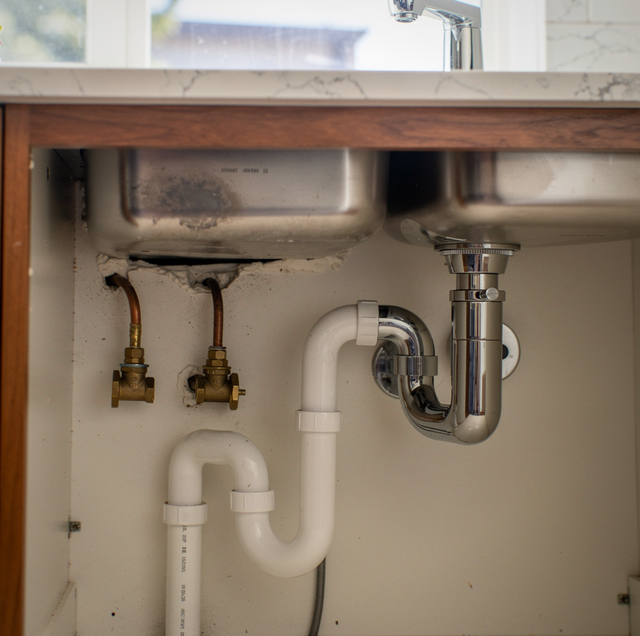
Quick Answer: A faucet or sink swap remains a small, self-contained job as long as the shutoffs close and the drain reconnects as before. It becomes plumbing work at five specific points, all of them behind the cabinet door.
The question usually arrives pointed in the wrong direction. " Plumber" or "handyman" is a question about people, and the thing sitting under your sink is not a person. It is a set of connections, and it has no opinion about who is holding the wrench.
The useful question is narrower: what does this particular job actually touch once the cabinet doors are open? A fixture swap and pipe work on the branch behind the wall can begin with the same phone call and the same faucet in the same box.
This is not the do-it-yourself question. Whether to take a faucet on yourself is a separate decision with its own answer. You have already decided to pay someone. You are choosing between two trades that both change faucets, and both of which will change yours correctly on the day the job stays small.
The Version of This Job That Stays Small
Plenty of faucet replacements go exactly the way they look like they will go. That is worth saying plainly because an article that concludes that every sink needs a licensed plumber does not describe the work honestly.
A faucet swap is bounded by three things: the two shutoff valves under the sink, the supply connections between those valves and the faucet, and the drain assembly that comes apart and goes back together in the same places. The job is self-contained because the shutoffs isolate the fixture from everything upstream. The rest of the house stays pressurized and undisturbed.
When all three hold, the job is a fixture job: bounded, finishable in one visit, and well within the reach of a careful hand who changes faucets regularly.
What nobody can promise from the kitchen doorway is that your job belongs to that category. All three of the conditions that bound it are learned by testing them, and you test them by starting.
The Moment the Stop Will Not Close
The first change comes when you turn the shutoff, and the water does not stop. Why an angle stop seizes is covered in its own article; what matters at this moment is what the job just became.
The isolation is gone. Shutting the water off now means going to the main, which takes every fixture in the house out of service for as long as the work runs. The stop is no longer a valve you turn; it is a part you remove, and removing it means breaking a connection that has been made and left untouched for years. A new stop then has to go back on and hold when the main reopens.
A stop that will not turn is not a handle to lean on. Enough force can shear the valve off the pipe behind it, and the water then runs with nothing left to close.
That is a different requirement than fitting a fixture. It asks for someone who works on supply piping as an ordinary business: who can make up a connection on a branch line, bring the whole house back into service before leaving, and be confident the new joint holds when full pressure is restored. Not a better person. A different scope of work.
A Corroded Stub-Out Puts the Job in the Wall
Sometimes the stop comes off, and the trouble is the pipe it came off of. Why a galvanized stub-out gives way at the threads is taken up in the article on what makes a faucet replacement simple or complicated. What matters here is where it puts the job: no longer at the fixture, but at the pipe, and the pipe disappears into the wall.
Finishing it means reaching sound material behind the finished surface, cutting back past the corroded section, and making up a new connection to whatever is left. Sometimes that is reachable through the cabinet. Sometimes the wall has to be opened to get at it.
This is where the job stops being about the sink. Whoever is standing there needs the fittings and transition materials to work on the water line as a water line, and the judgment to decide how far back is far enough. Mid-afternoon with the house water off is a poor time to discover that the pipe behind the wall is the actual job.
When the Drain Has to Be Re-Fit Instead of Reconnected
Reconnecting means the pieces that came apart go back together where they came from. Re-fitting means they no longer land where they used to, and new pieces have to be cut and made up from nothing. Those are different jobs wearing the same name.
A replacement sink that is not the same depth as the one it replaces puts its outlet at a new height. Every piece below that outlet was cut for the old height. The tailpiece length changes. The point where the vertical run meets the trap changes with it. None of that is adjustable the way the slip fittings make it look; the built-in range is small, and it runs out quickly.
The capability the job now asks for is the ability to cut and make up drain joints that were not there before, and to prove them properly. A drain that passes a running tap can still weep when a full basin is released at once, because that is the moment the joints carry real weight and real flow. Testing under load rather than under a trickle is the difference between finished and finished-looking.
A Disposal or Dishwasher Makes the Sink a Junction
A garbage disposal under the sink is, at minimum, an obstruction: it occupies the space where the work has to happen and may have to be removed before anything else proceeds. Whatever is or is not wrong with the disposal itself is a separate subject.
The larger change is that both a disposal and a dishwasher tie the sink into systems that are not the sink. The dishwasher draws water from the cabinet and returns its drain to the sink's plumbing, so the sink is no longer a single fixture on two supply lines. It is a junction. A job that alters the drain assembly alters the appliance's path out, and a job that alters the supply may alter the appliance's path in.
Any work involving a disposal is done with the circuit off at the breaker, and the wiring itself is outside what a faucet or sink visit covers. The plumbing side now includes putting an appliance back into service and running it through a full cycle before the job is called done.
When the Trap Alignment Changes
The last one is geometry. The trap arm has to travel from the trap to the drain opening in the wall, and it has to do that on a consistent fall the whole way. Move the sink outlet sideways, forward, or vertically, and the arm no longer meets the wall opening at the required angle. A new sink in an old cabinet can move the outlet in any of those directions.
Small misalignment gets absorbed. Larger misalignment does not, and forcing a joint that is fighting the geometry is how a connection that looked fine on the day starts weeping a month later. The fix is not more sealant; it is re-establishing the alignment: cutting the arm to a new length, changing the height at which it leaves the trap, or, where the offset is large enough, redoing the connection where the drain enters the wall.
That last option is work behind the finished surface, which puts the job back in the same category as the corroded stub-out. It is no longer about the sink you bought; it is about the drain the house already had.
What Decides the Call
Five conditions, and not one of them is readable from the kitchen doorway. The stop that will not close. The stub-out that will not hold a thread. The drain that has to be re-fit. The appliance that ties in. The alignment that no longer works.
If the stops turn cleanly, the supply connections come apart without argument, the sink and drain stay exactly as they are, and no appliance is involved, then the job is what it appears to be and will be finished by anyone who does that work regularly. That outcome is real, and it should not be talked out of existence.
The argument for a plumber is not that a simple swap requires one. It is that those five moments are invisible from the doorway and reveal themselves after the connections are loose and the water is off. Ask it that way, and it answers itself: how likely is this sink to change category, and who do you want standing there when it does?
Frequently Asked Questions
That is a sink question rather than a plumber-or-handyman one, and it has its own article. What determines the trade is what happens below the new bowl rather than around its rim: a different bowl depth moves the outlet, and a moved outlet is the re-fit case above, not a reconnection. The opening can match perfectly, and the job still changes category underneath.
Yes, in the same shape, minus the drain half of it. A hose bibb has no trap, no tailpiece, and no appliance tied into it, so only two of the five conditions exist out there: whether the connection behind the siding comes apart cleanly, and whether the pipe it threads onto still holds a thread. That narrows the fork rather than changing it.
It follows the same logic, on a wall instead of inside a cabinet. Laundry valves sit exposed on the wall face rather than behind a cabinet back, so the fork can be read before anything comes apart: whether the valve body meets sound pipe, or disappears into a patched wall where nobody can see what it is threaded to. What it becomes still turns on the same thing it turns on under a sink, whether the valve separates from the branch cleanly.
Ask whether both stops have been closed and watched, not whether they were turned. Turned and closed are two different readings, and the second one takes an open faucet and a minute spent looking at the spout rather than at the handle. It is also the only one of the five conditions that can be read before anything is broken loose; the other four announce themselves after the water is already off.
Run it empty the night before and leave it empty. A machine sitting mid-cycle or holding standing water when the drain assembly comes apart puts that water into the cabinet, and its drain hose is the one connection under there that cannot be capped off in place while the sink is open. Then treat it as out of service and tell the household not to start one.
The rest of the house does not have to stay dry. When a supply line cannot be completed the same day, it can be capped at a sound point so the main goes back on and every other fixture keeps working. It is worth knowing in advance whether the company you call answers outside normal hours, because a job that stalls at a shutoff needs someone available at an awkward time.
Start with the shutoffs, not the faucet — a licensed plumber can tell you whether your sink job stays a swap or turns into pipe work. Ser Plumbing takes emergency calls across the area, from emergency plumbing in Downey to Long Beach. Call (310) 953-3566.
