
Quick Answer: A hose bibb still running with the handle closed usually means a worn washer, failed packing, or, on a frost-free style, a seat set back inside the wall. Each calls for replacement, not force.
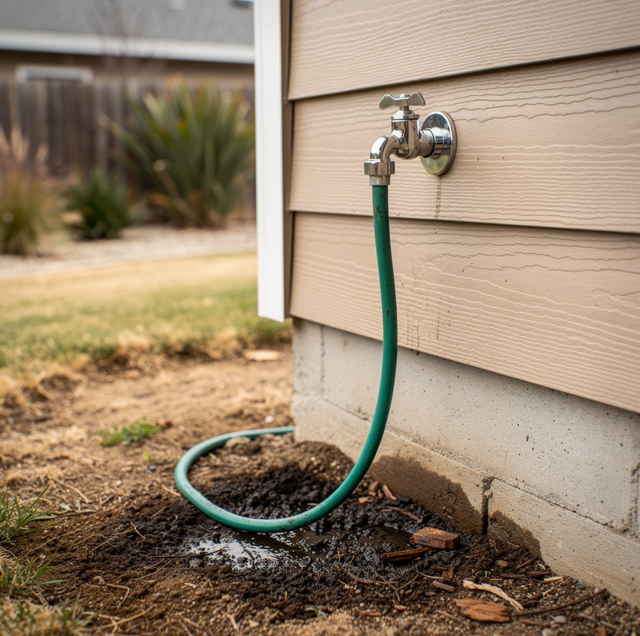
The handle is turned as far as it will go, and water is still finding a way out: a slow bead at the spout, or a damp patch seeping from underneath the handle itself. Indoors, a leak like that gets noticed within a day; you hear the drip or step in the puddle. Outdoors, a hose bibb that will not fully shut off can run for weeks before you happen to stand close enough to catch it, feeding a soft patch of soil beside the foundation or a water bill that keeps climbing with no obvious cause.
Each of those causes traces back to a different part of the valve, and identifying which one is failing starts with where the water actually appears.
The Seat Washer at the Far End of the Stem
Turning the handle on a standard hose bibb drives a threaded stem downward inside the valve body. At the bottom of that stem sits a rubber or synthetic washer, and it is that washer pressing flush against a fixed metal seat, not the handle's position, that actually stops the flow. When the washer is intact and seats evenly, closing the handle all the way is enough to shut the water off completely. Mineral content in the supply and simple age can flatten, crack, or shrink that washer until it no longer forms a complete seal against the seat, so a thin stream keeps passing around its edge no matter how far the handle turns. Because the washer sits at the working end of the valve, a leak from a failed washer shows up right at the spout opening: a steady drip or a fine stream with the handle fully closed and the rest of the fixture bone dry.
The Stem and Its Packing
A second point of failure sits higher up the valve, where the stem passes out of the body and through the housing to which the handle is attached. A packing washer or an O-ring seals that passage, and its only job is to keep water from tracking out along the stem, not to stop flow at the seat. When that packing dries out, hardens, or the stem's bearing surface is scored enough that the packing can no longer wipe against it cleanly, water works past the packing and shows up as dampness at the base of the handle or a trickle running down the pipe below, while the spout opening itself stays dry. Where the water appears points to which part failed before you open the valve: a dry handle housing over a dripping spout, or a dry spout under a damp handle.
A frost-free hose bibb, also sold as freeze-proof, uses the same stem-and-washer arrangement, running it back through the exterior wall to a sealing point set inside conditioned space, rather than sealing right at the exterior face the way a short compression bibb does. The washer and seat you would picture at the spout are not actually there; the sealing point sits inboard, out of reach and out of sight from outside the house. A frost-free bibb that will not fully close is failing at that inboard point, and because the sealing surface sits at the far end of a stem that has to come out of the wall to be reached, the work is a different job from swapping a washer at an exposed spout, even when the worn part turns out to be the same kind of washer.
What a Hose Left Attached Does to a Marginal Seal
A garden hose threaded onto the spout and left connected changes the plumbing behind it in a way that is easy to miss. Instead of opening to air between uses, the segment from the valve seat to the end of the hose stays full and pressurized rather than draining to air, so a washer that is only marginally sealing has nowhere to send the water it passes except into a hose that is already full. Anything that closes off the far end of that hose makes this particular leak harder to spot rather than easier: with the nozzle closed, a weak seal just backs up quietly inside the hose instead of dripping where you would see it, so the hose staying swollen or firm to the touch between waterings is often the only outward sign.
A hose bibb that spins loosely against the siding, one with a hose fused solid to its threads, and one that only trickles even fully open are each their own separate failures with their own separate fixes. This article covers one specific case: a bibb that, closed all the way, still passes water it should not.
A Different Part, a Different Backup, than an Indoor Stop
An indoor shutoff valve that will not close is a related failure in a different part, and the consequence when it happens is not the same. It sits on copper or PEX inside conditioned space, and when it fails, you can usually reach a nearby fixture stop or the main to isolate just that section. An outdoor hose bibb rarely has that option: where no isolation valve was ever fitted to the exterior line, the water main becomes the only shutoff on the property, and the whole house loses water rather than just the yard until the bibb is replaced.
What a Failed Seal Means for the Rest of the Valve
A valve that will not move, or will not fully close, under ordinary hand pressure is not a fitting to force.
A hose bibb that resists closing under hand pressure should not be forced with pliers, a wrench, or penetrating oil. Where no isolation valve sits between the bibb and the main, a cracked body means a whole-house shutoff.
A bibb body spends its whole service life outdoors, cycling through sun, cold, and moisture in a way no indoor valve does, and that exposure is what leaves the casting less forgiving than it looks. Once the seal inside it has failed, the part that stops the water has already reached the end of its working life, and the surrounding body is the older half of the assembly. A hose bibb in this condition is a candidate for replacement, and with the water main as the likely point of control, that replacement is worth scheduling before the failure decides the timing.
Frequently Asked Questions
Because they usually share a history rather than a coincidence. Bibbs installed during the same build or the same repipe are the same age, carry the same water chemistry, and their washers reach the end of their working life on roughly the same schedule. A second bibb starting to weep shortly after the first is a wear pattern, not a spreading fault.
Municipal supply pressure is not constant through the day. It runs highest when demand across the system drops, usually overnight, and a washer that is only marginally seated passes more water the harder it is pushed. A leak that appears to worsen by morning and ease by evening is following supply pressure, not getting structurally worse.
Sometimes. Water forcing past a washer that is nearly, but not quite, seated makes a faint continuous hiss, and that sound carries along the supply pipe better than it carries through open air. With the house quiet, the interior wall directly opposite the bibb is often where it registers first, before any wet spot appears outside.
A loose fragment of scale can wedge itself between the washer and the seat and briefly complete the seal the washer can no longer make on its own, then flush clear the next time the handle moves. The intervals tend to shorten as the washer degrades further, so an intermittent leak is a failing seal, not a recovering one.
That points past the washer to the connection above it. On a compression bibb, the stem carries the washer at its lower end, and a washer that has torn free or a stem that has snapped below the threads leaves the handle spinning through its full travel with no effect on flow. The handle moving normally is not evidence the valve is still working.
Usually, it will hold a drip from the spout, since the bibb body already sits under full-supply pressure whenever a hose with a closed nozzle is attached. Two limits are worth knowing: a cap does nothing to prevent water from tracking out around the stem, and it will not hold on a body that has already cracked. It stops a mess, not a failure.
Replace a hose bibb that will not close all the way — before a routine drip turns into a cracked valve body or a flooded flower bed. Ser Plumbing repairs sewer lines across the area, from sewer line repair in Norwalk to Compton. Call (310) 953-3566.
